How to Stop Rumination Effective Strategies to Break the Cycle and Find Calm
Have you ever found yourself lying in bed at night, replaying a conversation from three years ago or obsessing over a mistake you made at work? Your mind feels like a hamster on a wheel, spinning faster and faster, yet going absolutely nowhere. This phenomenon is known as rumination. It is not just simple thinking; it is a repetitive, intrusive cycle of negative thoughts that can feel impossible to switch off. The good news is that you are not powerless against your own mind. By understanding the anatomy of these thought patterns, you can learn to intervene, break the cycle, and reclaim your peace.
What Exactly is Rumination?
Rumination is the focused attention on the symptoms of one’s distress, and on its possible causes and consequences, as opposed to its solutions. Think of it as a mental loop. When you ruminate, you are not problem-solving. Instead, you are ruminating on the problem itself, turning it over and over in your mind. This state is frequently linked to higher levels of anxiety, depression, and chronic stress. Because our brains are wired for survival, they are naturally biased toward negative information. Rumination hijacks this protective mechanism, causing us to over-analyze threats that are either in the past or purely imaginary.
The Anatomy of the Loop
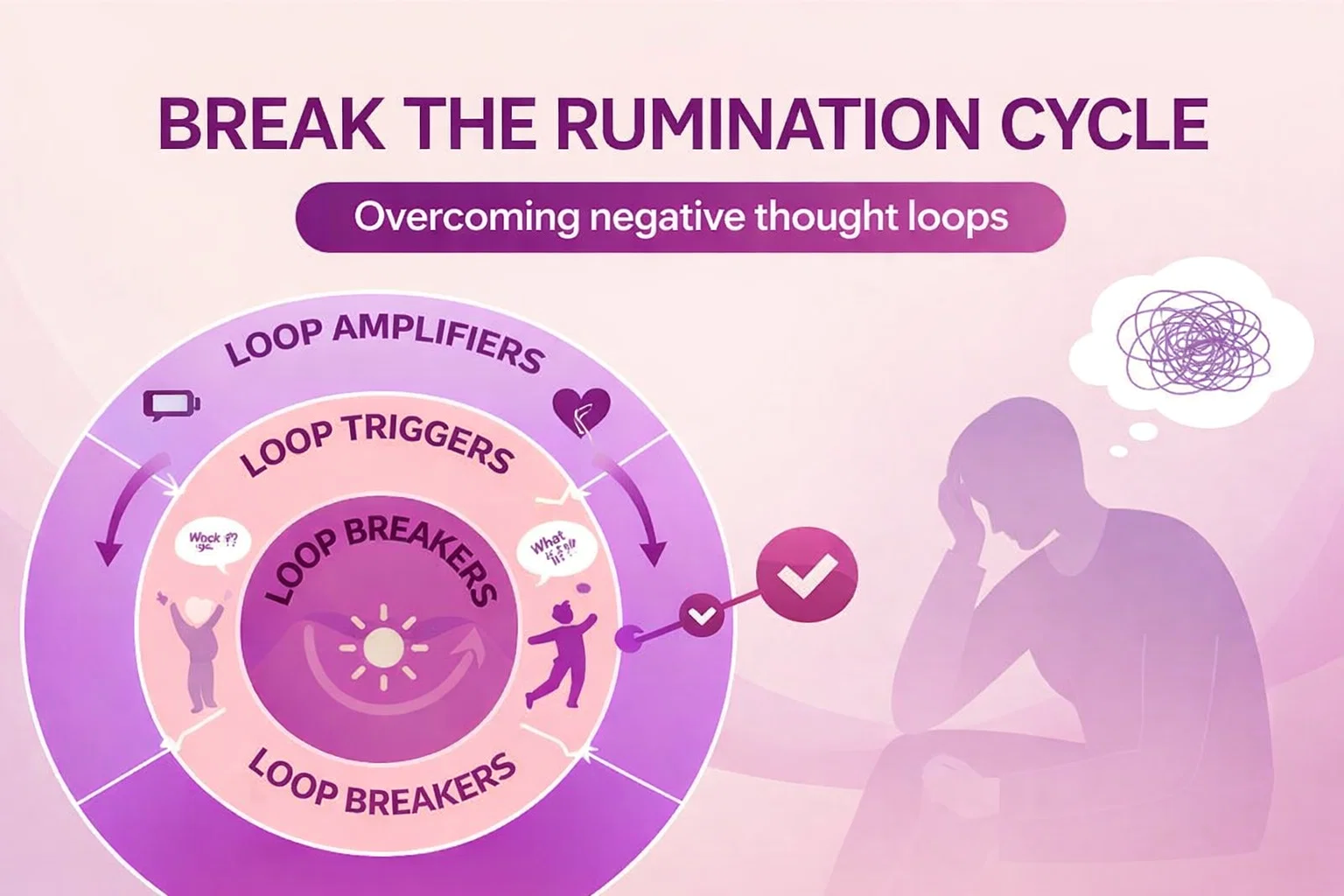
To stop the cycle, we first need to identify the components that keep it running. Rumination behaves like a system with layers. At the core, we have the triggers, which set the motion in play. Outside of that are the amplifiers, which act like gasoline on a fire. Finally, there are the breakers, which are the intentional actions we take to stop the momentum. Recognizing which layer you are currently in is the first step toward regaining control.
Recognizing the Triggers
Triggers are the starting points of a downward spiral. They are often subtle, everyday occurrences that our brains interpret as significant events. One common trigger is comparing yourself to others. In the era of social media, this is easier than ever. When you look at someone else’s highlight reel and compare it to your own behind-the-scenes struggles, your brain immediately starts looking for flaws in your own choices. Another major trigger is the habit of replaying old arguments. You think about what you should have said or how you could have been different. This keeps the emotional wound fresh, preventing it from ever truly healing.
The Danger of “What If” Thoughts
Perhaps the most insidious trigger is the “what if” thought process. This is the brain’s way of trying to predict the future to keep you safe. However, it usually results in catastrophic thinking. You might worry about losing your job, failing a project, or damaging a relationship. Because these scenarios are hypothetical, your brain cannot reach a logical conclusion, and it keeps running the simulation over and over. This is not preparation; it is paralysis.
What Fuels the Fire: The Loop Amplifiers
Once a trigger has started the loop, other factors can cause it to grow in intensity. These are the amplifiers. You can think of these as the conditions that make your mind more vulnerable to spiraling.
- Lack of Sleep: When you are sleep-deprived, the emotional centers of your brain become hyper-reactive. Your ability to regulate your thoughts diminishes, making it much harder to dismiss intrusive ideas.
- Unresolved Grief: If you have not processed a significant loss, that emotional weight stays near the surface. It provides a fertile ground for rumination to grow.
- Unspoken Boundaries: When you do not set clear boundaries with others, you often feel violated or resentful. This suppressed emotion frequently manifests as repetitive thoughts about what you should have done differently.
- Chronic Dysregulation: If your nervous system is constantly stuck in a fight or flight state, your brain perceives your environment as inherently dangerous, making it hyper-vigilant and prone to rumination.
Effective Strategies: The Loop Breakers
Knowing the triggers and amplifiers is helpful, but the magic happens when you apply specific “loop breakers.” These are intentional, conscious actions that pull you out of your head and back into your body. When you feel the spiral starting, use these tools to change your state.
Naming the Feeling
There is a powerful psychological concept called “name it to tame it.” Often, we feel bad but we don’t know why. By accurately labeling your emotion—whether it is anxiety, shame, envy, or sadness—you engage your prefrontal cortex. This shifts your brain activity from the emotional limbic system to the logical, analytical part of your brain. Simply saying, “I am feeling anxious about this meeting,” can take the edge off the intensity.
Practicing the True Pause
We are so conditioned to react to our thoughts that we forget we have a choice. A “true pause” is an intentional delay between a thought and your reaction to it. When you notice yourself spiraling, take a physical step back. Breathe. Give yourself permission to not solve the problem right this second. Remind yourself that your thoughts are just electrical signals in your brain, not objective truths or urgent to-do items.
The Power of Intentional Breath
Physiology is the fastest way to change your psychology. When you ruminate, your breathing becomes shallow and rapid, which signals to your body that you are in danger. By engaging in deep, slow, intentional breaths—specifically by making your exhale longer than your inhale—you physically switch on your parasympathetic nervous system. This is the “rest and digest” mode that naturally halts the panic and allows your mind to settle.
Moving Your Body
Rumination is a very “head-heavy” experience. To balance this, you need to bring awareness back to your body. You don’t need a heavy workout to do this. A simple walk, some gentle stretching, or even just feeling your feet firmly planted on the ground can interrupt the mental loop. Movement forces the brain to process sensory information, which naturally pulls resources away from the internal narrative of rumination.
Developing Long-Term Resilience
Breaking the cycle is not a one-time event; it is a practice. Over time, you can train your brain to catch these loops faster. The goal is not to eliminate negative thoughts entirely—that is humanly impossible. The goal is to change your relationship with those thoughts. Instead of seeing them as absolute truths that must be analyzed, start seeing them as passing weather patterns. You are the sky, and the thoughts are just clouds. They will move through, and eventually, they will move on.
Conclusion
Rumination is a heavy burden to carry, but you do not have to be a prisoner to your thoughts. By identifying your unique triggers, noticing how exhaustion or lack of boundaries might be amplifying your distress, and actively practicing loop breakers like naming your emotions and physical grounding, you can soften the noise. Start small. The next time you find your mind spiraling, pick just one technique from this list. Be patient with yourself. You are retraining years of mental habits, and that deserves a little bit of grace. Keep showing up for yourself, keep practicing, and watch as your mind begins to find the calm it has been searching for.