How Your Brain Learns Why Repetition Beats Motivation Neuroscience Reminder
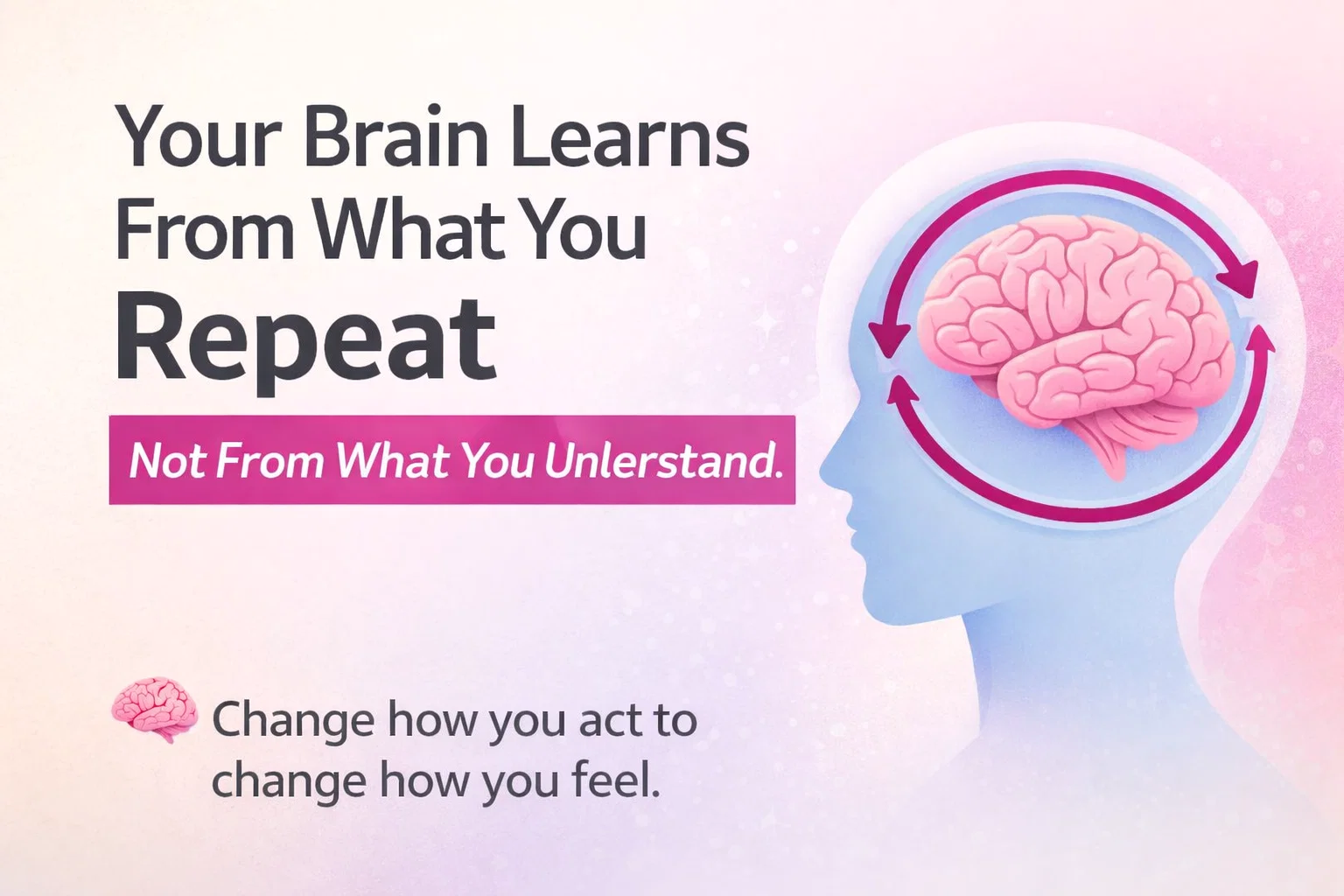
Understanding how your brain works is the ultimate shortcut to changing your life. Most of us spend years waiting for a spark of inspiration or a sudden burst of motivation to finally start that new habit, leave a toxic situation, or pursue a long-held dream. We read self-help books, listen to podcasts, and wait for the moment we feel ready. But neuroscience tells a very different story. The reality is that your brain is a biological machine that prioritizes repetition over understanding. It does not care about your intentions; it cares about your actions. If you want to transform your identity, you have to stop trying to think your way into a new life and start acting your way into one.
The Illusion of Insight: Why Knowing Isn’t Enough
Have you ever had a massive realization about your behavior, perhaps in therapy or while journaling, only to find yourself repeating the exact same mistake the next day? This is because insight alone does not rewire the brain. Understanding a pattern is a cognitive process that happens in the prefrontal cortex, the part of the brain responsible for logic and planning. However, our habits and automatic responses are stored in deeper structures like the basal ganglia.
There is a significant gap between knowing what to do and actually doing it. This gap exists because neural pathways are like physical trails in a forest. Knowing there is a better path doesn’t clear the brush or level the ground on that new trail. Only the physical act of walking the new path over and over again creates a permanent route. When we rely solely on insight, we are essentially looking at a map without ever taking a step. To see real change, we must move from the “thinking” phase into the “doing” phase, even when it feels uncomfortable or unnatural.
The Biology of Neural Pathways
Every time you perform an action or think a specific thought, a series of neurons fire in your brain. When you repeat that action, those same neurons fire again. Over time, the connection between these neurons becomes stronger through a process called long-term potentiation. This is often summarized by the famous phrase in neuroscience: neurons that fire together, wire together. This biological bonding is what creates a habit. The more often the circuit is activated, the more efficient it becomes, eventually requiring almost no conscious effort to trigger.
Repetition Creates Identity
We often think that we need to change our identity before we can change our behavior. We tell ourselves, I am not a runner, so I cannot run every day. Or, I am not a morning person, so I cannot wake up early. Neuroscience suggests the opposite is true. Identity is actually the result of repeated behaviors. Your brain looks at your actions to determine who you are. If you run every day, your brain eventually concludes that you are a runner, regardless of how you felt when you started.
This is a powerful realization because it removes the need for belief. You do not have to believe you are capable of change to start changing. You simply have to repeat the behavior of the person you want to become. The brain is incredibly plastic, meaning it is constantly reshaping itself based on input. By choosing your repetitions, you are literally sculpting your own identity. Consistency is the tool that carves out this new version of yourself.
The Role of the Basal Ganglia in Habit Formation
The basal ganglia is the area of the brain where our “autopilot” settings live. When a behavior is repeated enough times, the command for that behavior moves from the conscious prefrontal cortex to the subconscious basal ganglia. This is why you can drive home from work without consciously remembering every turn you took. By focusing on repetition, you are essentially “uploading” your new goals into your brain’s autopilot system, making success a matter of biology rather than willpower.
The Nervous System Follows Behavior, Not Motivation
Motivation is a fickle friend. It is influenced by your sleep, your diet, the weather, and your hormones. If you wait until you feel motivated to take action, you will be inconsistent. Your nervous system is designed to keep you safe, and “safe” to the brain usually means “familiar.” This is why new habits feel so difficult; your nervous system perceives the unknown as a potential threat and creates resistance in the form of procrastination or anxiety.
To bypass this, you must lead with behavior. When you take small, manageable actions, you signal to your nervous system that you are safe. You are showing your brain that the new behavior is not a threat. Motivation often shows up after you have already started. It is the reward for taking action, not the prerequisite for it. By focusing on the behavior first, you build momentum that eventually creates the very feeling of motivation you were waiting for in the beginning.
Creating Safety Through Small Wins
The brain’s survival mechanism, the amygdala, can be triggered by big, drastic changes. If you try to change everything at once, your brain may go into a “freeze” or “resist” mode. This is why the concept of small wins is so vital. By breaking down a goal into tiny, repeatable actions, you keep the amygdala calm. These small actions create a sense of predictability and safety, allowing the nervous system to relax and accept the new pattern as the new normal.
Consistency Beats Intensity (Biologically)
In our culture of “go big or go home,” we often value intensity over consistency. We think that a three-hour workout once a week is better than a fifteen-minute walk every day. From a biological perspective, this is incorrect. The brain values frequency because frequency creates predictability. Predictability, in turn, creates neural stability. A tiny behavior repeated daily sends a constant signal to the brain to keep those specific neural pathways open and active.
Intensity is often a one-time spike that doesn’t allow for the long-term structural changes the brain needs to make a habit stick. Consistency allows for the gradual thickening of the myelin sheath around your neurons. Myelin is a fatty substance that acts as insulation for neural pathways, making the electrical signals travel faster and more efficiently. The more consistent you are, the more “insulated” and permanent that habit becomes.
The Compound Effect of Daily Repetition
Think of repetition like interest in a savings account. A single day of effort might not seem like much, but when compounded over months and years, the results are radical. When you show up every day, you are building a biological foundation that supports your goals. This neural stability makes you more resilient to stress and less likely to fall back into old, destructive patterns during difficult times.
You Do Not Need Confidence to Act
One of the biggest myths in personal development is that you need to be confident before you can take a big step. This is a trap. Confidence is not a personality trait; it is a byproduct of competence. And competence is only gained through repetition. If you wait to feel confident, you might wait forever. The most effective way to build confidence is to act while you are still afraid, uncertain, or doubtful.
Action comes first. The brain records the fact that you did the thing you were afraid to do, and that record becomes the foundation for future confidence. Each time you repeat the action, the “fear signal” weakens and the “confidence signal” strengthens. You are training your brain to trust you. When you keep the promises you make to yourself through repeated action, you build an internal sense of reliability that no amount of positive thinking can replicate.
The After-Effect Principle
Confidence is the reward you receive after you have survived the discomfort of doing something new. It is an “after-effect.” By shifting your focus from “how do I feel?” to “what am I doing?”, you bypass the emotional roadblocks that keep most people stuck. Your brain is a practical organ; it cares about evidence. Give it the evidence of your actions, and it will eventually give you the feeling of confidence.
Practical Strategies for Rewiring Your Brain
Knowing the science is great, but applying it is where the transformation happens. To effectively rewire your brain, you need to set up a system that prioritizes repetition over everything else. Here are a few ways to get started:
- The Two-Minute Rule: When starting a new habit, make sure it takes less than two minutes to complete. This removes the barrier to entry and ensures you can repeat it even on your worst days.
- Habit Stacking: Anchor a new habit to an existing one. For example, “After I brush my teeth, I will meditate for one minute.” This uses an established neural pathway to help build a new one.
- Focus on the Streak: Make the goal the repetition itself rather than the result. Use a habit tracker to visually see your progress and motivate yourself to “not break the chain.”
- Environment Design: Make the desired behavior the path of least resistance. If you want to exercise in the morning, lay out your clothes the night before.
Conclusion: The Brain Will Catch Up
The journey of self-transformation is often frustrating because we expect our feelings to change before our reality does. We want to feel like a new person before we start doing new things. But the neuroscience is clear: if you want a new self, you must stop waiting to feel different. You must lead with the body, and the mind will follow. By embracing the power of repetition, you are taking control of your biological destiny.
Every small action you take today is a vote for the person you wish to become. It doesn’t matter if you don’t believe in it yet. It doesn’t matter if you don’t feel motivated. What matters is that you show up and repeat the behavior. Stay consistent, stay patient, and trust the process. Your brain is always learning, and eventually, it will catch up to the new reality you are creating, one repetition at a time.
Would you like me to generate a specific list of “habit stacking” ideas based on this neuroscience approach to help your readers get started?