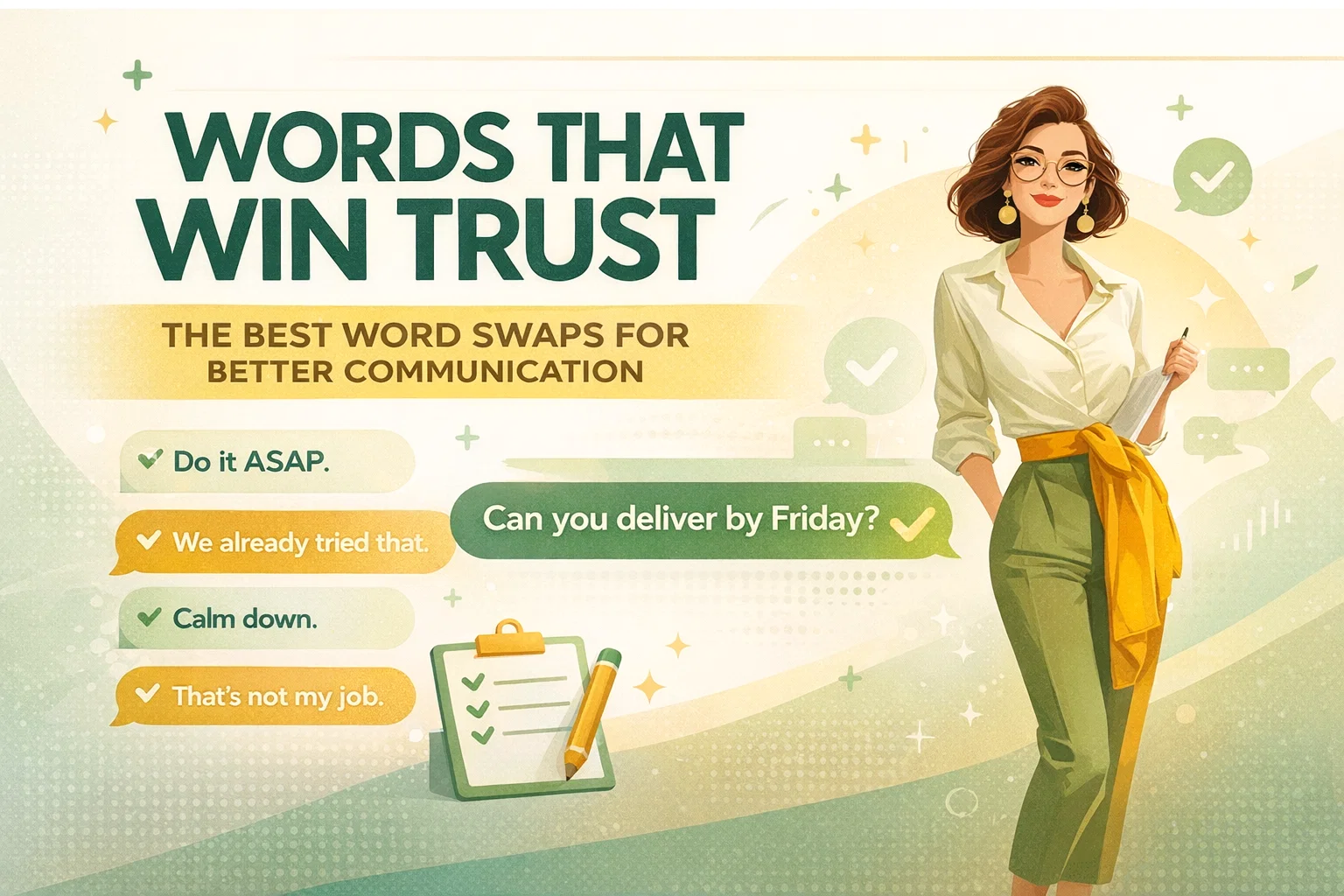
Master the Art of Professional Communication Simple Word Swaps to Build Trust and Leadership
Communication is the invisible engine that drives every professional relationship. Whether you are leading a massive department or collaborating with a single partner on a freelance project, the words you choose act as the bridge between friction and partnership. Most of us go through our workdays using inherited phrases, scripts we picked up from old bosses or high-pressure environments, without realizing how much they might be eroding the very trust we are trying to build. By making a conscious shift toward collaborative language, you can transform your professional reputation and create a culture of mutual respect and high performance.
The Psychological Power of Word Swaps
The human brain is wired to detect threats. When we hear phrases like “Do it ASAP” or “You should have known that,” our nervous systems often shift into a defensive posture. This is known as an amygdala hijack, where the feeling of being judged or pressured shuts down the creative, problem-solving parts of the brain. When you swap these phrases for more inclusive, inquiry-based language, you are literally inviting the other person’s brain to stay in a state of high-level cognitive function.
Professionalism is not about being cold or overly formal. It is about being precise, empathetic, and outcome-oriented. Using the right words allows you to hold people accountable without making them feel small. It enables you to say no to unreasonable demands while still appearing as a team player. Ultimately, these “words that win trust” are tools for emotional intelligence that make you a more effective and influential leader.
Moving from Urgency to Realistic Expectations
One of the most common friction points in the workplace is the “ASAP” trap. Telling someone to do something as soon as possible is often a sign of poor planning or a lack of clarity. It creates a sense of vague anxiety because the recipient does not know if “as soon as possible” means ten minutes from now or by the end of the week. This ambiguity is the enemy of trust.
Replacing Demand with Dialogue
Instead of “Do it ASAP,” try asking: “Can you deliver by Friday at 2 pm? If not, what is realistic?” This simple change does three powerful things. First, it provides a concrete deadline, which reduces stress. Second, it acknowledges that the other person has a schedule and a set of priorities. Third, it opens a negotiation by asking what is realistic. This makes the other person feel like a partner in the process rather than a cog in a machine. When people feel their time is respected, they are much more likely to meet your deadlines with high-quality work.
How to Handle Stagnation and History
In many organizations, the phrase “We already tried that” is a common innovation killer. It is often used to shut down new ideas based on past failures. While history is important, using it as a shield against change creates a culture of stagnation. It tells your colleagues that their fresh perspectives are not valued and that the organization is stuck in its ways.
Reframing Past Experiences
A better approach is to ask: “What could we try differently? What has changed since last time?” This acknowledges that a previous attempt might not have worked while remaining open to the possibility that the environment, the technology, or the team has evolved. It encourages a growth mindset. Instead of closing the door, you are asking for a deeper analysis. This builds trust because it shows you value the team’s ability to learn and adapt rather than just repeating the same scripts.
Navigating High Emotions with Empathy
Telling someone to “Calm down” is perhaps the fastest way to ensure they do not calm down. It is a dismissive phrase that minimizes the other person’s feelings and suggests that their reaction is the problem rather than the situation at hand. In a high-stakes environment, emotions are often a sign that someone cares deeply about the outcome. Shaming that emotion destroys trust instantly.
Validating Concerns through Impact Analysis
The professional alternative is to say: “I hear your concern. Can we walk through the impact together?” This validates the person’s feelings without necessarily agreeing with their entire perspective yet. By shifting the focus to “the impact,” you move the conversation from an emotional battle to a logical exploration of consequences. You are standing side by side with the person, looking at the problem, rather than standing across from them, looking at their personality. This collaborative stance is the hallmark of a trusted leader.
Redefining Boundaries and Roles
We have all been in a situation where we are asked to do something that falls outside our job description. Responding with “That is not my job” is technically accurate but socially damaging. It sounds rigid and unhelpful. However, saying yes to everything leads to burnout and poor performance. The key is to set boundaries that emphasize coordination over flat-out refusal.
The Art of Strategic Coordination
Try saying: “I can own X. For Y, we need Z. Want me to coordinate?” This response shows that you are willing to take responsibility for your specific domain while clearly identifying where other resources are needed. It positions you as an organizer and a strategist. You aren’t just saying no; you are explaining the architecture of the task. This builds trust because people know they can count on you for your specific expertise, and they appreciate your clarity on how the whole project fits together.
Giving Feedback Without Being Defensive
The phrase “No offense, but…” is a linguistic red flag. It usually signals that the speaker is about to say something offensive or overly critical. It puts the listener on the defensive before the meat of the feedback is even delivered. To build a culture of radical candor and trust, we need to eliminate these qualifiers and speak with transparent intent.
Offering a Different View
Instead, try: “Can I offer a different view and why I am leaning that way?” This is a respectful invitation. It asks for permission to share a perspective, which makes the listener more receptive. By including the “why,” you are showing your work. You are sharing the logic behind your opinion rather than just stating it as an absolute truth. This transparency invites the other person to engage with your logic rather than react to your personality.
Addressing Perceived Overreactions
Similar to the “calm down” trap, telling someone “You are overreacting” is a judgment on their character. It suggests that they lack perspective or professional maturity. Even if they are reacting strongly, labeling it as an overreaction does nothing to solve the underlying issue. It only creates a barrier between you and the other person.
Identifying Risks and Values
A more effective response is: “This matters to you. What are the risks you are seeing?” This shift does two things. First, it acknowledges that the topic is important to the other person, which builds immediate rapport. Second, it asks for data. By asking about “risks,” you are helping the other person translate their emotional energy into actionable business intelligence. You might find out they are seeing a danger that you completely missed. This turns a potential conflict into a valuable risk-assessment exercise.
Leading Through Rationale, Not Authority
In a hierarchical environment, it is tempting to fall back on “Because leadership said so.” While this might get the task done, it does nothing to build long-term trust or engagement. It makes you look like a messenger without any agency or understanding of the company’s goals. It also suggests that the decision might be arbitrary or even wrong, but unavoidable.
Connecting Tasks to Goals
Great communicators say: “Here is the rationale and how it ties to our goals.” People are much more likely to commit to a difficult task if they understand the “why” behind it. When you explain the connection to the larger mission, you are treating your team like adults who deserve to know the strategy. This builds a deeper level of commitment and trust in the organization’s direction.
Taking Ownership of Communication Failures
When a mistake happens, the instinct is often to point fingers. Saying “You should have known that” is a classic blame-shifting move. It assumes that information was shared perfectly and that the other person was simply negligent. This creates a culture of fear where people are afraid to ask questions or admit they don’t know something.
Aligning on Expectations
The trust-building move is to say: “I should have clarified expectations. Let us align and set checkpoints.” By taking initial responsibility for the lack of clarity, you immediately lower the tension. It allows everyone to move past the blame and focus on the solution. Setting “checkpoints” ensures that the mistake won’t happen again. This demonstrates that you care more about the success of the project than being “right.”
Building a Culture of Trust One Word at a Time
Implementing these word swaps is not about being “perfect” in every conversation. It is about a consistent effort to be more mindful of how our language affects those around us. When you consistently choose collaborative phrases over defensive or demanding ones, you send a signal to your team and your peers that you are a safe, reliable, and thoughtful partner.
- Consistency is Key: These phrases work best when they become your default mode of operation.
- Body Language Matters: Ensure your tone and facial expressions match the collaborative nature of your words.
- Listen More: The best communication is often 80 percent listening and 20 percent speaking.
As you begin to use these phrases, you will likely notice a change in the atmosphere of your meetings and digital communications. People will be more willing to share ideas, more honest about their capacity, and more engaged in finding solutions. You are not just changing your words; you are changing the social fabric of your workplace.
Final Thoughts on Professional Growth
The journey to becoming a master communicator is ongoing. Every interaction is an opportunity to practice these word swaps and refine your approach. By focusing on partnership rather than friction, you position yourself as a leader who can navigate complexity with grace and effectiveness. Trust is the currency of the modern workplace, and your language is the most powerful way to earn it. Start today by choosing one phrase to swap out and watch how the dynamic of your next conversation shifts for the better.