Off-Grid-Batterie Basics Die wichtigsten Stärken Schwächen für deine Stromversorgung
Building a life off the grid is one of the most rewarding challenges a modern adventurer can undertake. There is a profound sense of peace that comes from knowing your lights stay on because of the sun hitting your roof and the wind spinning a turbine in your backyard. However, the heart of this entire operation is not the panels or the blades themselves, but the silent workhorse sitting in the corner: the battery bank. Without a solid understanding of off-grid battery basics, even the most expensive solar array is just a collection of glass and silicone. To truly power your life independently, you need to understand how these energy reservoirs function, how to maintain them, and how to choose the right technology for your specific needs.
The Essential Role of Energy Storage in Autarky
In a standard grid-tied home, the utility company acts as your infinite battery. When you need power, you pull it; when you have extra, you push it back. When you go off-grid, that safety net vanishes. Energy storage becomes the bridge between production and consumption. The sun does not shine at night, and the wind does not always blow when you want to make a pot of coffee. Batteries allow you to harvest energy during peak production hours and store it for those moments when nature is quiet.
Understanding your battery bank is about more than just knowing how much power it holds. It is about understanding the flow of energy. Every time you turn on a light, you are drawing from a chemical reaction happening inside those cells. The efficiency of that reaction determines how much of your hard-earned solar energy you actually get to use. Choosing a system that aligns with your daily habits is the first step toward a successful homesteading experience.
Comparing Battery Chemistries: Lead Acid vs Lithium
For decades, deep-cycle lead-acid batteries were the only viable option for off-grid living. They are reliable, well-understood, and relatively inexpensive upfront. You will often see them in two forms: Flooded Lead Acid (FLA), which requires regular water top-offs, and Sealed Lead Acid (AGM or Gel), which are maintenance-free. The strength of lead-acid lies in its proven track record. If you are on a tight budget and do not mind a bit of regular maintenance, these can still be a functional choice for a cabin or a small workshop.
However, the industry has shifted dramatically toward Lithium Iron Phosphate (LiFePO4) technology. While the initial cost is higher, the benefits are hard to ignore. Lithium batteries are significantly lighter, which is a massive advantage for mobile setups like vans or tiny houses. More importantly, they offer a much deeper discharge rate. While you should only drain a lead-acid battery to about 50 percent to avoid damage, lithium can often be discharged to 80 or 90 percent without breaking a sweat. This means you get more usable energy out of a smaller, lighter package.
The Lifespan Factor
When calculating the cost of your energy system, you have to look past the sticker price and consider the cost per cycle. A well-maintained lead-acid bank might last 500 to 1,000 cycles. In contrast, a high-quality lithium battery can easily exceed 3,000 to 5,000 cycles. Over ten years, the lithium option often ends up being the cheaper investment because you are not replacing the entire bank every few seasons. This longevity is a cornerstone of true sustainability.
Understanding Capacity and Voltage
Battery capacity is typically measured in Amp Hours (Ah) or Watt Hours (Wh). Think of Amp Hours like the size of a fuel tank. A 200Ah battery holds more “fuel” than a 100Ah battery. However, voltage plays a crucial role here as well. A 100Ah battery at 12 volts holds 1,200 Watt Hours of energy, while a 100Ah battery at 24 volts holds 2,400 Watt Hours. For most medium to large off-grid homes, 24V or 48V systems are preferred because they allow for thinner wiring and higher efficiency over long distances.
Calculating Your Daily Load
Before buying your first battery, you must conduct a thorough energy audit. List every appliance you plan to run, from your refrigerator and laptop to your water pump and LED lights. Multiply the wattage of each device by the number of hours you use it daily. This gives you your total daily Watt Hour requirement. A good rule of thumb is to size your battery bank to hold at least three days worth of energy. This provides a buffer for those inevitable cloudy stretches where your solar panels cannot keep up with demand.
The Importance of the Charge Controller
A battery is only as good as the device charging it. The charge controller is the brain of your power system, sitting between your energy sources and your storage. Its job is to ensure the batteries are charged at the correct voltage and to prevent overcharging, which can lead to permanent damage or even safety hazards. There are two main types of controllers: PWM and MPPT.
PWM (Pulse Width Modulation) controllers are simpler and cheaper, but they are less efficient because they cannot adjust the voltage of the solar panels to match the battery perfectly. MPPT (Maximum Power Point Tracking) controllers are the gold standard. They act like a smart transmission for your power system, converting excess voltage into extra current. This can increase your charging efficiency by up to 30 percent, which is vital during short winter days when every drop of sunlight counts.
The Impact of Temperature on Performance
Many people forget that batteries are essentially boxes of chemical reactions, and chemicals are sensitive to temperature. Lead-acid batteries lose a significant portion of their effective capacity when the temperature drops below freezing. If your battery bank is kept in an unheated shed during a harsh winter, you might find your lights flickering much earlier than expected. On the flip side, excessive heat can accelerate the degradation of the internal components, shortening the overall lifespan of the system.
Lithium batteries have a specific quirk: they should never be charged when the internal cells are below freezing. Doing so can cause permanent plating of the lithium, ruining the battery. Most modern off-grid lithium batteries now come with built-in heating pads or advanced Battery Management Systems (BMS) that automatically stop the charging process if it gets too cold. When designing your battery enclosure, insulation and ventilation should be top priorities to keep your energy heart beating steadily year-round.
Maintenance and Monitoring for Long-Term Success
If you choose flooded lead-acid batteries, maintenance is a monthly ritual. You must check the electrolyte levels and add distilled water as needed. You also need to perform “equalization” charges, which is a controlled overcharge that helps balance the cells and remove sulfate buildup from the plates. It is a hands-on approach that connects you deeply to your power source.
For those who prefer a set-it-and-forget-it approach, lithium and AGM batteries are much more appealing. However, even maintenance-free batteries require monitoring. Installing a high-quality battery monitor is one of the best investments you can make. These devices provide a real-time “state of charge” percentage, much like the battery icon on your phone. Knowing exactly how much energy you have left removes the guesswork and helps you decide whether you can afford to run the vacuum cleaner or if you should wait until the sun comes out tomorrow.
Safety First in the Battery Room
Energy storage involves high currents and heavy components. Always ensure your battery bank is properly fused. A fuse is a cheap insurance policy that prevents a short circuit from turning into a fire. Additionally, ensure your batteries are secured so they cannot tip over. If you are using lead-acid batteries, proper ventilation is mandatory because they can off-gas hydrogen, which is flammable. A well-organized, clean, and labeled battery area is the mark of a professional off-grid setup.
The Future of Off-Grid Energy
We are living in an exciting era for energy independence. As technology advances, batteries are becoming more energy-dense, safer, and more affordable. We are seeing the rise of “all-in-one” power stations that combine the inverter, charge controller, and battery into a single plug-and-play unit. While these are great for beginners or mobile setups, a custom-built modular system remains the best choice for a permanent homestead because it allows you to replace or upgrade individual parts as your needs grow.
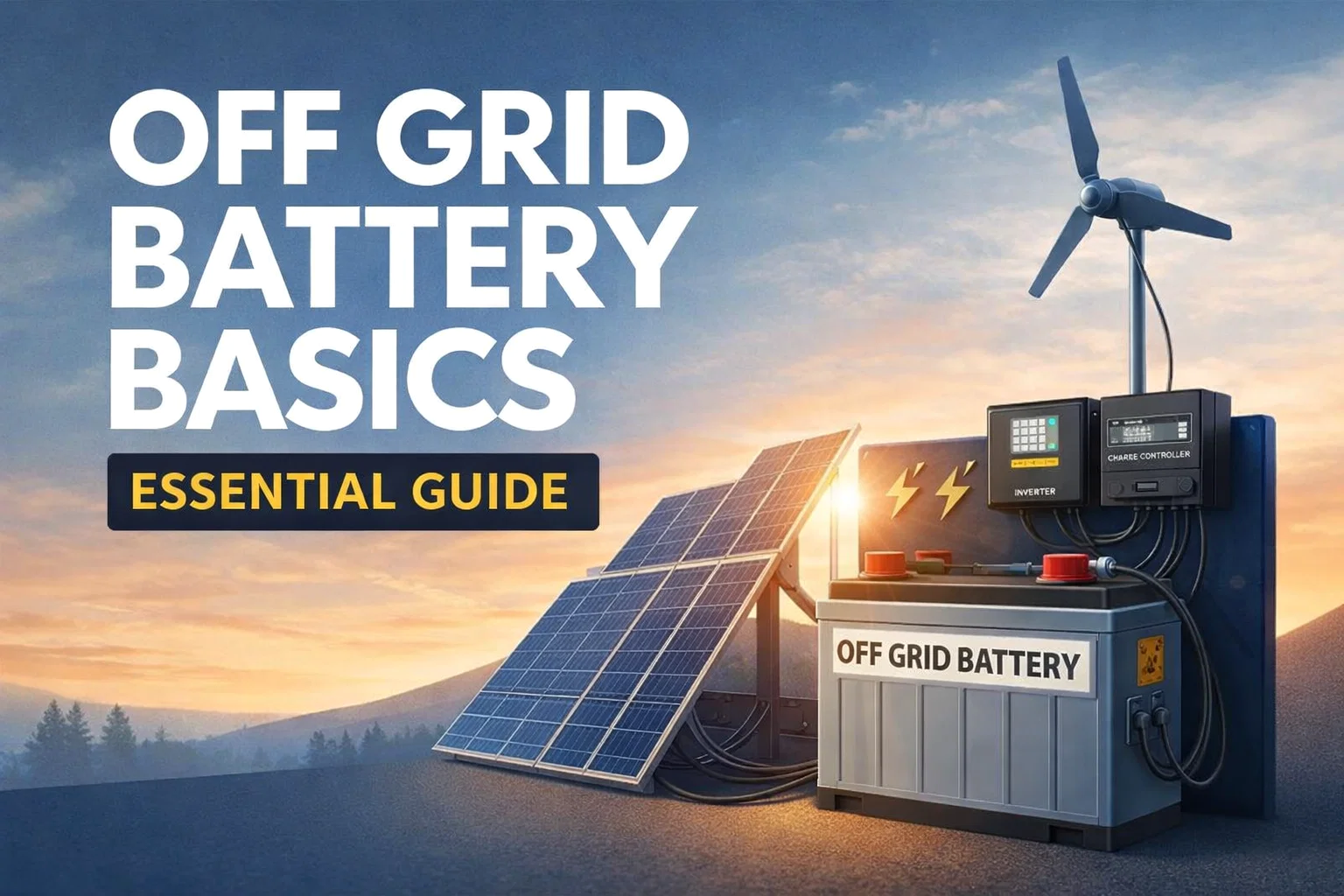
Wind turbines are also becoming more integrated with battery technology. In the image we analyzed, a small wind turbine complements the solar panels, providing a diverse charging profile. Wind often picks up at night or during stormy weather when solar is inactive. This hybrid approach reduces the stress on your battery bank because there is a more consistent trickle of incoming energy, preventing deep discharge cycles that can wear out your hardware prematurely.
Conclusion: Powering Your Life with Confidence
Stepping away from the grid does not mean you have to live in the dark or give up modern comforts. It simply means you are taking responsibility for your own infrastructure. By mastering the basics of off-grid batteries, you move from being a passive consumer to an active producer. You understand the limitations of your system, but you also appreciate the incredible freedom it provides.
Whether you choose the rugged reliability of lead-acid or the high-tech efficiency of lithium, the key is to respect the equipment and stay informed. Start with a clear energy audit, choose components that work together harmoniously, and never skimp on a good charge controller or safety fuses. Your battery bank is the silent heart of your home. Treat it well, and it will keep your life powered, your food cold, and your lights bright for many years to come.