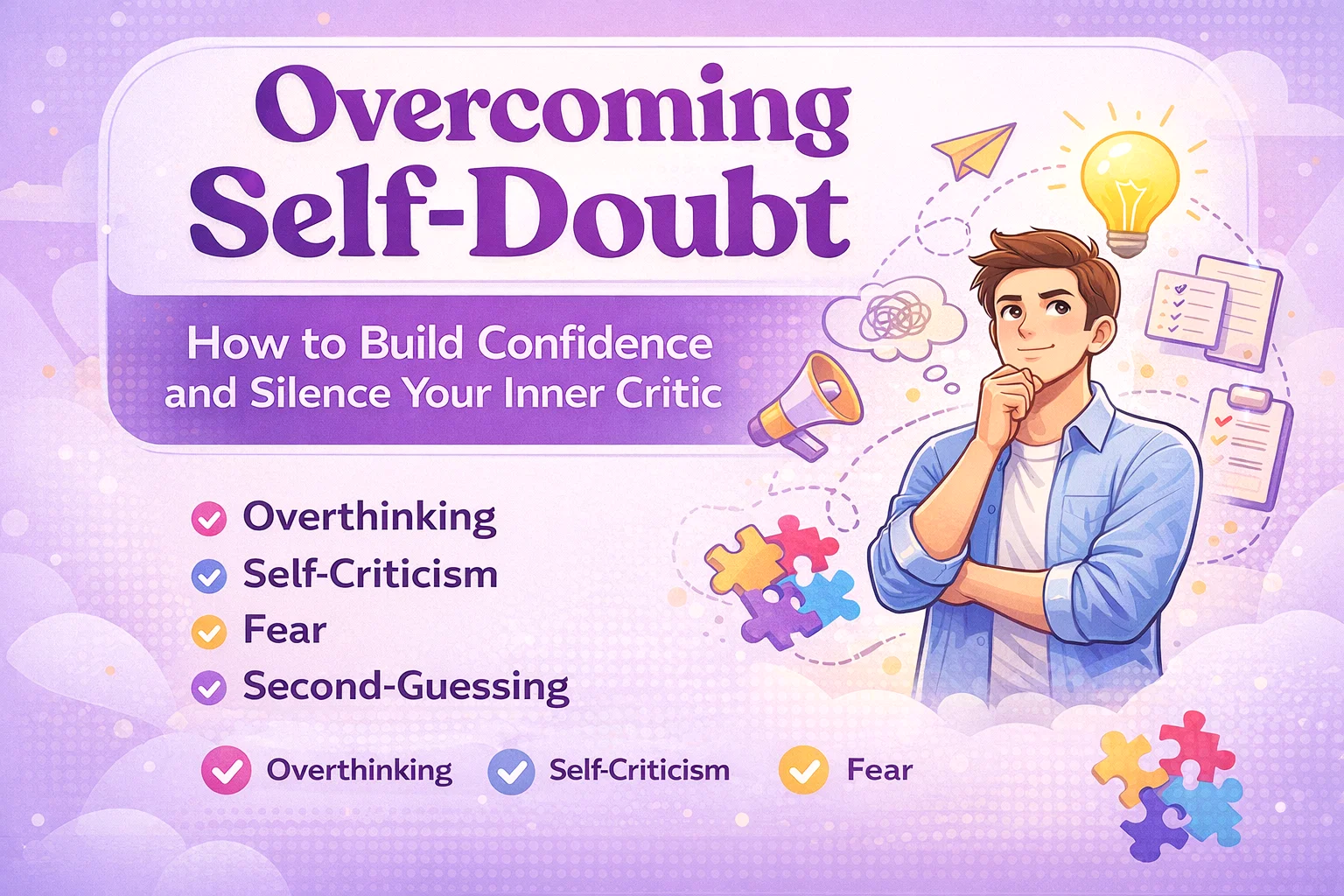
Overcoming Self-Doubt 6 Practical Strategies to Build Confidence and Stop Overthinking
Do you ever feel like an invisible wall is standing between you and your true potential? You are not alone. Many of us navigate our professional and personal lives while battling a persistent, quiet inner voice that questions our abilities, second-guesses our decisions, and keeps us trapped within the safe, predictable confines of our comfort zones. This internal landscape, often dominated by self-doubt, can paralyze progress and hinder the happiness we deserve.
The good news is that self-doubt is not a permanent character trait. It is a cognitive habit, and like any habit, it can be unlearned, reshaped, and replaced with empowering behaviors. By understanding the specific ways self-doubt manifests, we can begin to dismantle it piece by piece. Below, we dive deep into the six core pillars of self-doubt and, more importantly, how to reclaim your confidence.
1. Breaking the Cycle of Overthinking
Overthinking is often disguised as careful planning, but in reality, it is a form of procrastination. When you find yourself obsessively focusing on past failures or spiraling into “what if” scenarios about potential future catastrophes, your mind becomes stuck in a loop of analysis paralysis. This is commonly referred to as the “monkey mind” taking control, jumping from one anxious thought to the next.
The Solution: Action as the Antidote
The most effective way to quiet an overactive mind is through movement and action. You cannot think your way out of overthinking. Instead, break the cycle by committing to small, tangible steps. When you focus on executing a task, you force your brain to switch from the abstract, anxious state to a concrete, productive one. As you complete these small steps, you cultivate a sense of momentum that naturally crowds out unproductive ruminations.
2. Moving Beyond the Need for External Reassurance
Do you find yourself constantly asking for advice on minor decisions, or waiting for a “green light” from others before you feel confident in your own choices? While collaboration is valuable, relying on external approval is a hallmark of self-doubt. It shifts your locus of control outward, making you a people pleaser who disregards their own intuition and instincts.
The Solution: Self-Approval and Certainty
To overcome this, you must begin to practice self-approval. This starts with identifying your personal values and beliefs. When you know what you stand for, your decisions become an extension of your own identity rather than a search for external validation. Start by making small decisions without asking for input and trust the outcome. Over time, this builds the internal certainty required to lead your own life.
3. Challenging Negative Self-Talk
The inner critic is often the loudest voice in the room. When you repeat phrases like “I am not good enough” or “I am not smart enough,” you are essentially programming your brain to believe these limitations. This narrative dictates your behavior, causing you to avoid challenging career opportunities or meaningful relationships because you have already decided you are destined to fail.
The Solution: Reframing Your Internal Script
Changing your self-talk is not about toxic positivity; it is about objective truth. Start by identifying the negative statements and consciously replacing them with empowering, realistic alternatives. Instead of “I am not smart enough,” try “I am capable of learning what I need to know to succeed.” By consistently interrupting the negative narrative with constructive affirmations, you build the courage necessary to pursue the life you actually want.
4. Overcoming Imposter Syndrome
Imposter syndrome is that nagging suspicion that you do not actually deserve your position, your success, or your accolades. Even when you are performing well, you might feel like a fraud waiting to be “found out.” This mindset causes you to downplay your achievements and ignore the very real value you provide to your team or your community.
The Solution: Focusing on Strengths and Self-Reflection
To combat this, start a “win list.” Document your accomplishments, positive feedback you have received, and the specific skills you have used to overcome challenges. Regular self-reflection allows you to see the objective evidence of your competence. When you shift your focus from what you lack to the tangible value you provide, the imposter feelings begin to lose their power.
5. Stopping the Pattern of Second-Guessing
There is nothing more exhausting than making a decision and then immediately looking back and wondering if you made the wrong choice. Second-guessing drains your mental energy, leads to inconsistency, and ultimately delays your progress. When you cannot stick to a commitment, you lose trust in your own judgment.
The Solution: Staying Present with Decisions
To cultivate resilience, you must learn to stay present with your decisions. Once a choice is made based on the information you had at the time, commit to seeing it through. Recognize that “perfect” decisions are rare, but “committed” decisions are what lead to results. Even if a path isn’t perfectly linear, staying the course allows you to learn, adjust, and gain the benefits of your actions.
6. Escaping the Safety Trap
The final pillar of self-doubt is the urge to play it safe. By staying within your comfort zone and following the same rigid routines, you protect yourself from perceived failure, but you also starve yourself of growth. Stagnation is the ultimate result of fearing the unknown.
The Solution: Embracing Calculated Risks
Growth only happens on the other side of comfort. Start by taking small, calculated risks. Sign up for that class, speak up in that meeting, or try a new routine. By diversifying your experiences, you broaden your perspective and prove to yourself that you can handle uncertainty. An improved, fulfilling life is built through the accumulation of these new experiences.
Conclusion: Building Your Future
Overcoming self-doubt is a journey of active participation. It is not about waiting for a day where you feel perfectly fearless. It is about acknowledging the doubt and choosing to act in spite of it. By quieting the overthinking, replacing negative scripts, and leaning into your own strengths, you stop being a passenger in your own life. Remember that every small step you take—whether it is silencing a negative thought or making a decision without external approval—is a brick in the foundation of your future self. Start small, stay consistent, and watch how your life begins to expand.