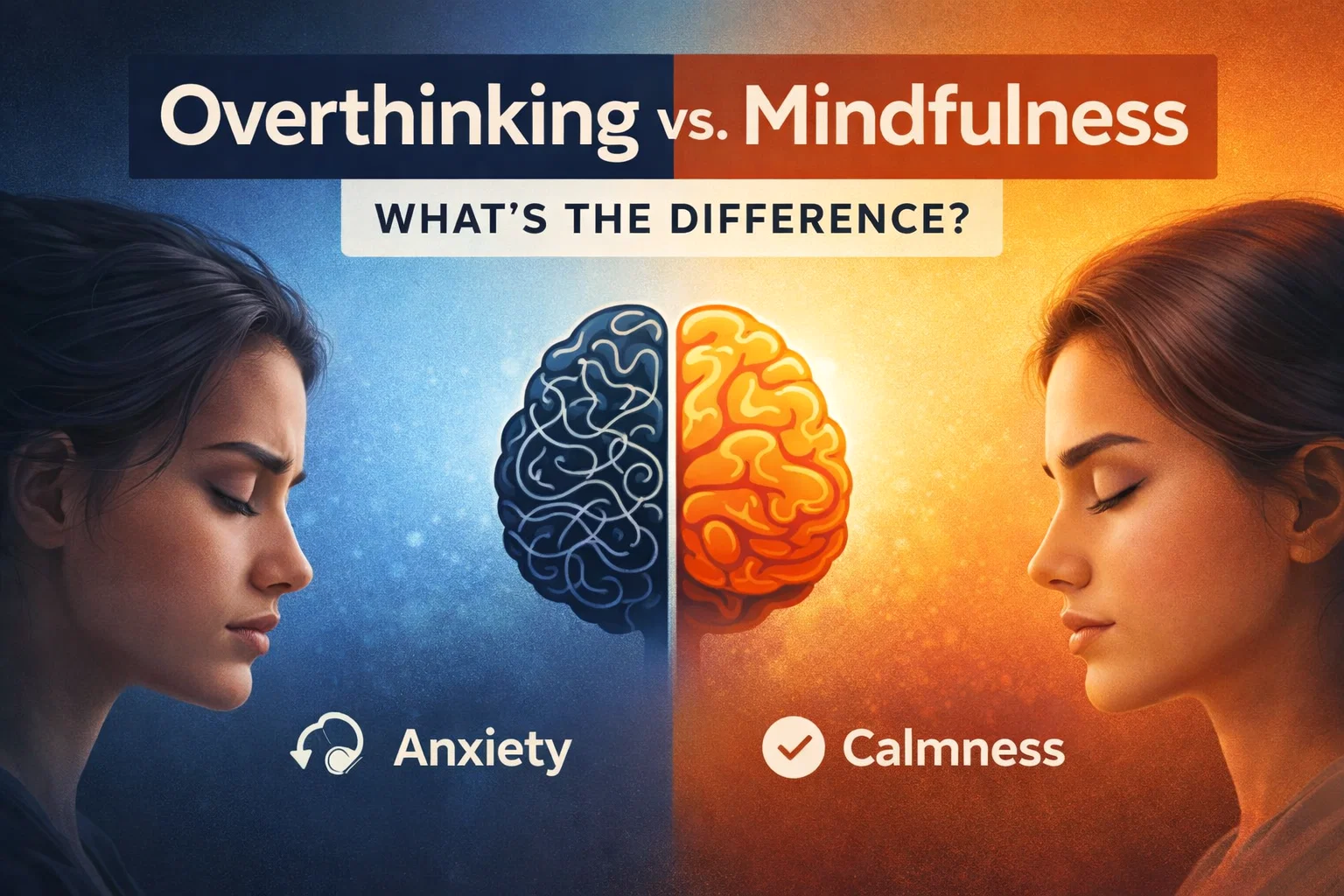
Overthinking vs. Mindfulness 7 Signs You Are Overthinking and How to Stop Mindful Habits
The human mind is a powerful tool, but sometimes it feels less like a precision instrument and more like a runaway train. We have all been there, lying awake at 2 AM while our brain meticulously replays a conversation from three years ago or builds an elaborate catastrophe out of a minor work email. This mental loop is the hallmark of overthinking, a common struggle that can drain your energy and cloud your judgment. However, there is a transformative alternative that allows you to reclaim your mental space: mindfulness. Understanding the difference between these two states is the first step toward a more peaceful, productive life.
When we look at the internal dialogue that defines our daily experience, we often see a battle between a past-focused or future-focused anxiety and the grounded reality of the present. Overthinking tethers us to things we cannot change or things that haven’t happened yet. Mindfulness, on the other hand, is the practice of coming home to the right now. It is about shifting from a state of constant questioning to a state of calm observation. In this guide, we will explore the subtle signs that you are overthinking and provide actionable strategies to transition into a mindful way of living.
Recognizing the Cycles of Overthinking
Overthinking is not just “thinking a lot.” It is a specific type of mental activity that is repetitive, unproductive, and often distressing. It usually falls into two categories: ruminating about the past and worrying about the future. When you ruminate, you are stuck on the “should haves.” You might find yourself saying, “I should have been more prepared,” or “I should have said something else.” This creates a loop where you analyze your perceived failures without ever reaching a resolution.
The second pillar of overthinking is future-based anxiety. This sounds like, “What if everything goes wrong?” or “What do others think of me?” These thoughts are rooted in a desire for control over things that are inherently uncontrollable. Because the future is uncertain, the brain tries to solve for every possible negative outcome, leading to a state of “analysis paralysis.” You become so consumed by the potential for failure that you lose the ability to take meaningful action in the present.
The Physical and Mental Toll
The impact of a racing mind goes beyond just feeling stressed. Chronic overthinking can lead to physical symptoms like tension headaches, digestive issues, and profound fatigue. When your brain is constantly “on,” your nervous system stays in a state of high alert. This prevents you from entering the “rest and digest” mode necessary for healing and recovery. Mentally, it erodes your self-confidence. The more you question whether you made the right choice, the less you trust your own intuition and capabilities.
The Power of Mindfulness as an Antidote
If overthinking is a storm of “what-ifs,” mindfulness is the anchor that keeps you steady. Mindfulness is the simple act of being fully present and engaged with whatever we are doing at the moment, free from distraction or judgment. It is not about clearing your mind of all thoughts, that is nearly impossible. Instead, it is about changing your relationship with your thoughts. Instead of being the person caught in the storm, you become the person watching the storm from a safe distance.
When you practice mindfulness, your internal dialogue shifts significantly. Instead of asking what others think of you, you tell yourself, “I am focusing on right now.” Instead of worrying about being unprepared, you affirm, “I can handle whatever comes.” This shift in language is not just “positive thinking.” It is a recalibration of your focus toward the only time and place where you actually have power: the present moment.
Key Benefits of a Mindful Perspective
- Reduced Stress: By staying in the present, you stop reacting to imaginary future threats.
- Improved Focus: Mindfulness trains your brain to stay on task rather than wandering into distractions.
- Emotional Regulation: You learn to observe your feelings without being overwhelmed by them.
- Better Decision Making: When the mental noise subsides, you can see the facts more clearly.
Transforming Your Internal Dialogue
The most effective way to move from overthinking to mindfulness is to actively interrupt your negative thought patterns. This requires self-awareness. You have to catch yourself in the act of overthinking before you can change it. Once you notice the loop, you can consciously choose to replace an overthinking statement with a mindful one. This is a skill that improves with practice, much like a physical workout for your brain.
For example, if you find yourself thinking, “I keep going over this in my head,” acknowledge the thought without judgment. Then, pivot to a mindful action like, “I am taking deep breaths to stay calm.” This physical intervention helps signal to your brain that you are safe and that the mental looping is no longer necessary. Similarly, if you are stuck on “I am not sure I made the right choice,” try shifting to “I am letting go of what I cannot control.” This acceptance is the ultimate shortcut to peace.
Practical Mindful Affirmations
Using specific phrases can help ground you when your mind starts to wander. Consider incorporating these into your daily routine:
- “I am learning from this experience.” (Replaces: “I should have known better.”)
- “I am accepting things as they are.” (Replaces: “This shouldn’t be happening.”)
- “I am grateful for what I have today.” (Replaces: “What if I lose everything?”)
Simple Daily Habits for Mindfulness
You do not need to sit on a meditation cushion for hours to be mindful. You can integrate mindfulness into the smallest moments of your day. The goal is to bring your full attention to your sensory experiences. This grounds you in the physical world and pulls you out of the abstract world of overthinking. Here are a few ways to start.
The Five Senses Technique
Whenever you feel a spiral coming on, stop and identify five things you can see, four things you can touch, three things you can hear, two things you can smell, and one thing you can taste. This technique is incredibly effective for social anxiety or overwhelming stress because it forces your brain to process current data rather than hypothetical scenarios.
Mindful Eating and Walking
How often do you eat lunch while scrolling through your phone or walking to your car while worrying about a meeting? These are perfect opportunities for mindfulness. When you eat, focus entirely on the flavors and textures of your food. When you walk, feel the ground beneath your feet and the air on your skin. These micro-moments of presence build your mental resilience over time.
The Role of Acceptance and Letting Go
At the heart of overthinking is a struggle for control. We overthink because we believe that if we just analyze the situation enough, we can prevent pain or guarantee success. Mindfulness requires us to embrace the uncomfortable truth that we cannot control everything. In fact, we can control very little outside of our own reactions and efforts.
Learning to “let go” is not a sign of weakness or apathy. It is a strategic choice to conserve your energy for things that actually matter. When you accept things as they are, you stop wasting energy fighting against reality. This doesn’t mean you don’t care about the outcome. It means you understand that worrying about the outcome won’t change it. By accepting the present, you gain the clarity needed to navigate whatever the future brings.
How to Practice Radical Acceptance
Radical acceptance involves acknowledging the facts of a situation without trying to fight them or judge them. If you made a mistake, instead of spiraling into “I am so stupid,” you say, “I made a mistake, and I am feeling frustrated.” By labeling the event and the emotion accurately, you take the power away from the overthinking loop. You are then free to ask, “What is the next best step?” instead of “Why did this happen to me?”
Conclusion: Choosing Peace Every Day
Moving from overthinking to mindfulness is a journey, not a destination. You will likely find yourself slipping back into old patterns of worry and rumination, especially during stressful times. The beauty of mindfulness is that you can always start over. Every breath is an opportunity to come back to the present. Every time you catch yourself overthinking, you have a chance to practice a new, healthier way of being.
By recognizing the signs of overthinking, such as the “what-ifs” and the “should-haves,” you empower yourself to make a different choice. You can choose to focus on the right now, to handle whatever comes, and to let go of what you cannot control. This mental shift leads to a life filled with more gratitude, less stress, and a deeper sense of inner peace. Start today by taking one deep breath and acknowledging that, in this very moment, you are okay.