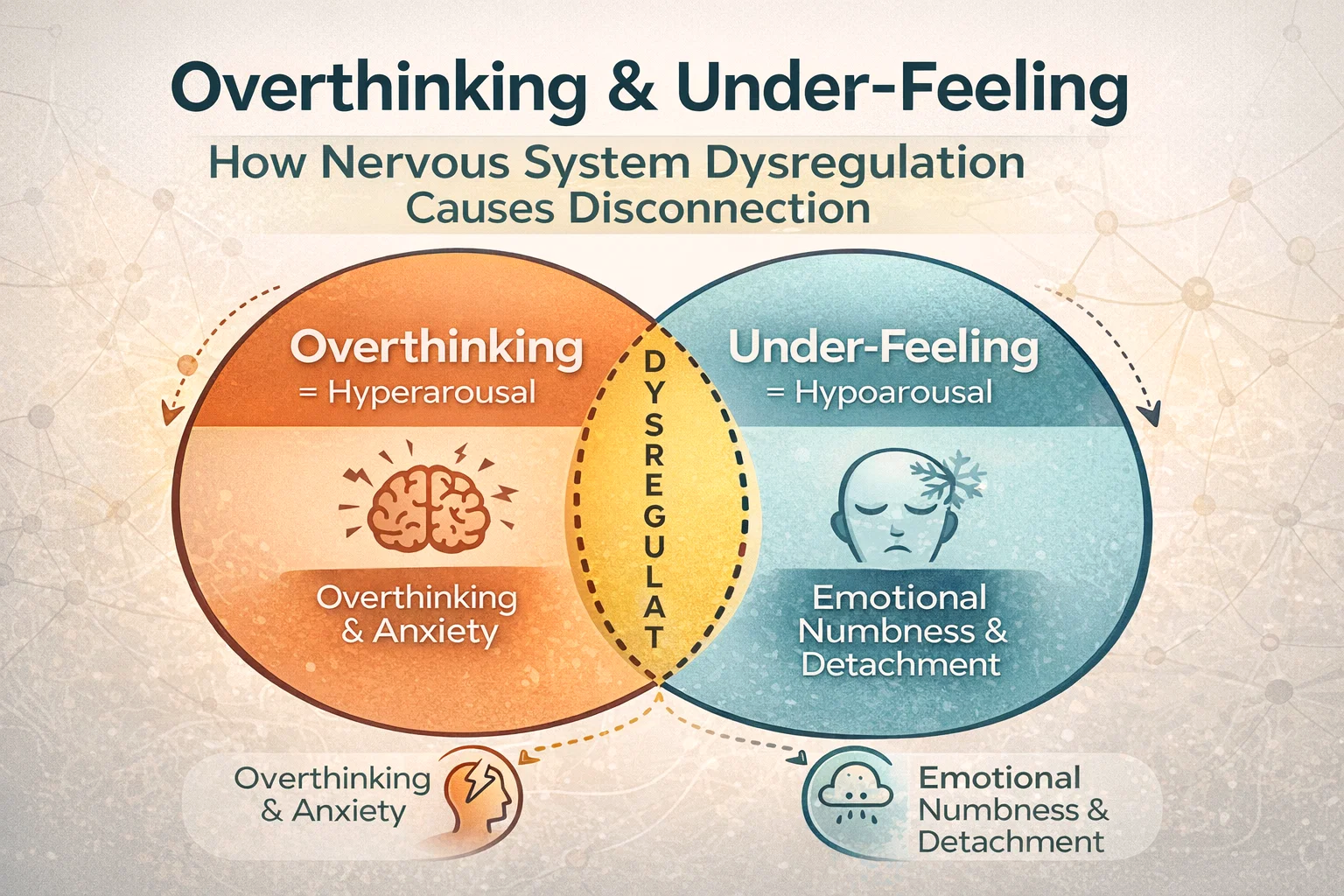
Overthinking vs Under-Feeling How Nervous System Dysregulation Causes Anxiety Disconnect
Have you ever felt like your brain is a browser with fifty tabs open, all playing different videos at maximum volume, while your body feels strangely silent or even numb? It is a common yet deeply frustrating experience where your thoughts are racing at a million miles per hour, but you feel completely disconnected from your physical sensations and emotions. This internal tug-of-war is not just a personality quirk or a sign that you are “bad at relaxing.” It is actually a biological response driven by your nervous system. When we talk about the intersection of overthinking and under-feeling, we are really looking at the mechanics of nervous system dysregulation and how it shapes our daily reality.
Understanding the science of why we disconnect is the first step toward coming back home to ourselves. Most of us have heard of the fight or flight response, but we often view it as something that only happens during extreme danger. In reality, modern stress keeps many of us in a low-grade, chronic state of survival. This creates a feedback loop where our minds over-analyze to keep us safe, while our bodies shut down feeling to protect us from overwhelm. Let’s dive deep into how this happens and what you can do to find your way back to a state of balance and flow.
The Anatomy of Dysregulation: Hyperarousal vs. Hypoarousal
To understand why we overthink and under-feel, we have to look at the Window of Tolerance. This is a concept in psychology that describes the zone where we can effectively manage and process our emotions. When we are pushed outside this window, our nervous system shifts into one of two primary survival modes: hyperarousal or hypoarousal.
Hyperarousal and the Overthinking Mind
Hyperarousal is associated with the sympathetic nervous system, better known as the fight or flight branch. When you are in this state, your system is flooded with stress hormones like cortisol and adrenaline. Your brain goes into overdrive because it perceives a threat, even if that threat is just a mounting to-do list or an awkward social interaction. This manifests as excessive mental chatter. You find yourself analyzing every detail of a conversation from three days ago or constantly questioning your decisions. In this state, the mind believes that if it can just think hard enough, it can solve the problem and finally feel safe.
Hypoarousal and the Under-Feeling Body
On the flip side, we have hypoarousal, which is linked to the dorsal vagal complex of the parasympathetic nervous system. This is the freeze or shutdown response. If the brain decides that fighting or running away is not an option, or if the stress is simply too much to bear, it pulls the emergency brake. This leads to emotional numbness, a sense of being “spaced out,” and a significant difficulty in recognizing or expressing emotions. You might feel like you are watching your life through a foggy window. You are physically present, but emotionally, the lights are off.
The Paradox of Simultaneous States
One of the most confusing aspects of nervous system dysregulation is that these two states can actually happen at the same time. This is often referred to as a “functional freeze” or a “high-functioning anxiety” state. You are internally revved up (overthinking) but externally immobilized or detached (under-feeling). It is like having one foot on the gas and the other on the brake simultaneously. This creates a massive amount of internal friction and exhaustion.
- Mental Symptoms: Constant “what-if” scenarios, perfectionism, and a need for control.
- Physical Symptoms: Muscle tension, shallow breathing, digestive issues, and a lack of awareness of physical hunger or fatigue.
- Emotional Symptoms: Feeling “flat,” inability to access joy, or feeling like you are performing emotions rather than truly experiencing them.
Why Disconnection Becomes a Survival Strategy
It is important to remember that your nervous system is not trying to sabotage you. In fact, it is trying to save you. If you grew up in an environment where your emotions were not validated, or if you experienced prolonged periods of stress, your body learned that feeling was “unsafe.” By numbing out your physical sensations (under-feeling), your system protects you from the pain of your environment. However, since the energy of that stress still needs to go somewhere, it travels upward into the mind, fueling the engine of overthinking.
Overthinking acts as a distraction from the body. As long as you are obsessing over a work project or a social gaffe, you don’t have to feel the tightness in your chest or the hollowness in your stomach. This disconnection from the present moment is a brilliant, albeit taxing, survival mechanism. But while it keeps you safe in the short term, it prevents you from making intuitive decisions and experiencing true intimacy in the long term.
Shutterstock
The Cost of Living in the Grey Zone
Living in a state of dysregulation has a profound impact on your quality of life. When you are disconnected from your intuitive responses, decision-making becomes an agonizing process of pros and cons lists rather than a “gut feeling.” You lose the ability to trust yourself because you can no longer hear what your body is trying to tell you. This leads to chronic stress and a constant background hum of anxiety that never quite goes away.
Furthermore, this state impacts your relationships. Authentic connection requires vulnerability and emotional presence. If you are under-feeling, you might struggle to empathize with others or feel distant even when you are with loved ones. If you are overthinking, you might be so caught up in your own internal narrative that you miss the subtle cues of those around you. The result is a pervasive sense of loneliness, even in a crowd.
How to Reconnect and Regulate Your System
The good news is that the nervous system is plastic. You can train your body to feel safe again and teach your mind to quiet down. This process is not about “fixing” yourself, but about gently expanding your Window of Tolerance so you can stay present with your experiences.
Start with Somatic Awareness
Since the problem lives in the body, the solution must start there too. Somatic (body-based) practices help bridge the gap between the thinking mind and the feeling body. Start small by practicing “body scanning.” Several times a day, ask yourself: “What do I feel from the neck down?” Don’t judge it as good or bad. Just notice if there is warmth, cold, tension, or heaviness. This simple act of noticing begins to repair the neural pathways of connection.
Gentle Grounding Techniques
When the overthinking gets too loud, you need to anchor yourself in the physical world. Use the 5-4-3-2-1 technique: identify five things you see, four things you can touch, three things you hear, two things you can smell, and one thing you can taste. This shifts the focus from the internal mental chatter back to the external environment and your physical senses.
Creating Safety Through Routine
A dysregulated nervous system thrives on predictability. Establishing small, consistent routines can signal to your brain that the environment is safe. This could be a morning cup of tea enjoyed without a phone, a consistent sleep schedule, or a daily walk. These “glimmers” of safety help lower the overall stress load on your system.
Moving from Survival to Thriving
As you begin to regulate your nervous system, you will notice a shift. The “mental fog” begins to lift, and your emotions start to return in manageable waves. You might find yourself crying more easily, but you will also find yourself laughing more deeply. This is a sign that your system is coming back online. Your intuition, which was once buried under layers of over-analysis, will start to speak up again in the form of quiet “knowings” and physical pulls toward what feels right.
The goal is not to never feel stressed or overwhelmed again. The goal is resilience: the ability to move out of the “grey zone” and back into balance more quickly. You are learning to move from a state of disconnection to a state of embodied presence.
Final Thoughts on Finding Balance
Overthinking and under-feeling are not life sentences. They are simply signals from a nervous system that is doing its best to protect you from a world that often feels like “too much.” By acknowledging these states with compassion rather than frustration, you take the power back. You can learn to quiet the chatter and tune back into the wisdom of your body.
Remember that healing is not linear. There will be days when the mental loops return and days when you feel a bit numb again. That is okay. Every time you choose to take a deep breath, feel your feet on the floor, or label a feeling, you are doing the work of regulation. You are moving away from the exhaustion of survival and toward the vibrant, connected life you deserve. Keep going, be patient with your process, and trust that your system knows the way back to balance.