Reduce Overthinking Build Emotional Stability 20 Mental Health Tips
In a world that never seems to stop moving, our minds often follow suit, racing through endless loops of what ifs and worst case scenarios. If you have ever found yourself lying awake at 2:00 AM dissecting a conversation that happened three years ago, you know exactly how exhausting overthinking can be. It is more than just a nuisance; it is a significant barrier to emotional stability and overall mental well-being. But here is the good news: mental clarity and emotional resilience are not traits you are simply born with. They are skills you can build, one intentional choice at a time.
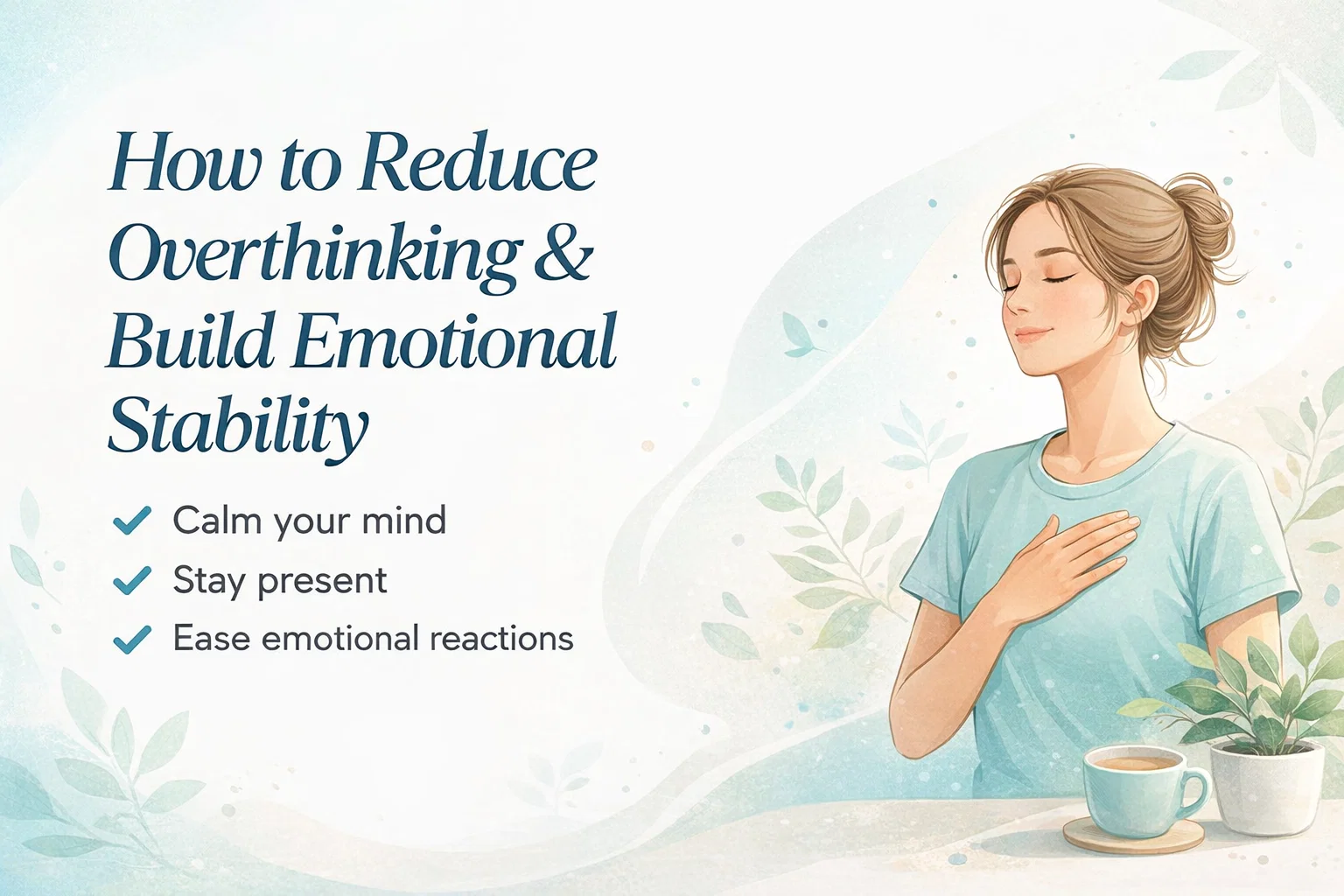
The image we are looking at today provides a powerful roadmap for anyone feeling overwhelmed by their own thoughts. It highlights twenty actionable steps to ground yourself, quiet the internal noise, and reclaim your peace. In this deep dive, we are going to explore how to implement these strategies in your daily life to transform your relationship with your mind and build a foundation of lasting emotional stability.
The Anatomy of Overthinking
Before we can fix overthinking, we have to understand what it actually is. Overthinking is not the same as deep reflection or problem solving. Problem solving leads to action, whereas overthinking leads to a loop of worry that keeps you stuck. It often manifests as rumination (dwelling on the past) or catastrophizing (imagining the worst possible future). When we overthink, we are essentially trying to control the uncontrollable by thinking about it from every possible angle.
This process triggers the body’s stress response, making us feel anxious, tired, and emotionally fragile. By learning to recognize these patterns, we can begin to use the tools necessary to break the cycle. The goal is not to stop thinking altogether, that is impossible, but rather to change how we relate to those thoughts.
Grounding Yourself in the Present Moment
One of the most effective ways to combat a runaway mind is to return your attention to the present. The present moment is the only place where you have actual influence and where peace can truly be found. Many of the strategies in our guide focus on this specific area.
Mastering Intentional Breathing
When your mind starts to spiral, your nervous system often follows. You might notice your heart racing or your breath becoming shallow. By focusing on slow, intentional breathing, you send a direct signal to your brain that you are safe. This is more than just a relaxation technique; it is a physiological override that calms your nervous system first, allowing you to think more clearly.
Taking Small Grounding Breaks
You do not need an hour of meditation to find balance. Small grounding breaks throughout the day can prevent stress from building up to an unmanageable level. This could be as simple as feeling the weight of your feet on the floor, noticing five things you can see, or spending sixty seconds away from your screen. These micro-moments of mindfulness act as anchors, keeping you from being swept away by the tide of your thoughts.
Shutterstock
Developing Emotional Resilience
Emotional stability does not mean you never feel sad, angry, or anxious. Instead, it means you have the tools to handle those emotions without being overwhelmed by them. It is about building a buffer between your feelings and your reactions.
Pausing Before Reacting
Reacting impulsively to an emotion usually leads to regret or further overthinking. By practicing the pause, you create space to choose your response. Ask yourself: Is this reaction helpful? Is it based on facts or feelings? This simple gap between an emotional trigger and your subsequent action is where emotional intelligence lives.
Accepting Discomfort Without Resistance
Much of our suffering comes from our resistance to pain. We think we should not feel anxious, so we get anxious about being anxious. When you learn to accept discomfort without resisting it, you take away its power. You acknowledge that the feeling is there, like a passing cloud, and you allow it to exist without needing to change it immediately. Surprisingly, this acceptance usually helps the feeling pass much faster.
Challenging the Inner Critic
The way we speak to ourselves internally dictates our reality. If your inner monologue is harsh, judgmental, or pessimistic, your emotional stability will suffer. Transforming this dialogue is essential for mental health.
Separating Facts from Imagined Fears
Our brains are incredibly good at storytelling. We often mistake a fearful thought for a concrete fact. To stop overthinking, you must become an investigator of your own mind. When a worrying thought arises, ask: What evidence do I have that this is true? Most of the time, we find that our fears are based on assumptions rather than reality. Learning to separate these two is a superpower.
Speaking Kindly to Yourself
We are often our own harshest critics. If you wouldn’t say it to a friend, do not say it to yourself. Practicing self-compassion reduces the stakes of your mistakes and lowers the volume of overthinking. When you speak kindly to yourself internally, you create a safe environment within your own mind, which is the ultimate form of stability.
Simplifying Your Mental Landscape
Overthinking thrives on complexity and the search for perfection. To find peace, we often need to strip away the unnecessary noise and simplify our approach to life and decisions.
Letting Go of the Need for Perfection
The search for perfect answers is a major driver of overthinking. In reality, there is rarely a perfect choice, only a series of trade-offs. By stopping the search for perfection and settling for “good enough,” you free up immense amounts of mental energy. This allows you to move forward rather than staying paralyzed by analysis.
Limiting Mental Rehearsing
We often rehearse future conversations or scenarios in our heads, thinking it will prepare us. However, this mental rehearsing usually just fuels anxiety. Trust your ability to cope in the moment. You have handled every difficult situation in your life so far, and you will handle the next one too. Believe in your resilience rather than trying to script every moment of your life.
Practical Habits for a Calmer Mind
Beyond the internal shifts, there are practical, everyday habits that support a stable mind. These actions create a lifestyle that discourages overthinking from taking root.
Reducing Exposure to Stressful Inputs
We live in an era of information overload. Constant news alerts, social media comparisons, and endless emails keep our brains in a state of high alert. To protect your mental health, you must be the gatekeeper of your attention. Limit your exposure to stressful inputs, especially in the morning and before bed. Create digital-free zones to allow your mind to rest.
Allowing Silence Without Filling It
Many of us are afraid of silence because it is when our thoughts become the loudest. However, constantly filling every moment with podcasts, music, or scrolling is just a form of avoidance. Practice allowing silence. Sit with your thoughts. Over time, you will find that the silence is not something to fear, but a space where your mind can finally settle and decompress.
Building Trust in Yourself
At the core of overthinking is often a lack of trust. We don’t trust the world to be safe, we don’t trust others to be kind, and most importantly, we don’t trust ourselves to handle whatever comes our way. Building emotional stability requires rebuilding that trust.
Releasing Unrealistic Expectations
We often hold ourselves and others to impossible standards. When these expectations aren’t met, we spiral into overthinking. By releasing these expectations gently, you accept life as it is, not as you think it should be. This doesn’t mean you stop striving for better; it means you stop punishing yourself for being human.
Trusting Your Ability to Cope
Remind yourself of your track record. You have survived 100 percent of your worst days. That is a perfect record. When you trust your ability to cope, you no longer need to spend hours overthinking every possible obstacle. You know that if a problem arises, you will find a way through it. This confidence is the bedrock of emotional stability.
The Power of Rest and Reflection
Finally, we must recognize that mental health requires actual physical and mental rest. You cannot think your way out of burnout; you have to rest your way out of it.
Resting When Your Mind Feels Heavy
Sometimes the best thing you can do for overthinking is to stop thinking. If your mind feels heavy, it is a signal that you are overtaxed. Give yourself permission to rest. This might mean a nap, a walk in nature, or simply closing your eyes for ten minutes. Rest is not a reward for productivity; it is a requirement for a healthy brain.
Returning Attention to the Present
The journey toward mental health is not a straight line. You will have days where you overthink, and that is okay. The goal is simply to notice when you have drifted and gently return your attention to the present. Every time you bring yourself back, you are strengthening the “mental muscle” of presence and stability.
Conclusion
Reducing overthinking and building emotional stability is a lifelong journey, but it is one that pays dividends in every area of your life. By implementing these twenty strategies, from noticing your thoughts without judgment to trusting your ability to cope, you are taking control of your mental environment. Remember that progress is better than perfection. You do not have to do all of these things perfectly today. Just choose one or two that resonate with you and start there.
Your mind can be a place of peace rather than a battlefield. It starts with a single breath, a moment of kindness toward yourself, and the brave decision to let go of the need for total control. As you cultivate these habits, you will find that you are not just surviving your thoughts, but truly living your life with clarity, purpose, and stability.