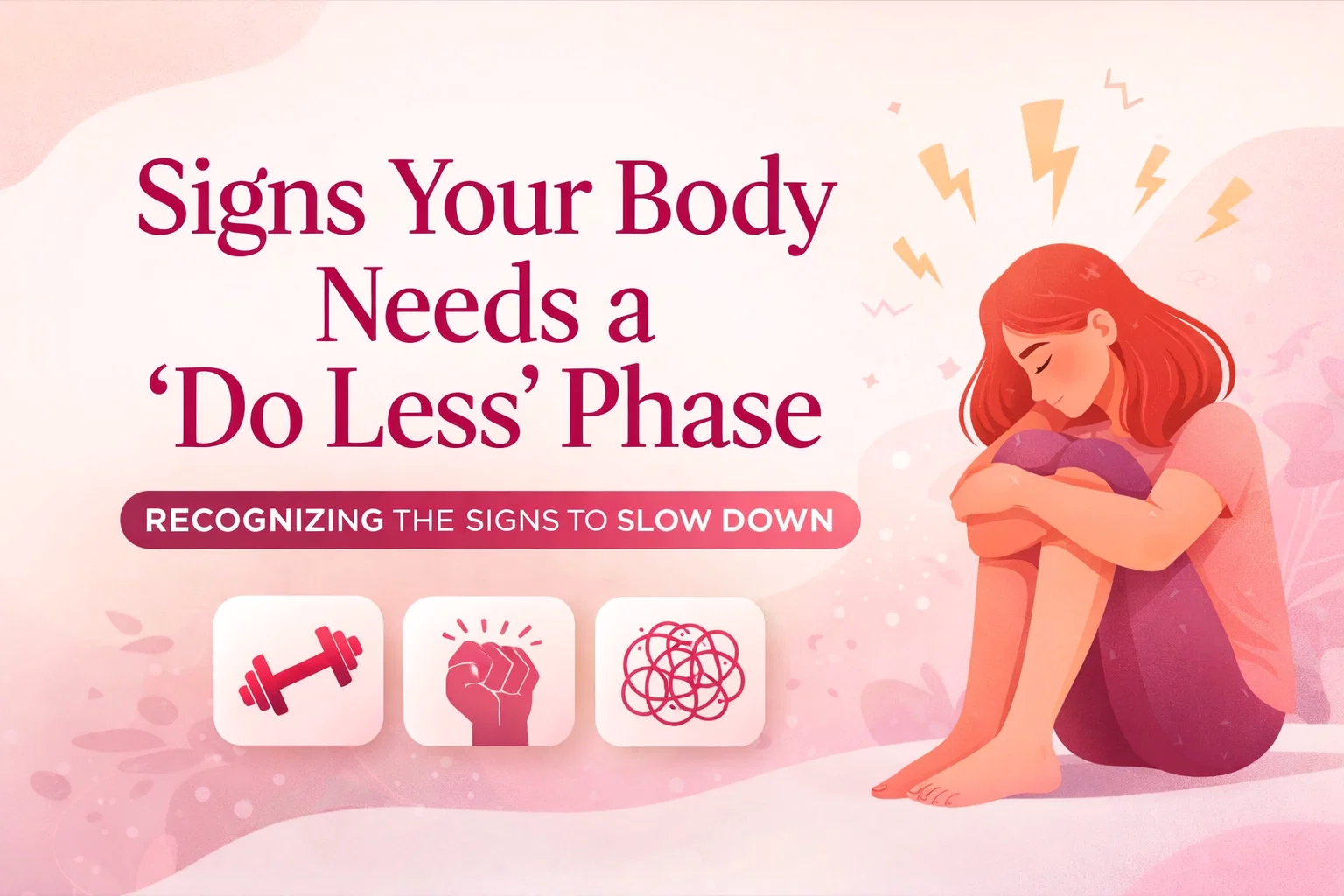
Signs your body is begging for a do less phase
We have all been there: you are checking every box on your to-do list, hitting the gym with discipline, and maintaining a social calendar that would make an influencer jealous. Yet, despite doing everything right, something feels off. It is not the soul-crushing exhaustion of total burnout or a dramatic health crisis. Instead, it is a series of quiet whispers from your nervous system suggesting that you are redlining. This is the subtle art of recognizing when your body is begging for a “do less” phase. It is a concept that challenges our modern obsession with “more” and invites us to embrace the power of strategic regulation to build long-term resilience.
Understanding the “Do Less” Philosophy
In a culture that rewards the hustle, the idea of doing less can feel like an admission of defeat. However, doing less is not about quitting or being lazy. It is a sophisticated physiological strategy designed to prevent the very collapse we fear. Think of it like a high-performance engine: even the best machines cannot run at maximum RPM indefinitely without a tune-up. A “do less” phase is that tune-up. It is a period where you intentionally lower the intensity of your inputs, reduce your mental load, and give your nervous system the space it needs to down-regulate.
This phase is about respecting the natural cycles of expansion and contraction. Nature does not bloom all year round, and neither should you. By honoring these cycles, you actually increase your capacity for growth in the long run. When we ignore the whispers, the body eventually starts to scream. By listening now, you ensure that you stay in the game for years to have, rather than burning out in months.
1. When the Gym Feels Like a Chore: The Physical Signal
One of the first places a need for recovery shows up is in our physical performance. You might find that your usual 5k run feels like a marathon, or the weights you normally lift for ten reps feel like they are bolted to the floor. You are still capable, and you are still strong, but the “perceived exertion” has skyrocketed.
This happens because your nervous system is likely carrying a heavier load than your muscles. When you are under chronic stress—whether from work, relationships, or lack of sleep—your brain prioritizes survival over “gains.” This is a signal that your central nervous system is fatigued. Pushing through this type of fatigue often leads to injury or overtraining syndrome. Instead of forcing a “PR” (personal record), a do less phase might involve switching to restorative yoga, light walking, or simply cutting your volume in half for a week.
2. The Short Fuse: Irritability and Emotional Regulation
Have you noticed yourself snapping at a partner over a minor dish left in the sink? Or perhaps a work email that would usually be a minor nuisance now feels like a personal attack? This increased irritability is a classic sign of low-level chronic activation. When your system is constantly “on,” your window of tolerance shrinks.
In this state, your body stays in a reactive mode. This is not a personality flaw or a sign that you are a “mean” person. It is a physiological regulation signal. Your brain is overstimulated and is essentially telling you that it cannot process any more data. When you reduce the external inputs—fewer notifications, less news, fewer social obligations—you give your emotional regulation center a chance to reset.
Identifying Your Sensory Triggers
- Noise: Do everyday sounds like the humming of a fridge or distant traffic feel grating?
- Visuals: Does a cluttered room feel physically painful to look at?
- Social: Does the thought of a small talk conversation feel like an exhausting mountain to climb?
3. The Paradox of “Tired but Wired”
This is perhaps the most frustrating symptom of an overloaded system. You are physically exhausted. Your eyes are heavy, and your brain is foggy. Yet, the moment your head hits the pillow, your heart starts racing or your mind begins to reel through a list of worries. This is known as sympathetic dominance.
Your body is stuck in “go mode” even though your energy reserves are completely depleted. It is as if the “off” switch on your internal circuit breaker is jammed. A “do less” phase helps shift you back into the parasympathetic state, also known as “rest and digest.” To fix this, you cannot just sleep more; you have to do less during the day so your body feels safe enough to actually rest at night.
4. Physical Manifestations: The Constant Tension
Sometimes the body speaks through physical rigidity. Take a moment right now to check your posture. Is your jaw clenched? Are your shoulders creeping up toward your ears? Is your breathing shallow and restricted to your upper chest?
Chronic tension is a sign that your baseline level of stress is too high. Even when you think you are relaxing, your muscles are braced for a threat that never arrives. This constant physical guarding consumes an incredible amount of metabolic energy. By intentionally reducing intensity and practicing down-regulation techniques like deep diaphragmatic breathing, you can manually reset that baseline and teach your body that it is safe to let go.
5. The Mental Craving for Simplicity
When you find yourself daydreaming about a cabin in the woods with no internet, or if the idea of choosing what to have for dinner feels like an impossible task, your brain is craving simplicity. This is an efficiency mechanism. Your brain is one of the most energy-intensive organs in the body, and when energy is low, it tries to conserve it by rejecting complex decisions and plans.
This craving for simplicity is often mislabeled as laziness. In reality, it is your brain trying to restore clarity. In a “do less” phase, you should actively lean into this.
- Automate your meals: Eat the same thing for a few days to remove decision fatigue.
- Clear your calendar: Say no to “optional” events without guilt.
- Limit digital input: Put your phone on “Do Not Disturb” for set blocks of time.
6. The Loss of Joy: When Enjoyment Goes MIA
One of the saddest signs of an overloaded system is when the things you love start to feel like burdens. If your favorite hobby feels like just another item on the to-do list, or if you find yourself unable to feel the “spark” of joy in small moments, your reward system is likely blunted by stress.
When the system is in survival mode, it deprioritizes pleasure. Why feel joy when you are trying to “survive” the week? By stepping into a “do less” phase, you allow your dopamine receptors and your nervous system to recover. As the pressure drops, the joy naturally returns. You do not have to “find” your passion again; you just have to give it room to breathe.
How to Effectively Implement a “Do Less” Phase
Knowing the signs is only half the battle; the other half is actually taking the permission to slow down. Implementing a “do less” phase requires a strategic approach. It is not about doing nothing, but about doing what matters with significantly less intensity.
The Three Pillars of Strategic Regulation
- Lower Intensity: If you usually do HIIT, try a slow walk. If you usually write 2,000 words, aim for 500. Lowering the bar allows you to keep the habit without the strain.
- Fewer Inputs: This refers to the “noise” of life. Podcasts, social media, news, and even music can be inputs. Try to find pockets of silence throughout your day.
- More Space: Build buffers into your schedule. If a meeting ends at 2:00 PM, do not start the next task until 2:15 PM. Use that space to simply be.
The Concept of Contraction for Resilience
Resilience is often misunderstood as the ability to endure endless pressure. However, true resilience is the ability to bounce back. You cannot bounce back if you never allow the “spring” of your life to contract. By respecting the phase of contraction, you are essentially gathering energy for your next phase of expansion. This is how you build a life that is sustainable for the long haul.
Conclusion: Listening to the Whispers
Your body is an incredibly wise biological machine. It is constantly communicating with you, but it rarely uses a megaphone. It uses the heaviness in your legs, the tightness in your jaw, and the sudden irritability at a red light to tell you that it needs a break.
Choosing a “do less” phase is an act of self-respect. It is an acknowledgment that you are a human being with limits, not a programmable robot. When you honor these signals, you stop the cycle of burnout before it starts. You allow your motivation to return naturally, your body to repair itself, and your mind to regain its sharp edge.
Remember, backing off is often the fastest way to move forward. So, take a deep breath, look at your schedule, and ask yourself: where can I create a little more space today? Your body will thank you for it.
Would you like me to create a 7-day “Do Less” challenge outline to help you get started with this transition?