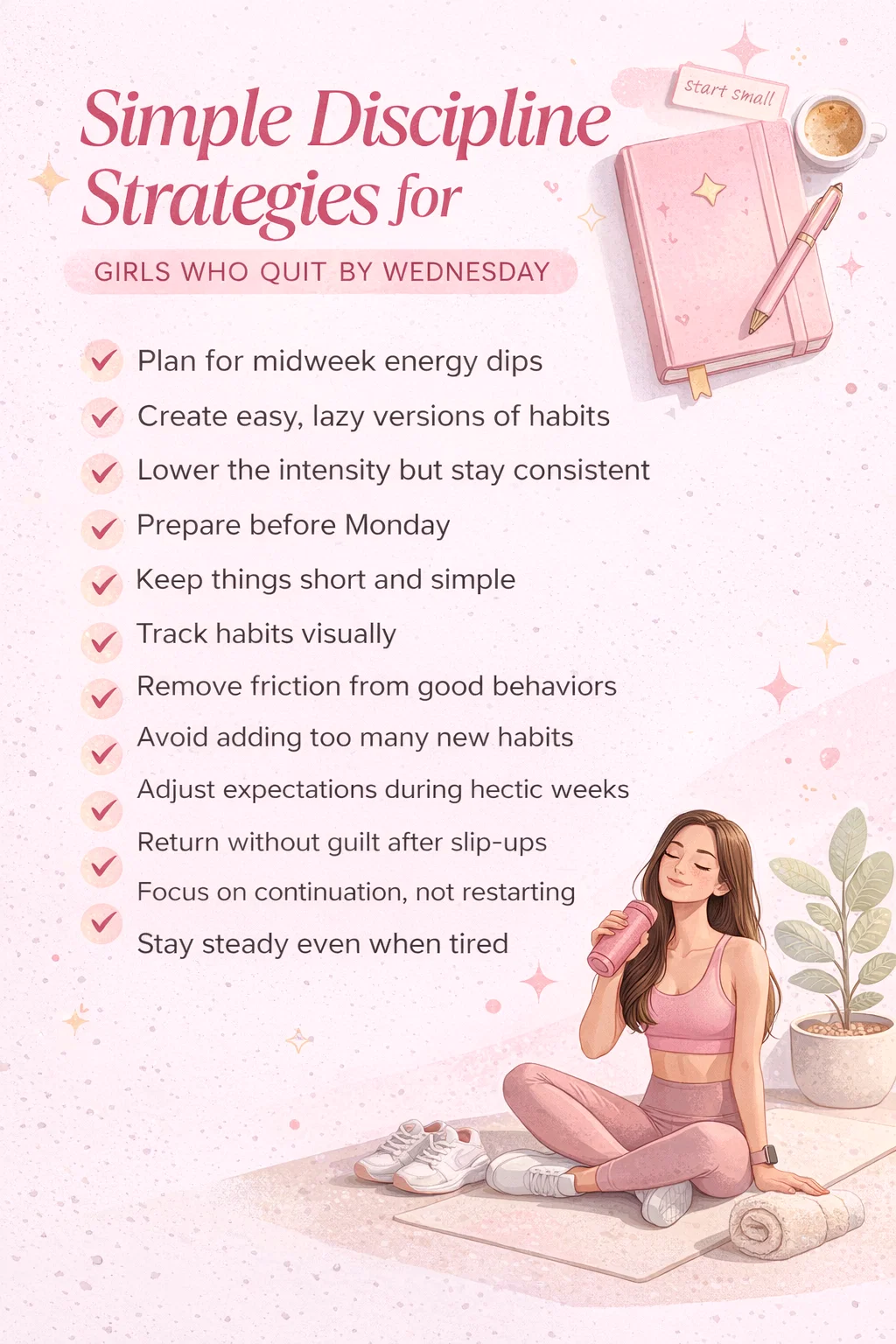
Simple Discipline System for Beginners Habits Consistency Tips for Women
We have all been there. Monday morning arrives with a burst of inspiration. You have a fresh planner, a new gym outfit, and a list of ambitious goals that feel entirely achievable. By Tuesday, you are still riding the wave. But then, Wednesday hits. The midweek slump settles in, your energy levels crater, and suddenly, the discipline you felt forty-eight hours ago has vanished. This phenomenon is so common it has practically become a cultural rite of passage for anyone trying to improve their life. However, it does not have to be your reality.
The secret to long term success is not more willpower; it is a better system. High achievers do not necessarily have more grit than you do, they simply have better structures in place to catch them when they fall. When we talk about a Simple Discipline System, we are moving away from the “all or nothing” mentality that leads to burnout. Instead, we are focusing on sustainability, friction reduction, and the power of the “lazy version” of your habits. This guide will break down how to stop the cycle of quitting and start building a life of consistent, effortless progress.
Understanding the Midweek Slump
Why is Wednesday the universal graveyard for New Year’s resolutions and weekly goals? It is usually the point where the initial hit of dopamine from “starting something new” wears off, and the reality of the work sets in. On Monday, you are fueled by the idea of the result. By Wednesday, you are faced with the monotony of the process. To beat this, you must stop relying on how you feel and start relying on what you have prepared.
Most people fail because they design their routines for their “Best Self” the person who has eight hours of sleep, a clear schedule, and high motivation. A truly resilient discipline system is designed for your “Tired Self.” It accounts for the days when you are running late, the kids are cranky, or you simply do not want to do the work. By planning for these energy dips, you ensure that the chain of consistency never breaks.
The Power of the Five Minute Fallback Rule
One of the most effective tools in your discipline arsenal is the five minute fallback rule. The logic is simple: on days when you cannot do the full version of a habit, you do the smallest possible version of it. If your goal is to workout for an hour but you feel exhausted, you commit to five minutes of stretching. If your goal is to write a chapter of a book, you write one paragraph.
Why Micro-Habits Work
- They protect your identity: By doing something, you remain “the type of person who works out,” even if the workout was short.
- They lower the barrier to entry: It is much easier to convince your brain to do five minutes of work than sixty.
- They maintain momentum: It is ten times harder to restart a habit after quitting than it is to continue a habit at a lower intensity.
Lowering Intensity to Keep Momentum
Consistency is a marathon, not a sprint. Many people quit by Wednesday because they set their intensity far too high on Monday. If you go from zero exercise to two hours of heavy lifting daily, your body and mind will rebel. A sustainable discipline system prioritizes continuation over intensity.
On high stress weeks, it is perfectly acceptable to lower the bar. If you usually cook a three course healthy meal but you are overwhelmed, “lowering intensity” might mean having a rotisserie chicken and bagged salad. You are still sticking to the goal of eating healthy, but you are doing it in a way that does not require a massive expenditure of mental energy. This prevents the “guilt spiral” that usually leads to quitting altogether.
Creating Friction-Free Environments
Discipline is often less about internal strength and more about external environment. If you want to drink more water, put a bottle on your desk. If you want to stop scrolling on your phone, put it in another room. This is the concept of adding friction to bad behaviors and removing it from good ones.
Removing Friction for Good Habits
To ensure you don’t quit by Wednesday, prepare your tools before the week even starts. This means meal prepping on Sunday, laying out your gym clothes the night before, and having your journal open to the right page on your nightstand. When the “Wednesday Wall” hits, you want your good habits to be the path of least resistance.
Increasing Friction for Distractions
Conversely, identify what usually pulls you off track. Is it Netflix? Is it a specific app? Make these harder to access. Delete the app for the work week or unplug the TV. By making it “annoying” to fail, you naturally drift toward your productive tasks.
The Never Skip Two Days Rule
Life happens. Sometimes, despite your best intentions, you will miss a day. The difference between those who succeed and those who quit is how they handle that miss. The Never Skip Two Days rule is a non-negotiable part of a simple discipline system. Skipping one day is an accident; skipping two days is the start of a new habit of inactivity.
When you miss a day, do not waste energy on guilt or “restarting” next Monday. Simply return to the routine immediately. This prevents the “What the Heck” effect, where one small slip leads you to give up on the rest of the week entirely. Focus on the fact that you are always just one decision away from being back on track.
Using Visual Tracking for Accountability
Our brains love visual rewards. There is a deep psychological satisfaction in checking a box or crossing an item off a list. Using a physical habit tracker or a visual calendar provides immediate positive reinforcement. When Wednesday rolls around and you feel like quitting, looking at the “X” marks for Monday and Tuesday can provide the small nudge you need to keep the streak alive.
Visual tracking also removes the ambiguity of “how you are doing.” It provides hard data. You might feel like you are failing, but your tracker might show you have been 80 percent consistent over the last month. This perspective is vital for maintaining long term motivation and avoiding emotional burnout.
Simplifying Your Weekly Schedule
Over-scheduling is the enemy of discipline. If your to-do list has twenty items, you are setting yourself up for failure. A simple system focuses on one core non-negotiable. This is the one thing that must get done regardless of how the day goes. Everything else is a bonus.
By narrowing your focus, you reduce decision fatigue. You no longer have to wonder what to do next because the priority is clear. This simplicity makes it much harder to quit because the “load” of your expectations is light enough to carry even on your hardest days.
The Importance of the Lazy Version
Every habit should have a “gold,” “silver,” and “bronze” version. The gold version is what you do when you have perfect conditions. The bronze version is the “lazy” version. Creating a lazy version of your habits is an act of self-kindness that actually fuels discipline. It acknowledges that you are human. If your “gold” meditation is twenty minutes, your “lazy” meditation is three deep breaths. Having these tiers ensures that you always have a way to “win” the day, no matter what happens.
Returning Without Guilt After Slip Ups
The most toxic part of the “quitting by Wednesday” cycle is the shame. We feel like we have failed, so we punish ourselves or decide we aren’t “the disciplined type.” Discipline is a skill, not a personality trait. You wouldn’t be angry at yourself for failing to play the piano perfectly on your first try, so don’t be angry at yourself for struggling with consistency.
A professional mindset focuses on continuation, not restarting. You aren’t starting over; you are just continuing from where you left off. Remove the emotional weight from your productivity, and you will find it much easier to stay steady even when you are tired.
Conclusion: Building Your Sustainable System
Discipline is not about being a robot; it is about being a good architect of your own life. By implementing a system that expects boredom, plans for energy dips, and embraces simplicity, you remove the need for constant, exhausting willpower. Remember that consistency grows slowly. The midweek slump is just a sign that you are in the middle of the work, not a sign that you should stop.
Start small today. Pick one core non-negotiable and commit to the “Never Skip Two Days” rule. As you build confidence in your ability to stick to the small things, the big things will naturally fall into place. You don’t need a total life overhaul; you just need a system that works for you every day of the week, including Wednesday.