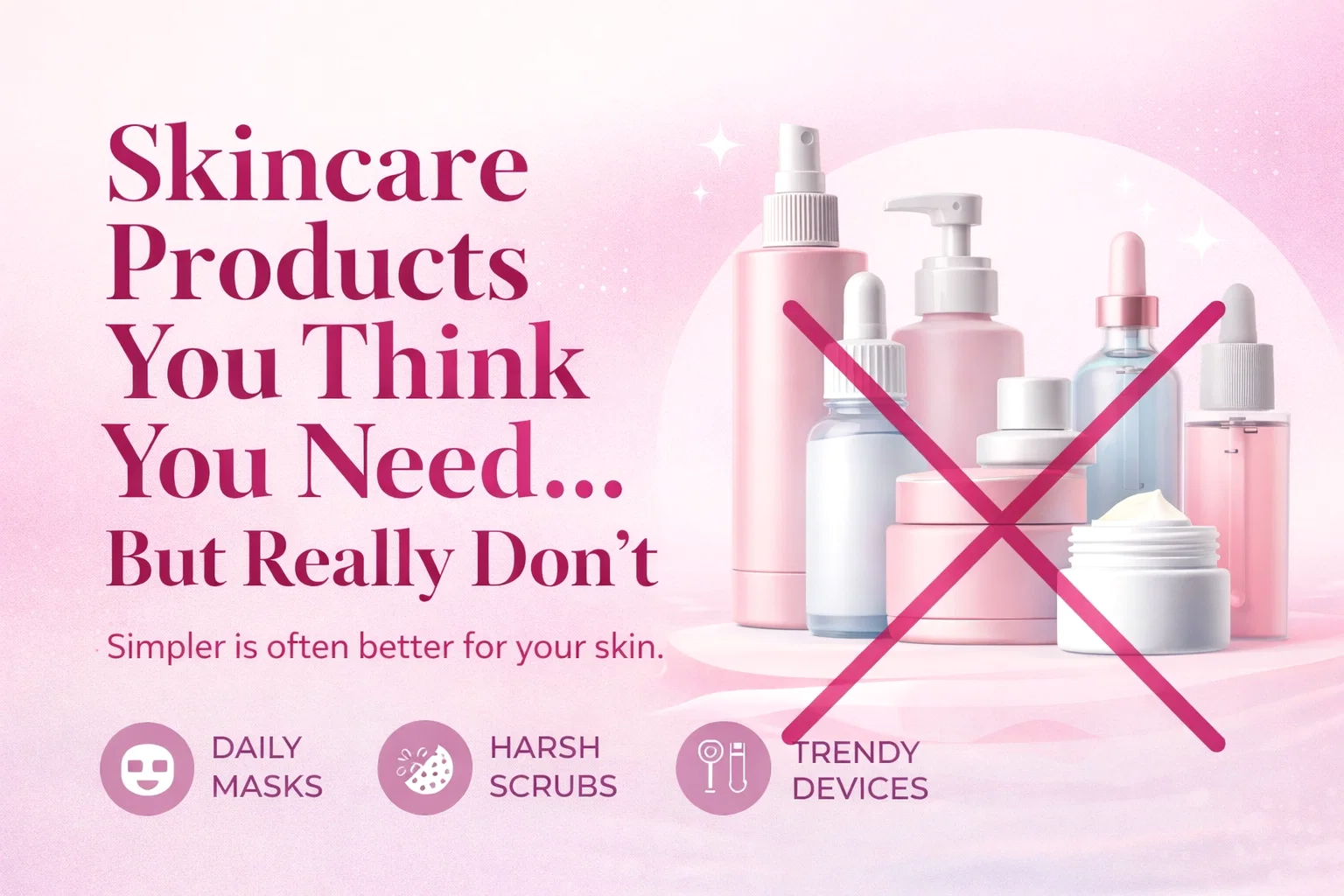
Skincare Products You Think You Need But Dont 6 Overrated Items To Skip For Better Skin
In a world where 10 step skincare routines and aesthetic vanity setups dominate our social feeds, it is easy to feel like your bathroom cabinet is never quite full enough. We are constantly bombarded with advertisements for the next miracle serum, the latest vibrating facial roller, or a specific cream for every square inch of our skin. However, the skincare industry often thrives on the idea that we are missing something essential. The truth is much simpler: your skin is a living organ designed to balance itself, and more often than not, less is actually more.
When we overload our faces with dozens of different products, we are not just spending more money; we are potentially damaging our skin barrier. If you have ever experienced mysterious breakouts, redness, or that annoying “pilling” where your products roll off in little balls, you might be a victim of product overload. It is time to peel back the marketing layers and look at what your skin truly needs to stay healthy, clear, and glowing.
The Myth of the Multi Step Routine
The rise of complex routines has led many to believe that skipping a single step, like a dedicated essence or a specialized toner, is a recipe for premature aging or dullness. But if you look at the ingredients in high quality moisturizers and serums, you will often find that they already contain the hydrating and soothing properties these extra steps claim to provide. If your moisturizer is doing its job, adding a separate mist or essence on top often does nothing more than increase the risk of irritation.
Understanding Product Overlap
Many skincare categories overlap significantly in their chemical makeup. An essence is often just a slightly more concentrated toner, while a mist is frequently just a diluted version of a hydrating serum. When you apply all three, you are essentially applying the same hydrating base three times. This does not triple the hydration; it just creates a thick film on the skin that can prevent more important active ingredients from penetrating effectively.
1. Why You Can Skip the Separate Toner, Essence, and Mist
For years, toners were marketed as a way to “balance skin pH” after using harsh, alkaline soaps. Modern cleansers are formulated to be pH balanced, making this step largely redundant for the average person. While some people enjoy the sensory experience of a cooling mist, it is rarely a functional necessity for skin health.
- Moisturizers do the heavy lifting: A well formulated moisturizer contains occlusives, humectants, and emollients that lock in moisture far better than a watery spray.
- Reduced risk of pilling: The more layers you add, the more likely the formulas are to clash, leading to that frustrating texture where products rub off instead of soaking in.
- Simplified mornings: Cutting these steps saves you time without sacrificing the quality of your complexion.
2. The Truth About Eye Creams
Perhaps the most controversial “skip” on this list is the eye cream. We have been told for decades that the skin around our eyes is “delicate” and requires a completely different formula than the rest of the face. While it is true that the skin is thinner there, most eye creams are simply thinner, more expensive versions of the moisturizer you already own.
When Your Regular Moisturizer is Enough
If your daily moisturizer is fragrance free, gentle, and packed with hydrating ingredients like hyaluronic acid or ceramides, it is perfectly safe and effective to use around your eyes. Unless you are treating a very specific concern that requires a high concentration of an active ingredient (like retinol specifically formulated for the eye area to avoid migration), a standard moisturizer will keep that skin hydrated and plump just as well as a tiny, thirty dollar jar of eye cream.
3. The Problem with Daily Face Masks
We all love the “self care” feeling of putting on a face mask after a long day. It feels luxurious and indulgent. However, the idea that you need a mask every day to see results is a marketing tactic rather than a dermatological reality. Masks are meant to be occasional treatments, not daily staples.
Consistency Over Intensity
Skin transformation does not happen because of a twenty minute mask session once a day. It happens through the consistent use of a solid base routine: a gentle cleanser, a reliable moisturizer, and daily SPF. In fact, using certain masks too often, especially clay masks or those with exfoliating acids, can strip your skin of its natural oils and lead to a compromised barrier. Stick to masking once or twice a week as a treat, but rely on your core products for the real results.
Shutterstock
4. Moving Away from Physical Scrubs
The era of the “apricot scrub” left many of us with a love for that squeaky clean, slightly tingly feeling after scrubbing our faces with grainy particles. Unfortunately, those grains are often jagged and can cause “micro tears” in the skin. These tiny injuries weaken the skin barrier, making you more susceptible to bacteria and inflammation.
The Rise of Chemical Exfoliants
Instead of physically tearing at the skin, chemical exfoliants like Alpha Hydroxy Acids (AHAs) or Beta Hydroxy Acids (BHAs) work by gently dissolving the “glue” that holds dead skin cells together. They provide a much more even and controlled exfoliation without the trauma of physical rubbing. If you must use a physical exfoliant, look for something extremely fine, like rice powder, but for most people, a gentle liquid exfoliant used twice a week is the safer, more effective route.
5. Beware of “Miracle” Gadgets and Tools
From LED pens to vibrating rollers and crystal Gua Sha stones, the tool market is booming. While these can be fun and provide a nice facial massage that aids in lymphatic drainage (reducing temporary puffiness), they are rarely the “miracles” they are claimed to be. An LED pen used for two minutes is unlikely to have the same effect as a professional treatment, and a vibrating roller will not “lift” your face permanently.
Invest in Ingredients, Not Just Plastic
If you have a limited budget, your money is almost always better spent on high quality ingredients like Vitamin C, Retinol, or Niacinamide rather than a trendy gadget. These ingredients have decades of clinical research backing their ability to change the skin at a cellular level, whereas many home tools provide only surface level, temporary results.
6. Avoid Using Multiple Serums for the Same Concern
It is tempting to buy every brightening serum on the shelf when you are dealing with hyperpigmentation. However, using five different products with similar active ingredients is a recipe for disaster. Not only is it a waste of money, but it can also overwhelm your skin, leading to “contact dermatitis” or extreme sensitivity.
- Choose one powerhouse: Find one well formulated serum that targets your specific concern and use it consistently.
- Let it work: Most skincare products take at least six to eight weeks to show visible results. Switching between products too quickly prevents you from seeing what actually works.
- Active ingredient synergy: Some ingredients work better together, but many (like Vitamin C and Retinol) can be irritating if layered at the same time. Keep it simple.
The Anatomy of a Functional Minimalist Routine
If we are cutting out all these popular products, what should be left? A functional routine is built on three main pillars. If you get these right, you will find that your skin looks better than it ever did with a dozen steps.
The Morning Routine
In the morning, your goal is protection. Use a gentle cleanser (or even just a rinse with water), a Vitamin C serum for antioxidant protection, a moisturizer if your skin is dry, and a broad spectrum SPF 30 or higher. The sunscreen is the most important anti aging product you will ever own.
The Evening Routine
At night, your goal is repair. Use a cleanser to remove the day’s dirt and sunscreen. This is the time to apply your treatment, such as a Retinoid or a gentle exfoliating acid. Finish with a nourishing moisturizer to support the skin’s natural repair process while you sleep.
Conclusion: Less is Truly More
Clear, healthy skin does not come from owning the most products; it comes from using the right products correctly and consistently. By eliminating the “fluff” from your routine, you reduce the risk of irritation, save a significant amount of money, and allow your skin to do what it does best: protect and renew itself. Skincare should support your skin, not overwhelm it. So, the next time you see a trendy new “must-have” product, take a look at your current shelf. You might already have everything you need for a healthy glow.
Embrace the simplicity of a minimalist routine and watch how your skin responds with clarity and health. Your wallet and your skin barrier will thank you.
Would you like me to create an SEO optimized meta description or a list of suggested tags for this post?