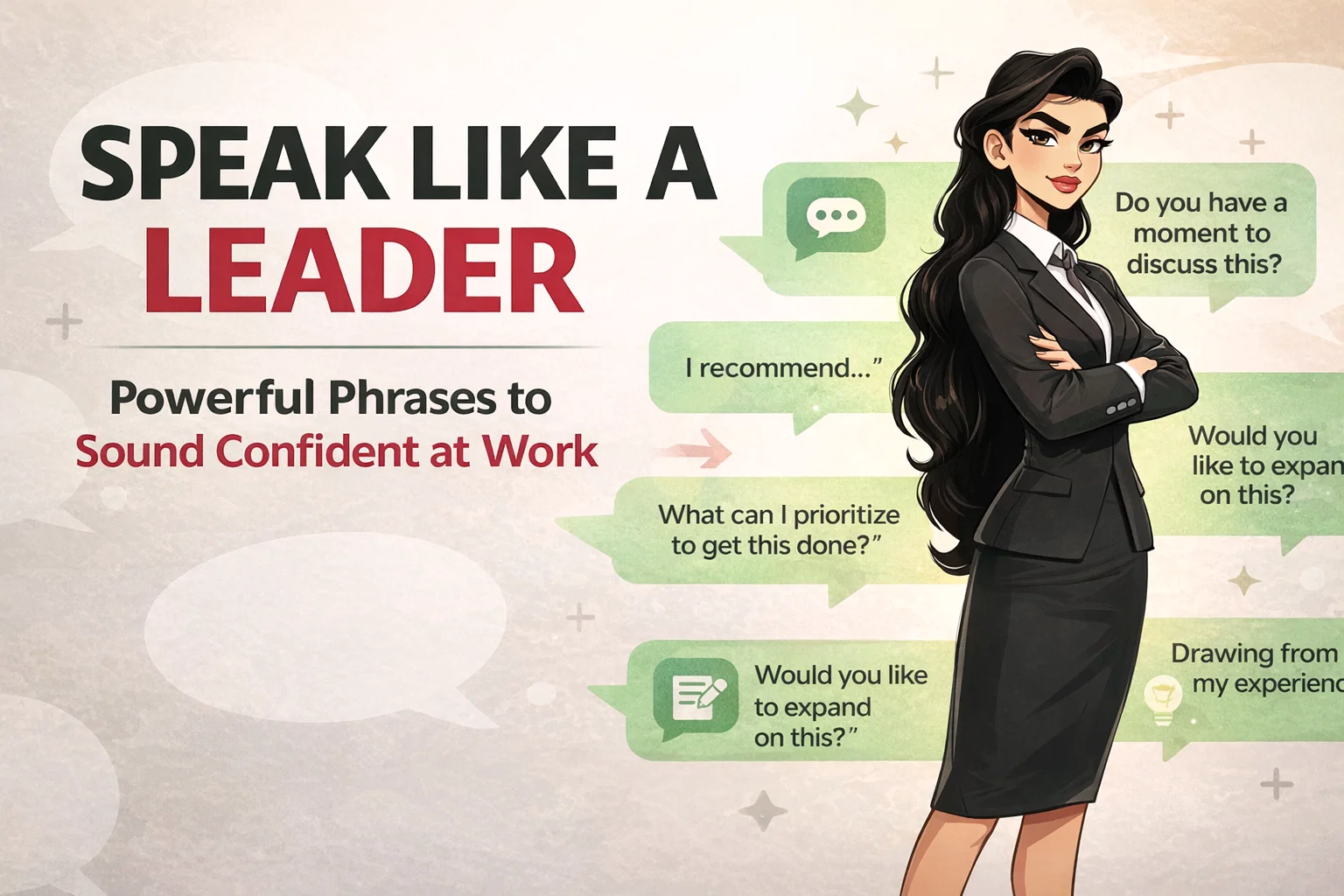
Speak Like a Leader 10 Ways to Sound More Confident at Work
Have you ever walked out of a meeting or hit send on an email only to immediately second-guess how you sounded? Many professionals struggle with projecting authority in the workplace. The truth is that the quality of your ideas only takes you so far. The actual packaging of those ideas dictates how your colleagues, managers, and clients perceive your competence. Minor tweaks to your daily vocabulary can completely transform your professional image. By swapping out tentative phrases for assertive statements, you step into a leadership mindset. You do not need a new job title to start speaking like a leader. You just need a new script.
The Hidden Cost of Passive Language
Passive language sneaks into our daily conversations disguised as politeness. We want to be accommodating, team-oriented, and approachable. However, there is a fine line between being polite and undermining your own authority. When you constantly apologize for existing in a professional space or downplay your contributions, you signal to others that your time and thoughts are not valuable. This habit can limit your career growth, keep you off high-visibility projects, and make it harder to advocate for yourself during salary negotiations.
The good news is that confidence is a muscle you can build through intentional communication. Leaders are not born with a magical dictionary. They simply learn to frame their thoughts in ways that command respect, set clear boundaries, and inspire trust. Let us dive deep into ten specific phrases you should eliminate from your work vocabulary right now and what to say instead to instantly sound more capable and self-assured.
Stop Apologizing When You Have Done Nothing Wrong
The reflex to apologize is one of the most common communication pitfalls in the corporate world. We say sorry for taking up space, for asking questions, and even for doing our jobs. Reframing these moments shifts the dynamic from one of subservience to one of mutual respect.
From Begging for Time to Requesting Collaboration
Instead of saying: “Sorry to bother you…”
Try saying: “Do you have a moment to discuss this project?”
When you start a conversation with an apology, you immediately frame your request as a nuisance. You are subtly telling your colleague that your need is less important than whatever they are currently doing. By asking if they have a moment to discuss a project, you are acknowledging their busy schedule while firmly establishing that your discussion is a valid business priority. It treats the interaction as a peer-to-peer collaboration rather than an interruption.
From Highlighting Mistakes to Expressing Gratitude
Instead of saying: “Sorry for the delay…”
Try saying: “Thanks for your patience.”
Things happen. Emails get buried, projects take longer than expected, and deadlines occasionally slip. While it is important to take accountability for major errors, constantly apologizing for minor delays only highlights your shortcomings. Flipping the script to thank the other person for their patience completely changes the psychological tone of the message. It compliments the recipient for being an understanding professional and removes the spotlight from your delay, allowing both parties to move forward constructively.
Owning Your Expertise and Ideas
If you do not believe in your own ideas, nobody else will. Many professionals dilute their brilliance by using hedging words that make their statements sound like mere suggestions or guesses.
From Timid Suggestions to Firm Recommendations
Instead of saying: “I think maybe we could…”
Try saying: “I recommend we…”
Adding words like “think” and “maybe” to your sentences acts as a verbal safety net. You use them so that if the idea fails, you are not fully responsible. However, this also means that when the idea succeeds, you do not get the full credit. Stepping up and saying “I recommend” shows that you have analyzed the situation, weighed the options, and are confident in your proposed direction. It shows leadership and a willingness to take ownership of team strategies.
From Diminishing Your Voice to Anchoring Your Value
Instead of saying: “My opinion is…”
Try saying: “Drawing from my previous experience…”
Opinions are subjective and easily dismissed. Experience is factual and carries weight. When you preface a thought by grounding it in your past successes, data analysis, or industry knowledge, you build instant credibility. You are reminding the room why you were hired in the first place. You bring a unique background to the table, and framing your insights around that background makes your contributions much harder to ignore.
Asking Questions With Confidence
Curiosity is a hallmark of a great leader. The smartest people in the room are usually the ones asking the most questions. Yet, the fear of looking uninformed often leads us to qualify our inquiries with self-deprecating remarks.
From Fearing Judgment to Seeking Clarity
Instead of saying: “This is a dumb question…”
Try saying: “I’d like to understand…”
There is absolutely no benefit to calling your own question dumb before you even ask it. It primes your audience to view you as less competent. Replacing this phrase with a desire to understand shows that you are actively engaged and committed to getting the details right. It frames the question as a pursuit of excellence rather than a confession of ignorance. More often than not, if you need clarification on a point, half the room is probably wondering the exact same thing and will be grateful you spoke up.
From Seeking Validation to Offering Elaboration
Instead of saying: “Does that make sense?”
Try saying: “Would you like me to expand on any points?”
We often end our explanations with “does that make sense?” as a nervous habit to seek reassurance from our listeners. Unfortunately, it can imply two negative things. It either suggests that you are bad at explaining things, or it insults the intelligence of the listener by implying they might not be able to comprehend your point. Asking if they would like you to expand puts you in the position of an authority offering further assistance. It keeps the power in your hands while ensuring the team is fully aligned.
Setting Boundaries and Managing Workloads
Leaders do not say yes to everything. They manage their time ruthlessly and set clear expectations. Failing to protect your bandwidth leads to burnout and dropped balls, which ultimately harms your professional reputation much more than a polite pushback.
From People-Pleasing to Strategic Prioritization
Instead of saying: “I’ll try to get this done…”
Try saying: “What can I deprioritize to get this done for you?”
Saying you will “try” is a non-committal response that leaves everyone anxious. The requester does not know if the task will actually be completed, and you are left carrying the stress of an overloaded to-do list. By asking what you should deprioritize, you force the requester to acknowledge your current workload. It shifts the conversation from your personal stamina to a strategic business decision about resource allocation. It shows you are a team player but also a professional who operates within realistic limits.
From Passive Waiting to Driving Action
Instead of saying: “I just wanted to check in on…”
Try saying: “When can I expect an update about…”
The phrase “just checking in” is the digital equivalent of nervously hovering by someone’s desk. It is passive and rarely results in a concrete timeline. Asking when you can expect an update is direct, professional, and requires the other person to commit to a specific deadline. It keeps projects moving forward and establishes you as a driver of progress rather than a passive participant waiting on the sidelines.
Cultivating a Growth Mindset and Professional Grace
How you handle compliments, gratitude, and your own areas of improvement speaks volumes about your character. Confident professionals do not deflect praise, nor do they hide their flaws. They address both with poise.
From Admitting Defeat to Highlighting Growth
Instead of saying: “I’m not good at…”
Try saying: “I’m currently improving my skills in this area…”
Nobody is an expert at everything, and it is perfectly fine to admit when you are out of your depth. However, labeling yourself as “not good” at something creates a permanent, negative brand around your capabilities. Stating that you are currently improving your skills reframes a weakness as an active journey of professional development. It tells your manager that you are self-aware, proactive, and capable of learning.
From Brushing Off Gratitude to Accepting Appreciation
Instead of saying: “No worries…”
Try saying: “Always happy to help.”
When someone thanks you for going out of your way to assist them, saying “no worries” or “no problem” diminishes the value of the favor you just provided. It implies that your time and effort cost you nothing. Replying with “always happy to help” gracefully accepts their gratitude. It acknowledges that you did indeed do them a favor, but you did so gladly because you are a supportive and valuable member of the team. It leaves a lasting positive impression.
Transform Your Career Through Conscious Communication
Changing the way you speak takes practice. You have likely spent years hardwiring these passive phrases into your daily interactions, and you will probably catch yourself typing out “Sorry to bother you” a dozen more times before the habit breaks. The key is to slow down. Take an extra three seconds before you hit send on an email or before you open your mouth in a Zoom meeting to review your words. Ask yourself if your language reflects the confident, capable professional you truly are.
Implementing these ten reframes will do more than just change how others see you. It will fundamentally change how you see yourself. When you start speaking with the authority of a leader, you start believing in your own leadership capabilities. You will feel more equipped to tackle challenging projects, navigate difficult workplace conversations, and advocate for the recognition you deserve. Start making these small adjustments today, and watch as your workplace presence transforms.