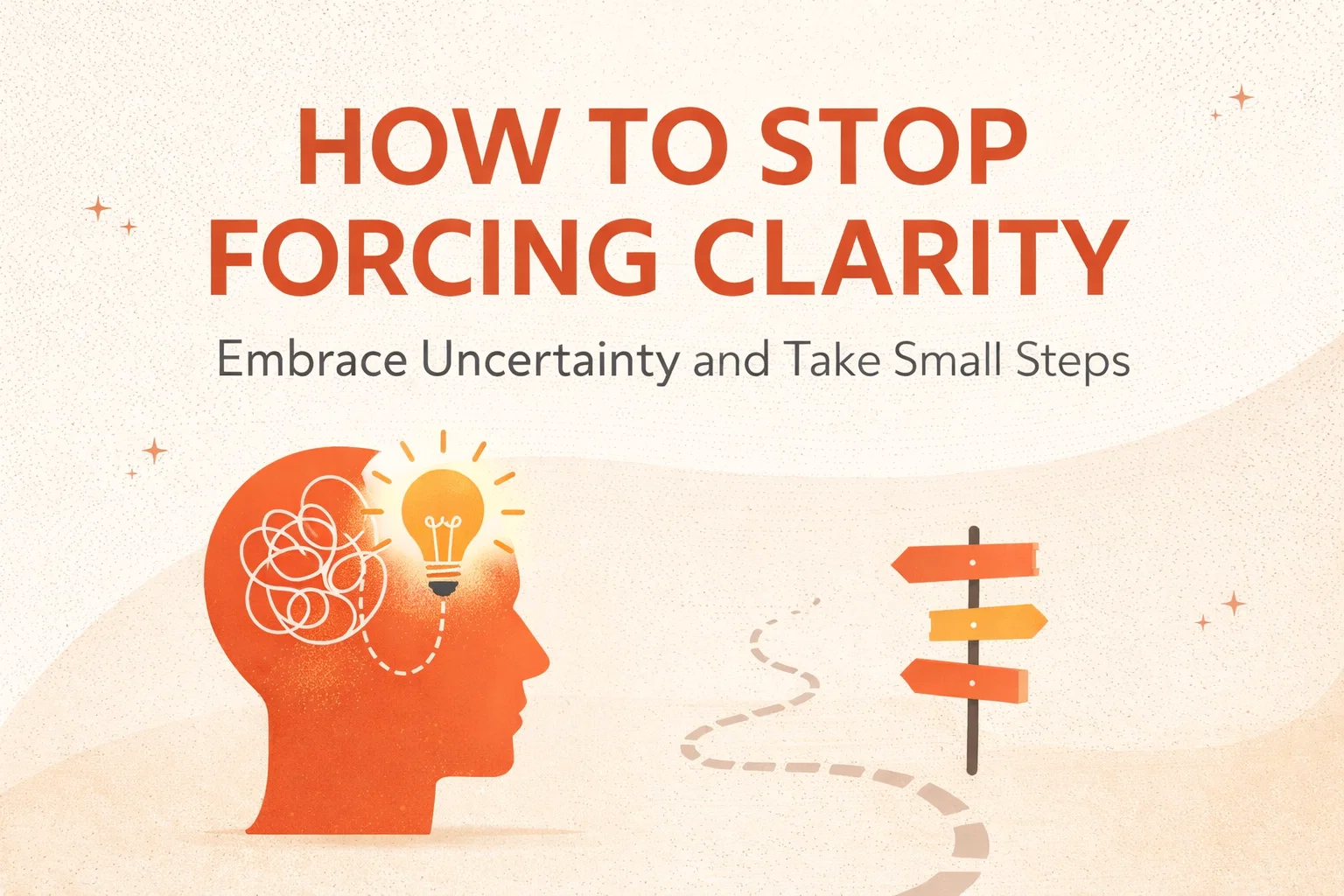
Stop Forcing Clarity How to Overcome Decision Paralysis and Find Your Path Through Action
We have all been there. You are staring at a blank screen or a ceiling fan at 3:00 AM, desperately trying to figure out what your life is supposed to look like in five years. You think that if you just ponder long enough, or read one more self-help book, or analyze your childhood one more time, a lightning bolt of clarity will strike. You expect a roadmap to appear, complete with a “You Are Here” sticker and a clear path to the finish line. But instead of a roadmap, you just get a headache. The truth that most people are afraid to admit is that clarity is not something you find through thinking. It is something you distill through doing. When you try to force clarity, you actually trigger a protective shutdown in your brain. The pressure to get it right makes the stakes feel so high that you become paralyzed. This is the trap of the linear mindset, and it is time to break free from it.
The Linear Expectation vs. The Iterative Reality
Most of us grew up in an era defined by algorithms. We are used to typing a query into a search engine and getting the exact answer instantly. This has conditioned our brains to have a linear expectation for life: Step A should lead directly to Step B. We think we need to know our passion before we apply for the job, or we need to be certain about a relationship before we go on the third date. We want the result before we have even started the process.
However, life is fundamentally iterative. Think of it like a scientist in a lab. A scientist doesn’t wait for a “gut feeling” that a chemical reaction will work; they run the experiment to see what happens. If the experiment fails, they have gained data. That data is the clarity. In an iterative mindset, you don’t need to know if you love marketing before you try it. You try it for three months, and even if you end up hating every second of it, you have achieved clarity. You now know for a fact that marketing is not for you. That is progress, not a failure.
Moving from Forcing to Doing
Forcing clarity sounds like this: I need to know my soul’s purpose before I can take a single step. Iterative clarity sounds like this: I am not sure if I like this direction, but I am going to walk this way for ninety days and see what the data tells me. You cannot think your way into a new way of living. You have to live your way into a new way of thinking. Action is the laboratory where clarity is synthesized.
Embracing Productive Uncertainty
The anxiety you feel when you do not know what to do next usually isn’t about the lack of direction itself. It is about the shame you feel for being “lost.” We live in a curated world where everyone else seems to have it all figured out. Their Instagram feeds and LinkedIn profiles suggest a seamless transition from one success to the next. But here is the reality: a huge percentage of people are simply faking their clarity. They are just picking a direction and walking, hoping for the best.
To find peace, you must give yourself permission to be in-between. Tell yourself: I am currently in a data collection phase. This simple shift in language does wonders for your biology. It lowers the cortisol levels in your brain, which allows your executive function to work better. When you are stressed and seeking “forever” answers, your brain’s prefrontal cortex partially shuts down, making it even harder to make good decisions. By embracing uncertainty as a productive part of the process, you regain your ability to think clearly.
The Power of the Data Collection Phase
When you are in a data collection phase, the pressure is off. You aren’t “failing” at a career; you are testing a hypothesis. You aren’t “wasting time” on a hobby; you are gathering information about your interests. This mindset turns every experience into a win because every experience provides information. You are no longer looking for the right answer; you are looking for more data points to help you triangulate your next move.
Solve for Next Instead of Forever
One of the biggest reasons for decision paralysis is that we try to solve for the next five to ten years all at once. Your brain is a powerful tool, but it cannot compute that many variables. There are too many unknowns in a ten-year span to make an accurate plan today. When you try to solve for forever, you end up doing nothing because the weight of the decision is too heavy.
The solution is to shrink the window. Stop asking, “What should I do with my life?” and start asking, “What is the most interesting or least boring thing I can do for the next ninety days?” Ninety days is a manageable timeframe. It is long enough to see results but short enough that the stakes remain low. If you can’t commit to a career, commit to a skill. If you can’t commit to a city, commit to a month-long trip or a new hobby. By solving for “Next,” you keep the momentum alive.
The Benefits of Low Stakes
- Reduced Fear: It is much easier to start something when you know you can reassess in three months.
- Skill Acquisition: Even if the direction changes, the skills you learn in a 90-day sprint stay with you.
- Flexibility: You remain agile and able to pivot as new opportunities arise.
Distinguishing Between Signals and Noise
When we are desperate for clarity, our first instinct is often to look at everyone else. We scroll through social media to see what our peers are doing, hoping to find a spark of inspiration. This is almost always a mistake. This is Noise, and it actually destroys the very clarity you are seeking. Looking outward for internal answers is like trying to hear a whisper in a crowded stadium.
To find real clarity, you must listen for Signals. Signals are internal and often subtle. They are the things you find yourself doing when you are supposed to be doing something else. They are the topics you naturally gravitate toward when you have free time. If you are procrastinating on your accounting work by reading about urban gardening, that is a signal. Don’t ignore it.
The Envy Test: Your Secret Map
Envy is often seen as a negative emotion, but in the search for clarity, it is one of your most valuable tools. If you feel jealous of someone, that is a clarity signal. It tells you exactly what you want but haven’t allowed yourself to pursue. Don’t suppress the envy; map it. Who are you jealous of? Why? Is it their lifestyle, their specific job, their creative freedom, or their public recognition? That “why” is your next direction. Envy is just your potential calling out to you from behind a green-eyed monster.
Practice Micro-Movements and the 1 Percent Rule
When you lack clarity, your brain often enters a state known as the Dorsal Vagal state, or the “freeze” response. You feel heavy, unmotivated, and stuck. To get out of this state, you cannot use logic alone. You need to prove to your brain that movement is safe. You do this through micro-movements.
The 1 Percent Rule suggests that instead of trying to overhaul your entire life, you just take one tiny action. Instead of choosing a whole new career, just send one DM to someone doing something cool. Instead of writing a book, just write one paragraph. These tiny actions create physiological momentum. Once you are moving, it is much easier to steer the car. It is impossible to steer a parked car. By starting small, you break the freeze response and begin the process of distillation.
Why Movement Creates Momentum
Action triggers the release of dopamine, the reward chemical. When you complete a small task, your brain gets a hit of “feel-good” energy that makes the next task feel easier. This builds a positive feedback loop. Before you know it, those micro-movements have turned into a steady stride, and the clarity you were chasing begins to appear in your rearview mirror.
Conclusion: The Path is Made by Walking
Clarity is not a destination you reach; it is a byproduct of a life well-lived and actively explored. If you are waiting for the perfect moment or the perfect plan, you are going to be waiting a long time. The fog only clears once you start walking into it. Stop demanding “forever” answers from a brain that is only designed to handle “right now.”
Embrace the uncertainty, listen to your internal signals, and trust that every small step is teaching you something valuable. Whether you are using the Envy Test to find your next goal or the 1 Percent Rule to get moving, the key is to stop thinking and start doing. Your future self isn’t found in your thoughts; they are waiting for you at the end of a long trail of experiments, failures, and micro-movements. So, take that one small step today. The clarity will follow.
Would you like me to generate a list of 90-day “Next Step” ideas based on a specific interest you have?