Stop Overthinking Take Action How to Break the Cycle and Boost Productivity
We have all been there. You are staring at a blank screen, a pile of laundry, or a daunting business proposal, and instead of moving your hands, your mind starts racing at a thousand miles per hour. You begin to weigh every possible outcome, imagine every potential failure, and suddenly, two hours have passed without a single lick of progress. This is the overthinking cycle, a mental loop that feels like running on a treadmill in a dark room. You are putting in immense effort, but you aren’t actually going anywhere.
Breaking this cycle is not about becoming a person who never has a doubt. It is about building a toolkit that allows you to acknowledge those doubts and then move past them anyway. In a world that prizes “hustle culture” and “perfection,” it is easy to fall into the trap of believing that if you just think about a problem long enough, you will find a flawless solution. The truth is that clarity usually comes from engagement, not speculation. In this guide, we are going to dive deep into how you can silence the internal noise and regain control of your productivity.
The Anatomy of the Overthinking Loop
Before we can break the cycle, we have to understand what it looks like. Overthinking usually starts with a simple “What if?” That single question branches out into a complex web of scenarios, most of which are negative. This creates a physiological stress response. Your heart rate might climb, your shoulders tighten, and your brain begins to treat the “imagined” failure as a real, present threat. Because your brain wants to protect you from that threat, it keeps you in “analysis mode” as a defense mechanism. If you don’t act, you can’t fail, right?
The problem is that staying still is its own kind of failure. It is the failure of potential. When we overthink, we are essentially trading our future progress for a false sense of security in the present. To stop this, we must recognize the physical and mental cues that signal the start of a loop. Do you start scrolling on your phone? Do you suddenly feel the need to research a completely unrelated topic? Recognizing these “tells” is the first step toward intervention.
Immediate Strategies to Interrupt Repetitive Thoughts
When you realize you are caught in a loop, you need a circuit breaker. You cannot simply “think” your way out of overthinking. You have to use your body or your environment to shift your state of mind. Here are some of the most effective ways to snap back into the present moment:
Utilize Grounding Techniques
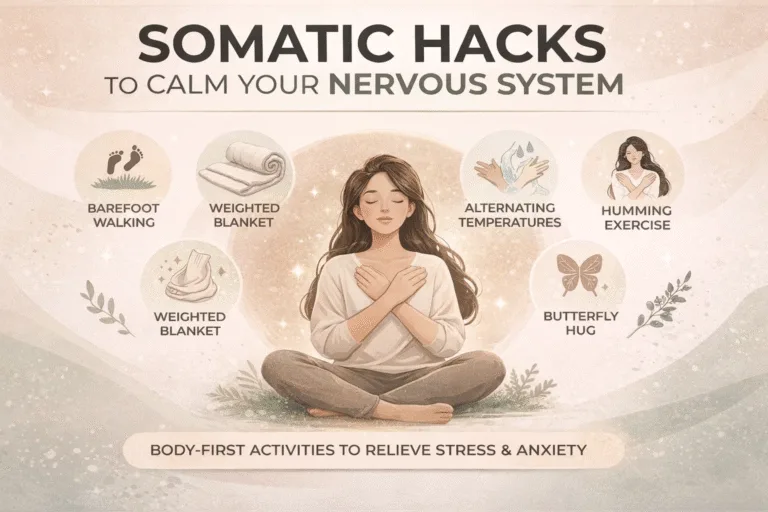
Grounding is a way to pull your focus away from the abstract “what ifs” and back to the concrete “what is.” One of the most common methods is the 5-4-3-2-1 technique. Identify five things you can see, four things you can touch, three things you can hear, two things you can smell, and one thing you can taste. By the time you reach the end of the list, your nervous system has usually settled enough for you to choose a more productive thought.
The Five-Second Rule
Popularized by productivity experts, the idea is simple: the moment you have an impulse to act on a goal, you must physically move within five seconds or your brain will kill the idea. Count backward: 5, 4, 3, 2, 1, and then GO. This countdown acts as a starting gun for your brain, bypassing the analytical centers and jumping straight into the motor cortex.
Shifting from Analysis to Action
One of the biggest hurdles to taking action is the “Perfection Trap.” We often wait for a moment of perfect clarity where the path forward is illuminated with neon signs. Unfortunately, that moment rarely comes. Real progress is messy, and it usually requires acting while you are still a little bit afraid or uncertain.
- Set a Short Timer: Tell yourself you will work on the task for just ten minutes. Usually, the hardest part is the transition from “doing nothing” to “doing something.” Once the timer is running, the momentum often carries you forward.
- Limit Your Research: We often mask overthinking as “doing research.” Give yourself a hard deadline for information gathering. Once that hour is up, you must make a decision based on the information you currently have.
- Trust Your Initial Judgment: More often than not, your first instinct is rooted in your experience and values. Continually questioning that instinct usually leads to “decision fatigue” rather than a better choice.
The Power of the Next Small Step
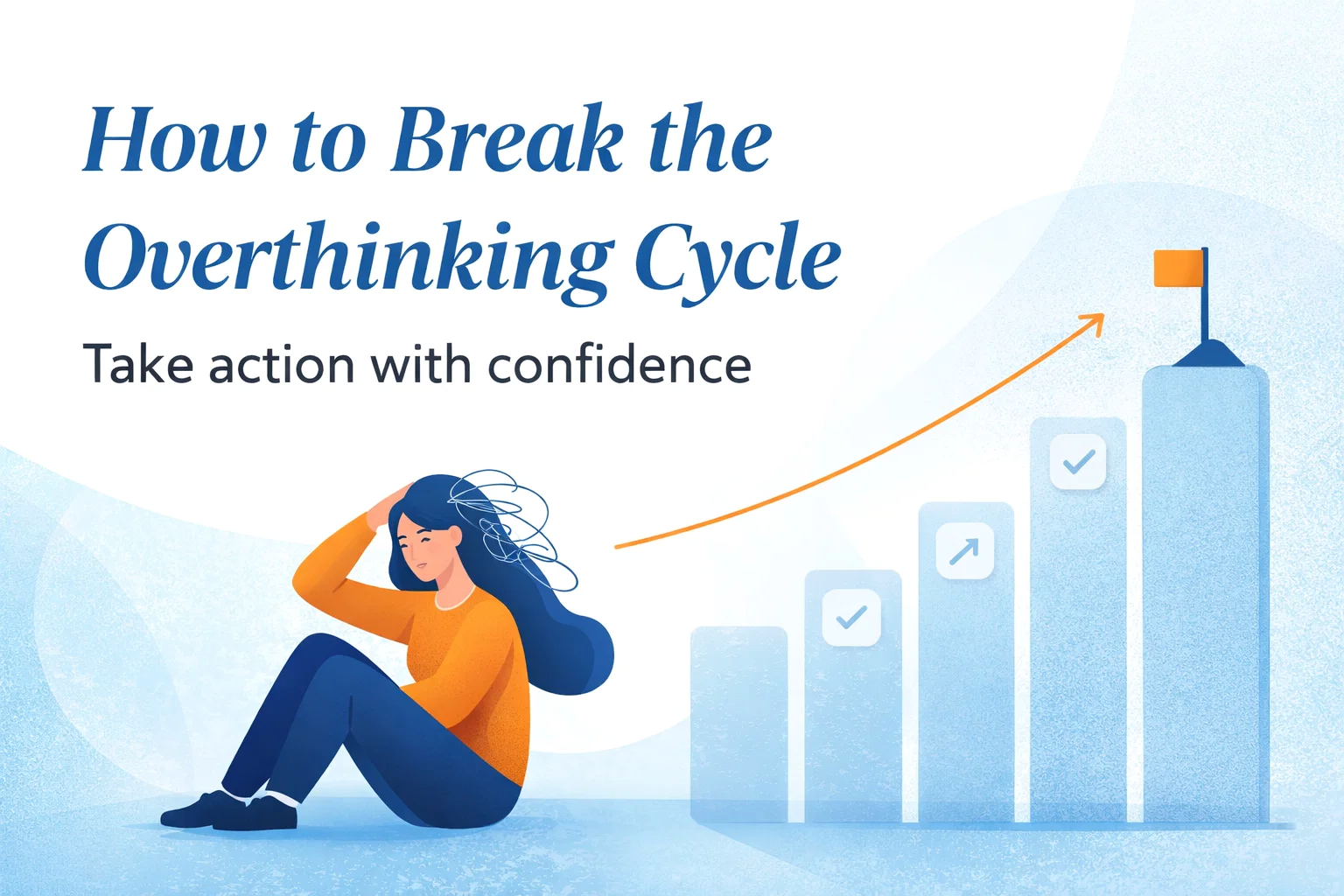
When we look at a massive goal, like writing a book or starting a business, our brain gets overwhelmed. Overthinking is often a symptom of a goal that is too large and poorly defined. To break the cycle, you must shrink the target until it is impossible to miss. Instead of “starting a business,” your task for today might be “buy a domain name.” Instead of “getting fit,” your task is “put on my running shoes.”
Breaking Big Goals Into Tiny Tasks
Create a micro-list. This isn’t a to-do list for the week; it is a list for the next hour. Each item should take less than fifteen minutes to complete. The dopamine hit you get from crossing off these small items builds the “confidence muscle” you need to tackle the bigger stuff later. Action creates information. You will learn more about how to finish your project by working on it for twenty minutes than you will by thinking about it for twenty days.
Managing Fear and Imagined Failure
At the core of almost all overthinking is fear. We fear looking stupid, we fear wasting money, and we fear that our best effort won’t be good enough. To take action, you have to change your relationship with failure. Instead of seeing failure as a dead end, try to see it as a data point. Each time something doesn’t work out, you have simply discovered one way that doesn’t work, which brings you closer to the way that does.
Write Down Worries Once Only
If a specific worry keeps circling your mind, give it a home on paper. Write it down, acknowledge it, and then decide that you have “processed” that thought. If it comes back up, remind yourself that it is already on the list and there is no need to re-examine it until you have actually taken a physical step forward. This frees up mental RAM for the task at hand.
Accepting Imperfect Results
Repeat this mantra: “A finished ‘B-‘ project is better than an unfinished ‘A+’ idea.” Give yourself permission to do a “messy first draft.” You can always edit, pivot, or improve later, but you cannot improve something that doesn’t exist. Perfectionism is just overthinking in a fancy suit.
Building Long-Term Momentum
Breaking the overthinking cycle once is great, but the real magic happens when you turn action into a habit. This involves curating your environment and your social circle to support a “bias for action.”
Reduce Outside Opinions
Sometimes, we overthink because we are trying to please too many people. If you ask ten people for their opinion, you will get ten different answers, which will only lead to more paralysis. Pick two or three trusted mentors or friends and ignore the rest of the noise. Trust your own reasonable judgment more than the hypothetical “they.”
Celebrate Small Wins
Don’t wait until the entire project is done to feel good about yourself. Celebrate the fact that you started. Celebrate the fact that you sat at your desk for an hour even if you didn’t feel inspired. By rewarding the process rather than just the outcome, you train your brain to enjoy the act of doing, which makes it easier to start the next time.
Staying Present While Working
Even after you start, overthinking can creep back in. You might be working on step two while your mind is already worrying about step ten. This is where “staying present” becomes a productivity tool. Focus entirely on the specific task in front of you. If you are typing, focus on the feel of the keys. If you are cleaning, focus on the movement. By narrowing your focus to the present, you leave no room for the future-based anxieties that fuel overthinking.
The Role of Repetition
Confidence is not a personality trait; it is a result of repetition. The more times you feel the urge to overthink and choose to act instead, the easier it becomes. You are literally rewiring your brain’s neural pathways. Over time, “taking action” becomes your default setting, and “overthinking” becomes the rare exception.
Conclusion: The Path Forward
Breaking the overthinking cycle is a journey, not a destination. There will always be days when your mind feels louder than your ambition, and that is okay. The goal isn’t to be perfect; it is to be persistent. By noticing your triggers, using grounding techniques, and focusing on the very next small step, you can reclaim your time and your energy.
Remember that you don’t need to see the whole staircase to take the first step. You just need to trust that as you move forward, the next step will become visible. So, put down the research, stop the endless planning, and do one small thing right now that moves you toward your goal. You have the power to break the loop. It is time to stop thinking and start living.