Stop Proving Your Point Why Defending Your Intent Escapes Conflict and Ruins Relationships
Have you ever been in the middle of a heated discussion, feeling your heart rate rise, desperately trying to get the other person to understand your point of view? You’re not trying to be difficult. You just want them to see it your way, to grasp your intent, to validate your perspective. But the harder you try, the more they resist, and the conversation spirals into a frustrating, circular argument. It’s a common, human experience, and it’s incredibly draining.
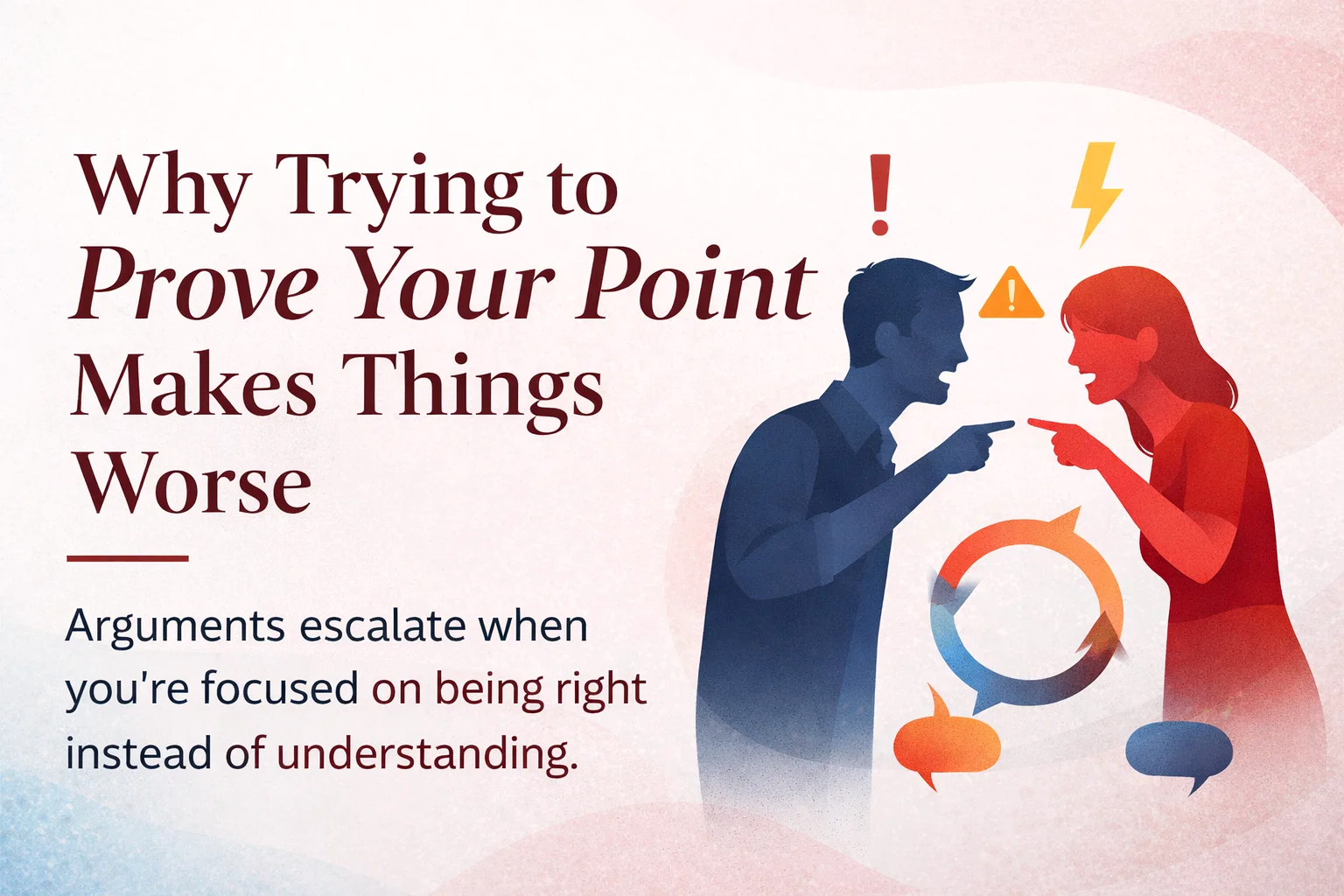
The image we see perfectly captures this universal struggle. It highlights the subtle, often invisible forces at play when communication breaks down. That initial instinct to clarify, to fix the narrative, seems entirely reasonable in our own minds. However, as the image so clearly articulates, that very impulse can be the catalyst for the conflict to escalate. The conversation shifts from a joint exploration to two individuals locked in a battle of self-protection.
This isn’t about blaming anyone. It’s about understanding the deep-seated psychological mechanisms that govern our interactions. We are all, at our core, protective of our identity and our sense of self. When we feel that identity is threatened or misunderstood, we react. We push. We defend. The challenge is that when both people are doing this simultaneously, no one is actually listening. We become like two ships sailing past each other, shouting to be heard but never truly connecting.
So, why exactly does trying to prove your point make things worse? Let’s delve deeper into this dynamic, explore the hidden drivers, and, most importantly, discover how to break this cycle of conflict and build more meaningful, connected relationships.
The Hidden Trigger: The Core Identity Threat
At the heart of every defensive reaction lies a threat to our core identity. It’s rarely about the specific topic of the argument. It’s about what that topic represents about us. When someone criticizes our actions, challenges our beliefs, or implies we are wrong, a part of us feels a sense of being attacked.
What Most People Don’t See: The Internal Struggle
As the image mentions, defensiveness escalates because both people are trying to protect their identity at the same time. While you are busy defending your intent, the other person is busy validating their experience. This is a critical point. Their resistance isn’t necessarily a sign that they are stubborn or difficult. It’s a sign that they feel their own experience, their own narrative, is being invalidated by your perspective.
Consider a simple disagreement over household chores. You might say, I forgot to do the dishes because I was stressed with work. You see this as a reasonable explanation of your intent. However, the other person, who did the dishes, hears this as an excuse. They feel unappreciated and as if their effort doesn’t matter. In their mind, your ‘explanation’ is a dismissal of their feelings. They dig their heels in to validate that their feelings do matter, and their experience is real. You, in turn, feel misunderstood and judged for your intentions. A power struggle begins.
The Erosion of Empathy: How Connections Break Down
One of the first casualties of a conversation focused on being right is empathy. When we are consumed by our own need to be understood, our ability to truly hear the other person diminishes. True empathy requires a suspension of judgment. It means setting aside our own perspective for a moment to fully inhabit the other person’s world, to feel what they feel, and to understand why they feel that way.
The Slippery Slope to Resentment
When communication consists primarily of one or both parties trying to prove their point, empathy cannot thrive. Without empathy, a sense of distance and disconnection begins to grow. We stop seeing each other as partners and start seeing each other as adversaries. This erosion of connection is the breeding ground for resentment.
Think about it. Each time a conversation ends in frustration, with neither party feeling truly heard, a small seed of resentment is planted. Over time, these seeds grow, choking out the warmth and intimacy in the relationship. We begin to anticipate conflict, leading us to be more guarded and less open, which, in turn, fuels more defensiveness. It’s a self-perpetuating loop of negativity that can take a heavy toll on our well-being and the health of our connections.
Beyond the Instinct: Cultivating Conscious Communication
If we are so wired for self-protection, is it possible to communicate differently? The answer is a resounding yes, but it requires a conscious, deliberate effort. As the image correctly suggests, skill and awareness alone are not enough. We need to intentionally shift our entire approach to communication.
A Structural Shift in How We Converse
This structural shift is not about suppressing your feelings or becoming a pushover. It’s about changing the goal of the conversation. Instead of trying to win the argument or prove you are right, the new goal should be to foster understanding and deepen the connection. This means shifting your priority from explaining yourself to understanding the other person.
Here’s a powerful framework you can begin to apply:
- Validate Their Experience First: Before you even think about sharing your perspective, make a conscious effort to validate the other person’s feelings. This doesn’t mean you have to agree with them. It simply means acknowledging their experience as real and valid from their perspective. Simple phrases like, I understand why you would feel that way, or, Thank you for sharing your experience, It sounds like you’ve been feeling unheard, can go a long way. This initial act of validation disarms their defenses and opens the door for a more constructive dialogue.
- Shift from ‘But’ to ‘And’: Pay attention to how often you use the word ‘but.’ It can be a conversational guillotine, instantly invalidating whatever came before it. Instead, try using ‘and.’ Compare I hear you, but this is what I was trying to say to I hear you, and I also want to share my own perspective on this. This small shift in language creates a conversational space where both truths can coexist, rather than competing with each other.
- Prioritize Impact Over Intent: In the heat of an argument, your intent doesn’t matter nearly as much as the impact your words or actions had on the other person. They are reacting to the impact. For example, if you make a joke that someone finds hurtful, your defense shouldn’t be, It was just a joke, I didn’t mean to hurt you. This is an immediate pivot back to your intent, which invalidates their feelings. Instead, a more empathetic response would be, I’m sorry that my joke was hurtful, and I had no intention of causing pain. Focusing on the impact shows that you care about their feelings more than your own image.
- Get Curious, Not Furious: When you feel your defensiveness being triggered, replace that anger with curiosity. Ask open-ended questions to genuinely understand their perspective. Instead of saying, Why do you always do that?, try, Can you help me understand what you were feeling when that happened? This turns the interaction into an act of collaborative exploration rather than a cross-examination. It transforms the other person from an adversary into a puzzle to be solved.
The Profound Value of Vulnerability
The image points out that we are all, inherently, protective. But what if we dared to drop the mask of certainty and be a little more vulnerable? True connection isn’t built on a foundation of always being right. It’s built on shared humanity, empathy, and the courage to admit our own imperfections.
Finding Strength in Softness
It can feel incredibly risky to be vulnerable. We worry about being judged, being seen as weak, or being taken advantage of. But true vulnerability is not weakness; it is a profound source of strength and resilience. It is the ability to say, I was wrong, or I don’t have all the answers, and I’m still worthy.
When we can let go of the need to be a polished, infallible version of ourselves and instead embrace our authentic, flawed selves, it gives others permission to do the same. This reciprocal vulnerability creates a space for a much deeper and more authentic connection than any argument could ever achieve. The next time you feel the urge to push, to defend, and to prove your point, take a breath. Remind yourself that the goal is not a victory; the goal is understanding. A victory in an argument is a hollow victory, and the real win is a stronger, more connected relationship.