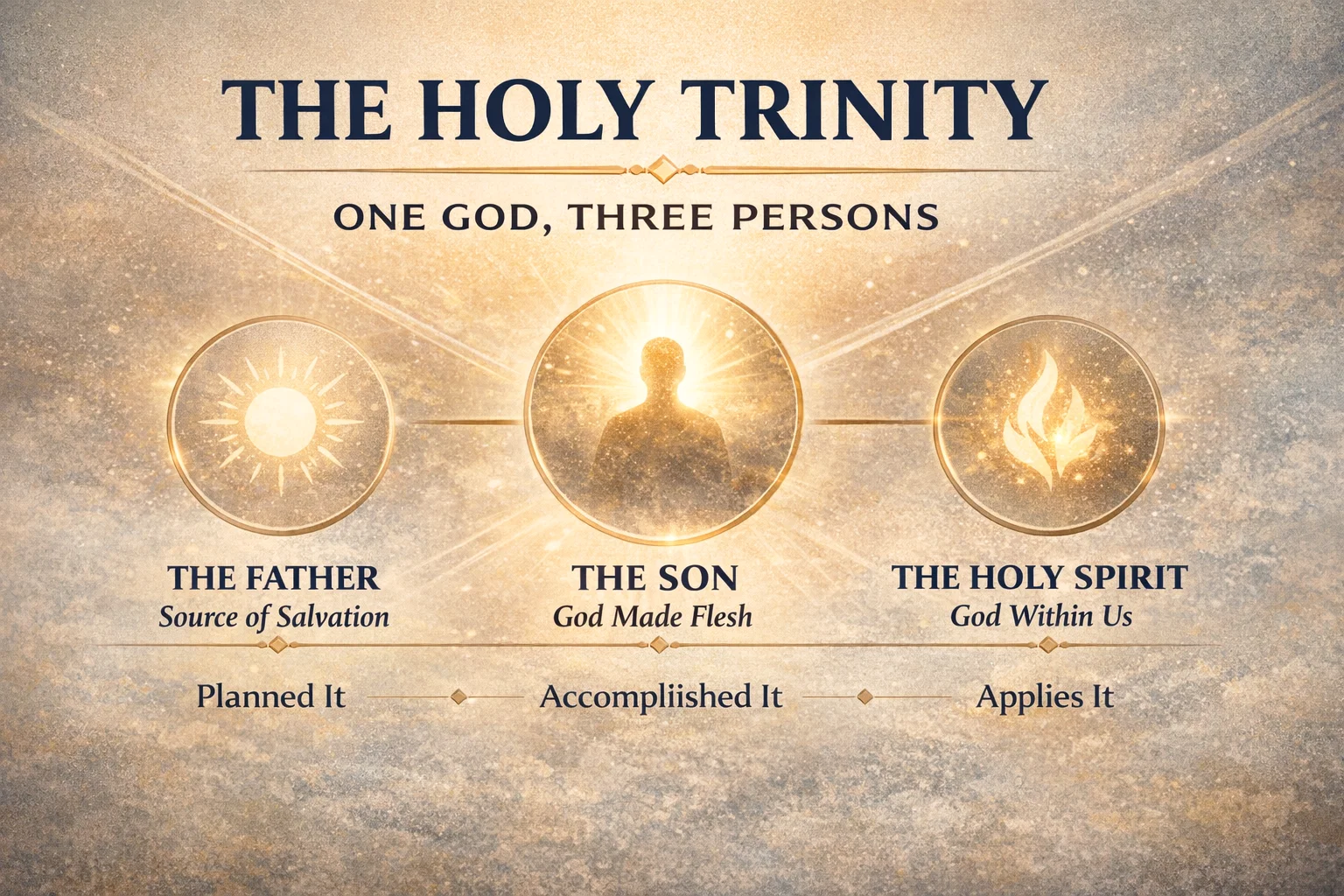
The Holy Trinity Explained One God in Three Persons Bible Verses Christian Infographic
Understanding the nature of the Holy Trinity is one of the most profound journeys a believer can undertake. It is a concept that sits at the very heart of the Christian faith, defining who God is and how He relates to His creation. While the term Trinity does not appear directly in the Bible, the evidence of one God existing in three distinct persons Father, Son, and Holy Spirit is woven throughout the entire fabric of Scripture. This beautiful mystery shows us a God who is not distant or singular in isolation, but a God who is relational, loving, and deeply involved in the redemption of humanity. By exploring the unique roles of each person within the Godhead, we can begin to appreciate the perfect harmony of the divine plan for our lives.
The Foundations of One God in Three Persons
The doctrine of the Trinity is often described as one God in three eternal, co-equal persons. To understand this, we must first look at the bedrock of monotheism found in the Old Testament. Deuteronomy 6:4 famously declares, Hear, O Israel: The Lord our God is one Lord. This foundational truth ensures that Christians worship only one God. However, as we move through the New Testament, we see this one God revealed through the Father, the Son, and the Holy Spirit. They are not three separate gods, nor are they merely three different names for the same person. They are distinct in their relations but one in their essence and nature.
The Father: The Divine Architect and Source
In the divine economy of salvation, God the Father is often recognized as the source and the planner. Before the foundations of the world were even laid, the Father had already envisioned a way to reconcile humanity to Himself. 1 Corinthians 8:6 tells us that there is but one God, the Father, from whom all things came and for whom we live. His role is characterized by sovereignty, providence, and a deep, paternal love that initiated the entire process of grace.
The Father’s work is evident in the way He chose us in Christ before the creation of the world, as mentioned in Ephesians 1:4. He is the one who sends the Son and the Spirit, directing the course of history toward a final restoration. When we pray to our Father in heaven, we are acknowledging the ultimate authority and the loving provider who sustains every breath we take.
The Son: God Made Flesh and Our Redeemer
Jesus Christ, the Son, is the visible image of the invisible God. He is God made flesh, the Word who dwelt among us to show us the Father’s heart. The role of the Son is centered on accomplishment and mediation. While the Father planned our salvation, it was the Son who stepped into time and space to achieve it. Through His birth, life, death on the cross, and subsequent resurrection, Jesus paid the price for sin that we could never pay ourselves.
John 1:14 beautifully captures this reality by stating that the Word became flesh and made his dwelling among us. This incarnation was necessary because only someone who was fully God and fully man could bridge the gap between a holy Creator and a fallen creation. When Jesus cried out on the cross, It is finished, He was declaring that the work of redemption was complete. He is our Savior, our One Head, and the only way to the Father.
The Holy Spirit: The Comforter and Indwelling Presence
After Jesus ascended to heaven, He did not leave His followers alone. He sent the Holy Spirit to be our Comforter, Advocate, and Guide. The Holy Spirit is the person of the Trinity who applies the work of Christ to our individual lives. He dwells within every believer, acting as a seal of our inheritance and a constant source of spiritual power. According to 1 Corinthians 6:19, our bodies are temples of the Holy Spirit, which means God Himself lives within us.
The Spirit’s work is transformative. He convicts us of sin, leads us into all truth, and produces spiritual fruit in our character. He is the one who gives us the assurance that we are children of God, crying out Abba, Father from within our hearts. Without the Spirit, the truths of the Bible would remain just words on a page, but through His illumination, they become living bread for our souls.
How the Trinity Works Together for Salvation
The beauty of the Trinity is most clearly seen in the process of salvation. It is a collaborative effort where each person of the Godhead plays a vital and necessary part. If we remove one, the entire structure of the Gospel changes. This divine teamwork ensures that our salvation is secure, purposeful, and entirely an act of God’s grace from start to finish.
- The Father Planned It: Salvation is not an afterthought. It was designed by the Father as an expression of His eternal purpose and will.
- The Son Accomplished It: Through His perfect obedience and sacrificial death, Jesus fulfilled every requirement of the law and defeated the power of death.
- The Spirit Applies It: The Holy Spirit brings us to faith, regenerates our hearts, and empowers us to live a life that honors God.
This structure shows us that we are surrounded by the love of the Trinity. We were planned by the Father, bought by the Son, and are currently being kept by the Holy Spirit. This provides a deep sense of security for the believer, knowing that the entire Godhead is committed to our spiritual well-being and final glorification.
The Practical Impact of the Trinity on Daily Worship
Understanding the Trinity is not just for theologians or scholars. It has practical, everyday implications for how we live and worship. When we recognize God as a Trinity, our prayer life becomes more vibrant. We come to the Father, through the Son, by the power of the Holy Spirit. This dynamic relationship allows us to experience God in various ways throughout our day.
Worshipping in Spirit and Truth
Jesus told the woman at the well that true worshippers must worship in spirit and truth. This is a call to engage both our minds and our hearts with the reality of who God is. We worship in truth by holding onto the biblical revelation of the Trinity, and we worship in spirit by allowing the Holy Spirit to stir our affections for the Father and the Son. This balance prevents our faith from becoming either cold intellectualism or baseless emotionalism.
Living by Grace and Not by Works
The Trinity reminds us that salvation is entirely a work of grace. Because the Father planned it and the Son finished it, there is nothing we can add to our justification. We are invited to walk by grace, trusting in the finished work of Christ rather than our own efforts. This realization brings incredible freedom. We no longer serve God to earn His love, but we serve Him because we are already loved by the Father, saved by the Son, and empowered by the Spirit.
Common Analogies and Their Limitations
Throughout history, people have used many analogies to explain the Trinity, such as water existing as ice, liquid, and steam, or the sun providing light and heat. While these can be helpful for children, every analogy eventually falls short because God is unique and unlike anything in the created order. Most analogies accidentally lean into ancient heresies, such as Modalism where God just changes masks or Partialism where God is split into three parts.
Instead of relying solely on analogies, it is better to lean into the mystery. We can accept that God’s thoughts are higher than our thoughts. The fact that we cannot fully wrap our finite minds around an infinite God is actually a reason for worship. If we could fully explain God, He wouldn’t be big enough to be our Creator.
The Trinity as the Ultimate Model for Relationship
Because God is a Trinity, He has been in a relationship for all eternity. Before humans were created, the Father, Son, and Spirit shared a perfect bond of love, honor, and communication. This means that at the very core of the universe, there is relationship. This is why we, as beings made in the image of God, crave connection and community. We were designed to reflect the relational nature of our Creator.
When we participate in a local church or build deep, selfless friendships, we are mirroring the unity of the Trinity. God’s desire is for His people to be one, just as He is one. This unity is not about everyone being identical, but about different persons working together in harmony for a common purpose, much like the distinct roles within the Godhead.
Conclusion: Trusting in the Triune God
The doctrine of the Holy Trinity is more than a complex puzzle. It is a revelation of a God who loves us enough to plan our rescue, join us in our suffering, and live within our hearts. As you reflect on the Father’s sovereignty, the Son’s sacrifice, and the Spirit’s presence, let it lead you into a deeper state of awe and gratitude. Our God is one Lord, and He is also our Father, our Savior, and our Comforter. Trust in Christ, walk by grace, and rest in the knowledge that the Triune God is with you every step of the way. By keeping these truths close to your heart, you will find a firm foundation for your faith that can withstand any storm life may bring.