The Winter Feeding Mistake That Kills Livestock Why Dusk Feeding Saves Your Herd in Winter
When the temperature drops and the frost begins to cling to the fence lines, every livestock owner knows the feeling of worry that sets in. You see your cattle and goats huddled together, their breath hanging in the frozen air, and your first instinct is to toss more hay over the fence. However, what if the secret to their survival during those brutal sub zero nights isn’t the volume of feed, but the specific hour the clock strikes when they eat it? Most farmers and homesteaders have been taught that a full belly in the morning is the key to a productive day, but during the winter, that traditional schedule might actually be putting your animals at risk. Understanding the biological internal furnace of your livestock is the most powerful tool you have to ensure they make it through the season healthy and strong.
The Science of the Internal Furnace
To understand why timing matters, we have to look at how ruminants like cows and goats actually produce heat. Unlike humans, who rely heavily on external layers and shivering, ruminants are equipped with a massive fermentation vat known as the rumen. When an animal consumes dry forage like hay, the microbes in the rumen go to work breaking down that cellulose. This metabolic process is highly exothermic, meaning it generates a significant amount of heat as a byproduct of digestion.
This heat production is what farmers often refer to as the internal furnace. It is a natural heating system that keeps the animal warm from the inside out. However, like any fire, this furnace has a peak and a burnout period. The heat generated from a meal typically peaks several hours after consumption. If you feed your animals primarily in the morning, that peak heat production occurs during the middle of the day when the sun is out and the ambient temperature is at its highest. By the time the sun goes down and the true freezing temperatures arrive, the fermentation process has slowed down, leaving the animal with a dropping core temperature during the most dangerous hours of the night.
The Morning Feeding Mistake
It is a common sight on many farms to see the tractor heading out at 7:00 AM to roll out hay. While this keeps the animals occupied during the day, it creates a metabolic gap. When livestock eat the bulk of their calories in the morning, their body temperature spikes around midday. In many cases, this can actually lead to the animal wasting energy as they try to dissipate that extra heat during the warmth of the afternoon. The real tragedy happens at 2:00 AM. At this hour, the morning meal has already passed through the most active stages of fermentation. The internal furnace is flickering out just as the thermometer hits its lowest point.
Without that active fermentation heat, the animal is forced to rely on its own fat reserves and muscle shivering to maintain a safe core temperature. This leads to rapid weight loss, a weakened immune system, and in extreme cases, livestock loss. By shifting our perspective on when the animal needs that heat most, we can change the entire health trajectory of the herd.
Why Digestion is Your Best Winter Tool
The beauty of using digestion as a heat source is that it is incredibly efficient. When an animal is fermenting hay, it is performing a dual task: it is absorbing nutrients for maintenance and growth while simultaneously keeping itself warm. When we rely on the animal’s fat stores for warmth, we are asking the body to break down its own tissue, which is a stressful and inefficient process. By providing the fuel at the right time, we allow the animal to stay in a state of maintenance or even gain, rather than a state of survival.
The Cold Night Protocol: Shifting to Dusk Feeding
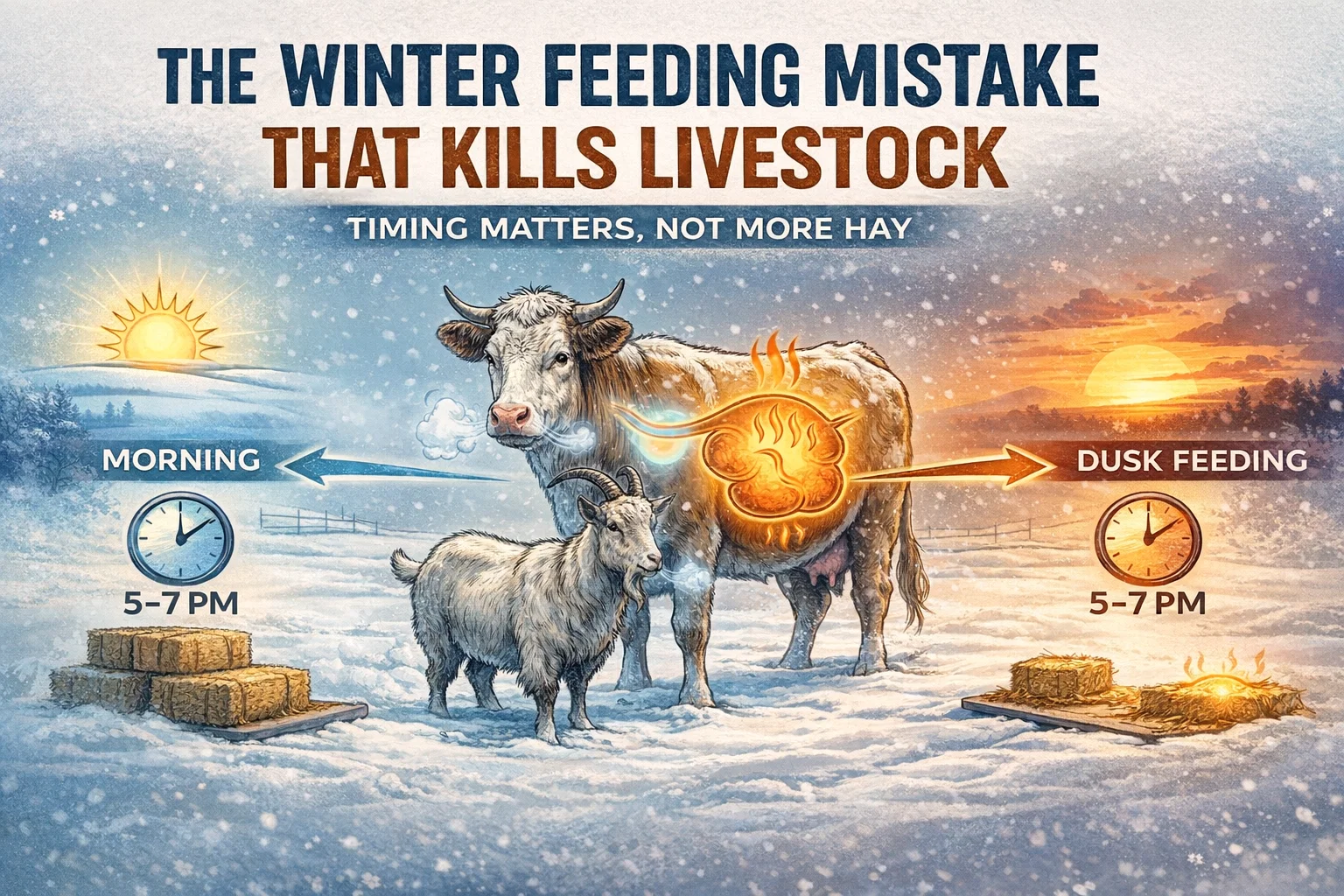
The fix for winter livestock stress is remarkably simple and costs absolutely nothing in extra supplies. It is called the Cold Night Protocol. The strategy involves shifting 60 to 70 percent of the daily feed ration to the evening hours, specifically between 5:00 PM and 7:00 PM. By doing this, you are intentionally timing the peak of the fermentation process to coincide with the coldest part of the night.
When you feed at dusk, the rumen begins the heavy lifting of digestion just as the sun disappears. By 10:00 PM or 11:00 PM, when the mercury is plummeting, the animal’s internal furnace is roaring at maximum capacity. This heat keeps the core temperature stable throughout the night, meaning the animal wakes up in the morning with more energy and less physical stress.
Implementing the 70 Percent Rule
- Morning Snack: Provide about 30 percent of the daily hay in the morning. This keeps them occupied and provides enough energy for daytime activity.
- Evening Feast: Provide the remaining 70 percent of the hay at dusk. Ensure there is enough bunk space or hay ring space for every animal to eat comfortably at once.
- Water Access: Remember that digestion requires water. Ensure your troughs are de iced so that the fermentation process can proceed smoothly.
Benefits Beyond Survival
While the primary goal of dusk feeding is to prevent livestock loss, the benefits extend much further into the overall management of your farm. When animals aren’t stressed by the cold, their overall health remains much higher. You will notice that cows kept on a dusk feeding schedule maintain better body condition scores throughout the winter. They aren’t burning through their back fat just to stay alive, which means they will be in better shape for spring calving and lactation.
Furthermore, goats, which are notoriously sensitive to cold and damp conditions, thrive under this protocol. Because they have a smaller body mass than cattle, they lose heat more quickly. Providing them with a large portion of their forage at night allows them to stay warm even in drafty barns or during unexpected cold snaps. It is a proactive approach to animal husbandry that respects the natural biology of the ruminant.
Saving Money on Feed Costs
It sounds counterintuitive, but better timing can actually lead to lower feed costs. When an animal is warm from fermentation, its caloric requirement for maintenance stays stable. If an animal gets too cold, its nutritional requirements can skyrocket by 20 to 30 percent just to maintain its weight. By keeping them warm from the inside, you are making every flake of hay work harder for you. You aren’t just throwing hay at a problem; you are using it strategically as a biological fuel.
Common Myths About Winter Feeding
There are several misconceptions that often lead farmers astray during the winter months. One of the most common is the idea that grain is the best way to keep an animal warm. While grain provides high energy, it is processed much faster than long stem forage. Forage and hay are the true “slow burn” fuels that provide sustained heat over many hours. Grain can provide a quick spike, but for a long, cold night, hay is the undisputed king of the rumen.
Another myth is that animals need to be locked in a tight, unventilated barn to stay warm. In reality, moisture is the enemy of winter health. A well fed ruminant with a thick winter coat and an active internal furnace can handle very cold temperatures as long as they are dry and out of the wind. The heat they produce from dusk feeding is more effective than a heater in a poorly ventilated shed.
Actionable Tips for the Modern Homesteader
Transitioning to a new feeding schedule can take a few days for both you and your animals to adjust to. Here are a few ways to make the shift as smooth as possible:
Monitor the Weather Forecast
Not every night requires a 70 percent shift. On milder winter nights, you can stick to a more balanced schedule. However, when a polar vortex or a significant cold front is predicted, that is the time to be strict with the dusk feeding protocol. Check the hourly temperature predictions to see exactly when the “danger zone” begins.
Check Your Forage Quality
The lower the quality of the hay, the harder the rumen has to work to break it down. While this actually generates more heat because of the increased fermentation time, you must ensure the animal is still getting enough actual nutrition. Combining a bit of high quality alfalfa with your standard grass hay in the evening can provide the perfect balance of heat and nutrition.
Observation is Key
Spend a few minutes in the evening watching your herd after they eat. Are they spread out and relaxed, or are they still shivering and bunched together? An animal that is warm from the inside will often stand quietly or lie down to chew its cud shortly after a meal. This is the sign of a happy, warm, and functioning internal furnace.
The Difference Timing Makes
In the world of agriculture, we often look for complex solutions to difficult problems. We buy expensive equipment, invest in supplements, and build elaborate structures. Yet, sometimes the most profound changes come from simply understanding the rhythm of nature. The image of a cow and a goat standing in the snow, glowing with internal warmth, isn’t just a nice thought; it is a biological reality that we can facilitate.
By shifting your feeding time, you are working with the animal rather than against the environment. You are acknowledging that the night is the greatest challenge they face and providing them with the exact tools they need to meet that challenge. It turns the chore of winter feeding into a strategic act of care that ensures your livestock don’t just survive the winter, but actually thrive through it.
Conclusion: A Simple Shift for a Healthy Herd
Winter farming brings a unique set of challenges that can test the resolve of even the most experienced livestock owners. It is a season of constant vigilance and hard work. However, by implementing a dusk feeding schedule, you can take a significant amount of pressure off both yourself and your animals. You will find peace of mind knowing that while you are tucked away in your warm home, your cows and goats have their own internal furnaces roaring, keeping them safe from the bite of the midnight frost.
This winter, don’t just give them more hay. Give them better timing. Observe your herd, watch the thermometer, and embrace the power of the evening meal. Your livestock will thank you with better health, higher vitality, and a successful transition into the spring. It is a small change with a massive impact, proving once again that in farming, knowledge and timing are just as important as the feed in the barn. Stay warm, keep your animals fed, and enjoy the beauty of a well managed winter homestead.