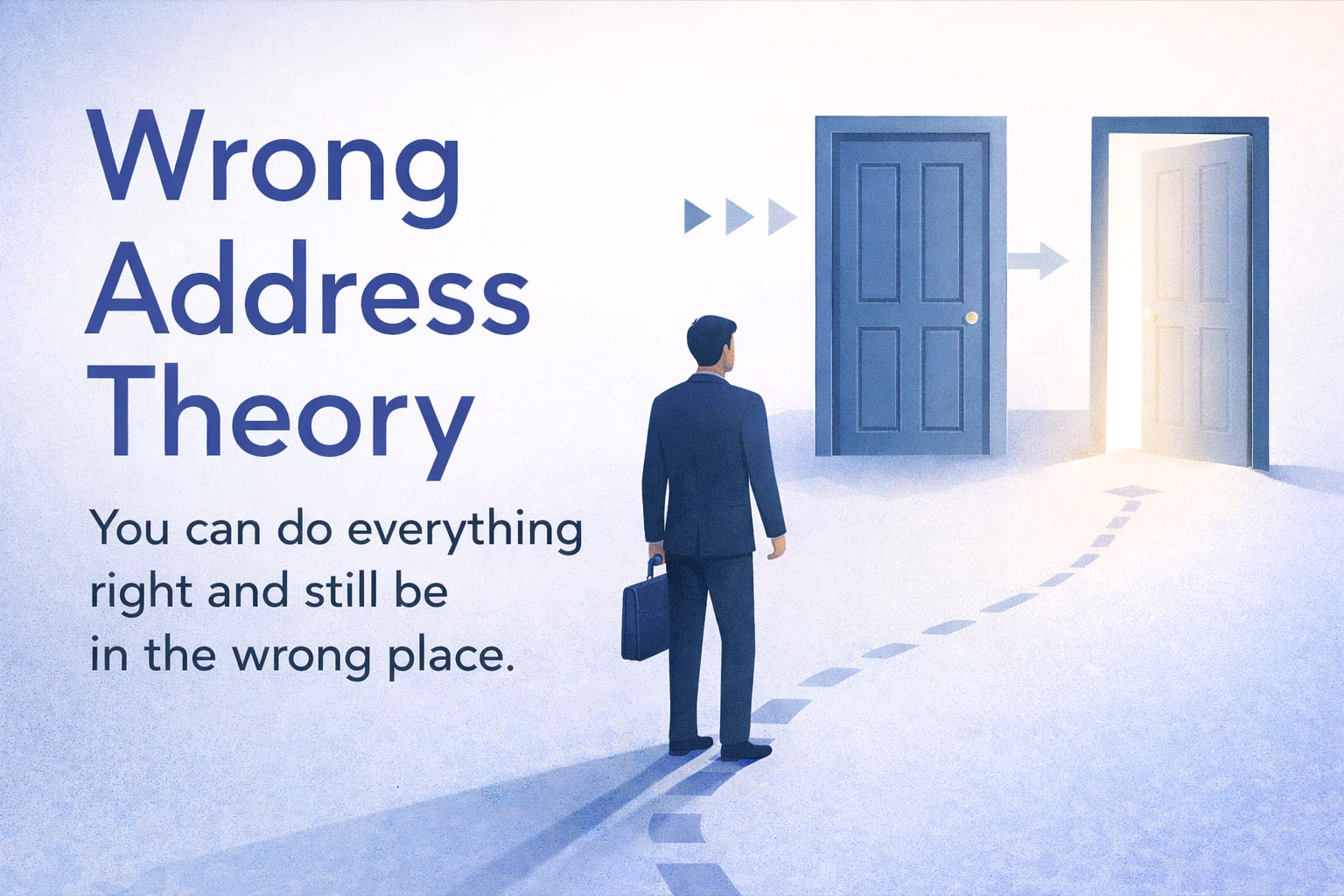
The Wrong Address Theory Why You Can Do Everything Right and Still Be in the Wrong Place
Have you ever felt like you were doing everything right but still getting the wrong results? You show up on time, you are patient, you give your best effort, and you constantly adjust your behavior to fit the needs of others. Yet, despite your best intentions and hard work, the door remains firmly shut. This is the essence of the Wrong Address Theory. It is a profound realization that sometimes the lack of progress in your life isn’t a reflection of your effort or your character, but rather a sign that you are simply in the wrong place. Understanding this concept can be the key to unlocking a future that actually resonates with who you are at your core.
What is the Wrong Address Theory?
The Wrong Address Theory suggests that you can be the most perfect version of yourself and still fail if you are trying to thrive in an environment that was never designed to receive you. Think of it like a key. You might be a masterfully crafted gold key, but if you are trying to turn the lock on a door that doesn’t belong to you, no amount of polishing or turning will make it open. The problem isn’t the key; the problem is the door.
In our personal and professional lives, we often internalize rejection as a personal failure. We assume that if a relationship fails or a job doesn’t work out, we must have knocked incorrectly. We tell ourselves that if we were just a little bit smarter, thinner, faster, or more accommodating, the outcome would be different. The Wrong Address Theory shifts this perspective. it teaches us that some situations and people are simply not built for us. When you stop blaming yourself for the closed doors, you gain the clarity needed to find the entrance that is already waiting for your arrival.
The Trap of Over-Adjusting Your Soul
One of the most exhausting parts of being at the wrong address is the constant need to shrink or change. When we feel out of place, our natural instinct is to adapt. We change the way we speak, we modify what we ask for, and we limit how much space we take up in a room. We do this in hopes that by becoming more palatable, we will finally be accepted. However, this is a dangerous game because it leads to a loss of self.
When you are in a space that was never designed for your soul, your adjustments are never enough. You might find yourself constantly walking on eggshells or feeling like a “too much” person in a “not enough” environment. The reality is that you are trying to find shelter in a house that can never be a home. Peace does not come from knocking harder or changing your shape to fit a mold. It comes from the quiet realization that you are free to walk away and find a place where your natural self is exactly what is required.
Signs You Are at the Wrong Address
- Constant Fatigue: You feel emotionally and physically drained because you are always performing a version of yourself that doesn’t feel authentic.
- Feeling Invisible: Despite your contributions and efforts, you feel like you aren’t truly seen or appreciated by those around you.
- The Need to Justify Your Presence: You feel like you constantly have to prove why you deserve to be in the room or the relationship.
- A Lack of Growth: Even when you do everything right, you feel stagnant because the environment doesn’t have the “nutrients” necessary for your specific type of growth.
The Power of Detachment and Walking Away
Real detachment is a misunderstood concept. Many people think it means being cold or uncaring, but it is actually an act of self-preservation and deep wisdom. Detachment is the moment you stop trying to convince a house to become a home. It is the realization that your energy is better spent moving toward a new destination than trying to renovate a space that isn’t yours to begin with.
Walking away is often seen as giving up, but in the context of the Wrong Address Theory, it is an act of courage. It requires you to trust that there is a place meant for you, even if you can’t see it yet. When you stop knocking on the wrong doors, your hands become free to open the right ones. This transition period can be scary and lonely, but it is the necessary bridge between the life you are settling for and the life you were meant to lead.
How to Practice Healthy Detachment
- Acknowledge the Truth: Be honest with yourself about whether a situation is actually serving you or if you are just staying because of the time you have already invested.
- Stop Seeking Validation: Recognize that you don’t need the “wrong door” to open to feel worthy. Your value is inherent, not granted by someone else’s acceptance.
- Focus on Your Destination: Shift your gaze from the closed door behind you to the horizon in front of you. What kind of environment would actually allow you to flourish?
Finding Your Right Address
So, how do you find the place where you truly belong? It starts with radical authenticity. When you stop pretending to be someone else to fit in, you naturally start to attract the people and opportunities that are meant for your true self. The “right address” isn’t a place where life is perfect, but it is a place where you are received with ease. In the right place, your “too much” is seen as “just right,” and your natural talents are recognized as essential assets.
Think about the areas of your life where things feel effortless. Maybe it is a specific hobby, a group of friends who truly get you, or a career path that feels like a natural extension of your personality. These are clues. They are the landmarks leading you toward your true home. The more you lean into these spaces, the more you realize that the struggle you experienced at the wrong addresses was never your fault.
The Benefits of Finding Where You Belong
When you finally arrive at the right address, everything changes. You no longer have to spend 90 percent of your energy trying to be understood. Instead, you can use that energy to create, to connect, and to thrive. There is a sense of “coming home” that settles in your spirit. You realize that you weren’t “broken” or “difficult” all those years; you were just a saltwater fish trying to survive in a freshwater pond. Once you find the ocean, swimming becomes second nature.
Stop Convincing and Start Living
The hardest part of the Wrong Address Theory is the period of “trying to convince.” We spend years trying to convince a partner to love us better, a boss to value our work, or a social circle to include us. We think that if we just find the right words or the right gesture, we can change the architecture of the situation. But you cannot convince a space to be what it isn’t.
When you stop the cycle of convincing, you reclaim your power. You stop being a solicitor at your own life and start being the architect. You realize that you don’t need permission to leave a space that makes you feel small. By choosing to walk away, you are making a profound statement to the universe that you know you deserve more. You are clearing the path for the place that is already waiting for you to arrive.
A Final Note on Redirection
If you are currently standing in front of a closed door, feeling rejected and confused, take a deep breath. Consider the possibility that this rejection is actually a form of protection. The door isn’t closed because you did something wrong; it is closed because there is nothing behind it that will nourish you. The Wrong Address Theory is your permission slip to stop trying so hard in the wrong places.
Your energy is a limited and precious resource. Don’t waste it on people and situations that aren’t built to receive you. Instead, take that energy and use it to walk toward the place that resonates with your soul. The journey might be long, and the path might be winding, but the relief you will feel when you finally reach the right address will make every step worth it. You are not a failure for being in the wrong place. You are simply a traveler who hasn’t reached home yet. Keep moving, stay true to yourself, and trust that the place where you truly belong is looking for you just as much as you are looking for it.