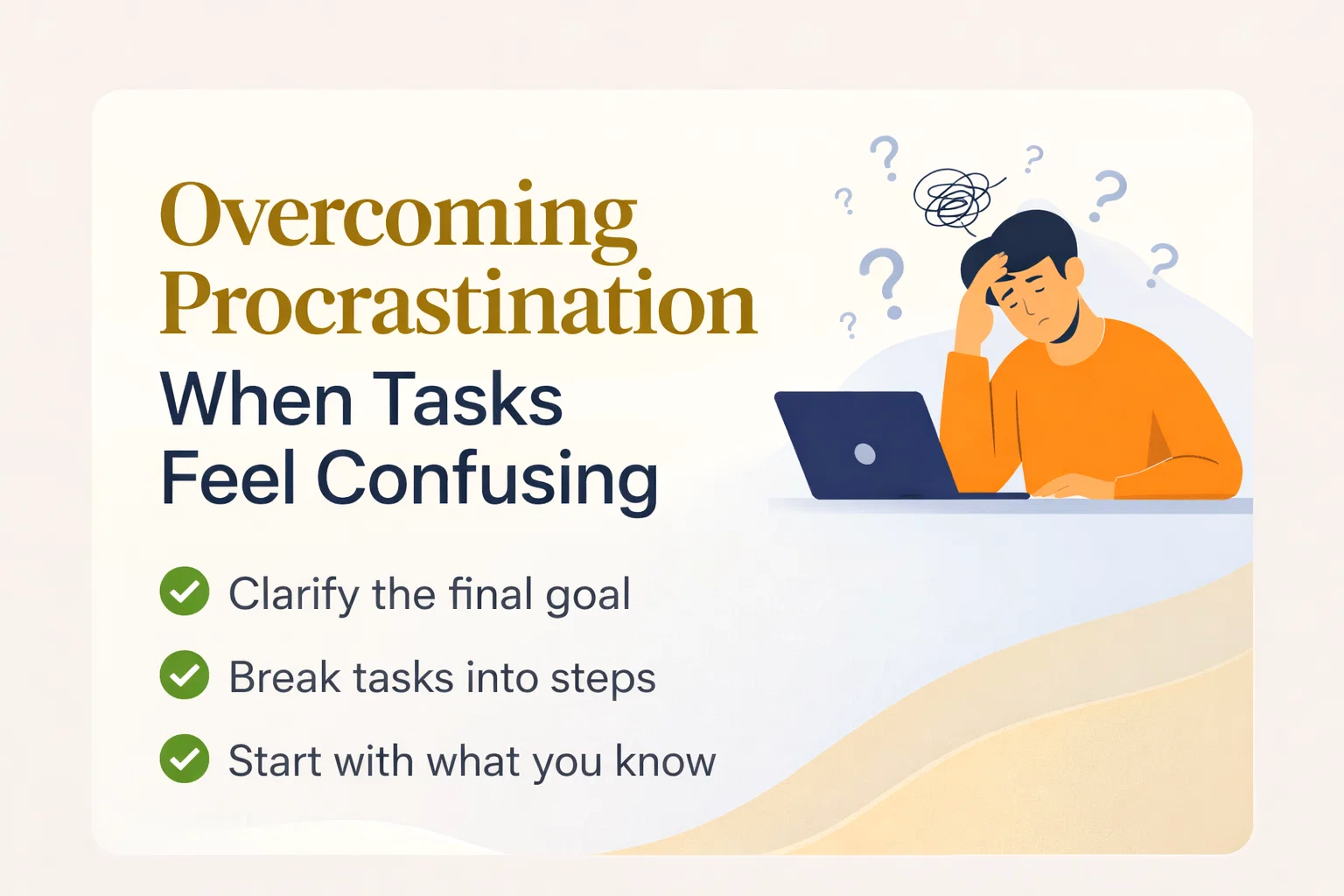
Ways to Overcome Procrastination When Tasks Feel Confusing
We have all been there. You open your laptop, stare at a project brief or a blank document, and suddenly feel a wave of fog settle over your brain. It is not that you are lazy, and it is certainly not that you lack the talent to get the job done. Instead, the task itself feels like a tangled knot of vague instructions and missing pieces. When a project feels confusing, our natural biological response is to protect ourselves from the discomfort of failure by simply walking away. This is where “productive procrastination” often kicks in, leading us to clean the kitchen or organize our inbox rather than facing the giant, blurry monster on our to-do list.
The Psychology of Why Confusion Leads to Procrastination
Most people view procrastination as a time management problem, but it is actually an emotion regulation problem. When a task is well-defined, your brain can easily map out the neural pathways required to execute it. However, when a task is “cloudy,” your amygdala—the part of the brain responsible for the fight-or-flight response—perceives that uncertainty as a threat. You are essentially afraid of the unknown elements of the project. To overcome this, you need to stop focusing on the massive end goal and start focusing on the process of creating clarity.
The image provided offers a brilliant roadmap for navigating these murky waters. It emphasizes that clarity is not something you wait for; it is something you build through action. By shifting your mindset from “I need to understand everything before I start” to “I will understand this as I go,” you dismantle the mental barriers that keep you stuck in place.
Step 1: Define the North Star and the Immediate Path
Clarify the Final Goal
Before you dive into the “how,” you must be crystal clear on the “what.” What does a successful finished product look like? If you are writing a report, is the goal to persuade an executive or to summarize data? Without a defined finish line, every step you take feels like you are wandering in a forest without a compass. Spend five minutes writing down the specific outcome you want to achieve.
Write Down Exactly What Needs Completion
Ambiguity is the best friend of procrastination. When you tell yourself, “I need to work on the marketing project,” your brain has no idea where to start. Instead, write down a concrete list of deliverables. For example, “Create three social media captions and find two header images.” Seeing the requirements in black and white makes them feel manageable and finite.
Break Unclear Tasks Into Defined Steps
If a task still feels overwhelming, it is likely too big. You need to slice it thinner. This is often called “chunking.” If a step on your list is “Research competitors,” that is still too vague. Break it down further into “List five top competitors” and then “Visit the homepage of competitor A.” Smaller steps lower the “activation energy” required to get started.
Step 2: Managing the Information Gathering Phase
Research Briefly but Avoid Endless Searching
There is a dangerous trap called “learning-based procrastination.” This happens when you spend hours reading articles and watching tutorials under the guise of being productive, but you never actually start the work. Give yourself a strict timer—perhaps 20 or 30 minutes—to gather the essential info. Once the timer dings, you must move into the execution phase, even if you do not feel like an expert yet.
Ask Specific Questions
If you are stuck because of a genuine lack of information, do not just say “I am confused.” Pinpoint exactly where the logic breaks down. Asking a colleague “What are the specific formatting requirements for this deck?” is much more effective than saying “I do not get this project.” Specific questions lead to specific answers, which lead to immediate action.
Step 3: Taking the “Leap of Faith” into the Work
Start With What You Already Understand
You do not have to start at the beginning. In fact, starting at the beginning is often the hardest part. If you are building a website and you know exactly how the “Contact Us” page should look but are lost on the “Home” page, start with the contact page. This builds “momentum,” which is the most powerful tool in your productivity arsenal. Once you are in the flow of working, the more difficult parts of the task will seem less daunting.
Ignore Complex Parts Temporarily
It is okay to use “placeholders.” If a certain section of your project requires a complex formula or a difficult conversation that you are not ready for, simply write “TO DO LATER” in that spot and move on to the next section. This keeps your momentum going and prevents a single roadblock from stopping the entire engine.
Step 4: Creating a Framework for Success
Create a Simple Outline First
An outline is the skeleton of your project. It does not need to be pretty, and it certainly does not need to be final. By sketching out a basic structure, you provide your brain with a visual map of the journey. This reduces the mental load because you no longer have to hold the entire project’s architecture in your head while trying to work on specific details.
Focus Only on the Next Action
Forget the 50 steps that come after this one. What is the very next physical action you need to take? Is it opening a specific folder? Is it sending one email? By narrowing your peripheral vision to only the “next action,” you prevent the “all-at-once” anxiety that leads to shutdown.
Avoid Perfection During Unclear Stages
Perfectionism is just procrastination in a fancy suit. When a task is confusing, your first draft is going to be messy. Accept that now. Allow yourself to produce “garbage” work initially. You can always edit a bad page, but you cannot edit a blank page. Growth and clarity happen during the revision process, not the inception process.
Step 5: Maintaining Emotional Balance
Pause When Confusion Becomes Overwhelming
There is a point of diminishing returns where staring at a screen only leads to increased frustration. If you feel your heart rate rising or your temper shortening, walk away. A five-minute walk or a quick stretch can reset your nervous system. Often, your subconscious mind continues to work on the problem in the background, and the solution will pop into your head when you are not actively forcing it.
Track Completed Sections Visually
Use a checklist or a progress bar. There is a real hit of dopamine that comes from crossing something off a list. For confusing tasks, this visual feedback is vital because it proves that you are making progress even if the final goal still feels far away. It turns the “invisible” work of figuring things out into “visible” markers of success.
The Power of “Building Clarity” Over Time
One of the most profound tips from the image is the idea of “beginning before full clarity appears.” We often operate under the illusion that successful people have a perfect plan before they start. In reality, most successful projects are the result of people stumbling forward, making mistakes, and adjusting their course in real-time. Clarity is a reward for action, not a prerequisite for it.
By using examples to guide your approach and limiting your planning time intentionally, you force yourself into the “doing” mode. Remember that consistent small actions act like a flashlight in a dark room. Each step you take reveals just a little more of the floor in front of you until, eventually, the whole room is illuminated.
Conclusion: Turning Confusion into Confidence
Overcoming procrastination when tasks feel confusing is not about becoming a faster worker or a smarter strategist. It is about being kinder to yourself and more tactical with your energy. By breaking down the barriers of ambiguity, allowing yourself to be a beginner, and focusing on the immediate next step, you can transform that overwhelming fog into a clear path forward.
Next time you find yourself reaching for your phone to scroll through social media instead of starting that confusing project, take a deep breath. Ask yourself: “What is one tiny thing I actually understand about this?” Start there. The rest will follow as you move. You have the tools to navigate the uncertainty; now, you just need to take the first step.
Would you like me to create a customized 5-step action plan for a specific confusing task you are currently facing?