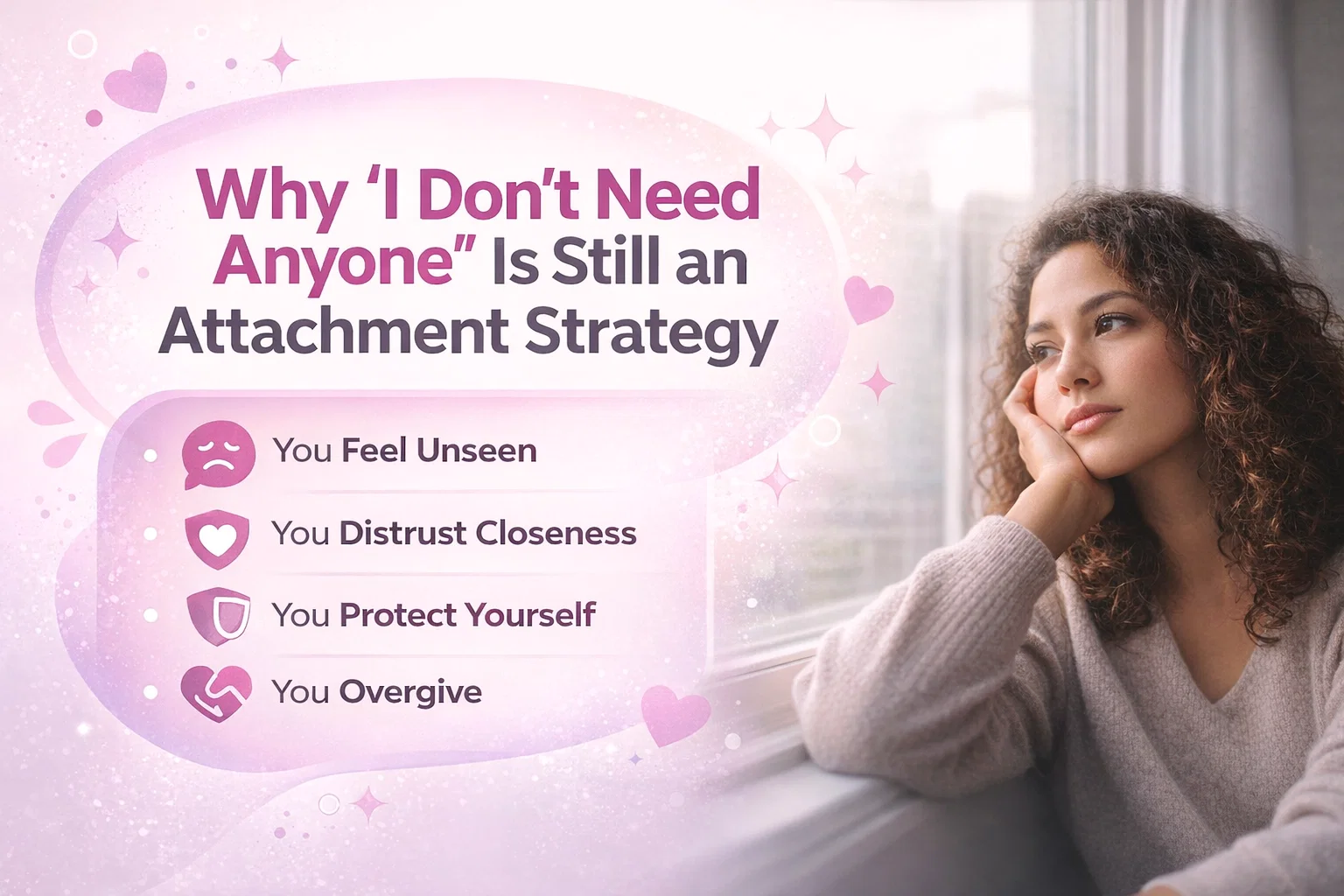
Why I Dont Need Anyone Is Actually an Attachment Strategy Dismissive Avoidant Tips
Have you ever caught yourself saying, “I don’t need anyone,” with a sense of pride, only to feel a heavy, inexplicable weight of loneliness later that night? Many of us wear our independence like a badge of honor. We celebrate being the one who can handle it all, the one who never asks for help, and the one who stays perfectly composed while everyone else seems to be falling apart. But what if that fierce self-reliance isn’t actually a personality trait, but a sophisticated defense mechanism? In the world of psychology, this is often referred to as a hyper-independent attachment strategy. It is a way of moving through the world that prioritizes personal control over emotional connection, often because at some point in our lives, relying on others felt far too risky.
When we dig beneath the surface of the “I’m doing fine” exterior, we often find a nervous system that is stuck in a state of high alert. This strategy keeps you safe from disappointment, but it also keeps you stuck in a cycle of shallow relationships and internal burnout. By understanding why we lean into these patterns, we can begin to dismantle the walls that keep us isolated and start building the authentic, supportive connections our systems truly crave. Let’s explore the mechanics of this attachment strategy and how to move toward a more open, fulfilling way of living.
The Paradox of the Emotional Laborer
One of the most frustrating ironies of the “I don’t need anyone” mindset is that it often attracts relationships where you end up doing all the heavy lifting. Because you present yourself as someone who is unshakable and entirely self-sufficient, you naturally become a magnet for people who are looking for a caretaker or someone to manage their emotional chaos. You become the “strong one,” the person who fixes problems and provides stability, yet your own needs remain entirely invisible.
This dynamic creates a cycle of overgiving. You might find yourself constantly checking in on others, anticipating their needs before they even speak them, and managing the logistics of the relationship with military precision. Subconsciously, you are overgiving to feel secure. If you are indispensable, you feel safe. However, this eventually leads to a deep sense of resentment. You start to feel bitter that others aren’t meeting your needs, even though you have never actually voiced what those needs are. You expect people to read your mind the same way you read theirs, and when they fail, it only reinforces your belief that you are better off alone.
Breaking the Cycle of Overgiving
To break this habit, you have to realize that your value isn’t tied to how much you can do for others. Healthy relationships are built on reciprocity, not a one-way street of service. Start by practicing “strategic pauses.” Before jumping in to solve someone else’s problem or taking on an extra task, ask yourself if you are doing it out of genuine desire or out of a need to feel secure in that person’s life. Learning to step back allows space for others to step up, which is essential for a balanced connection.
Why Connection Stays Shallow When Needs are Hidden
If you hide your needs, people simply cannot meet you there. It sounds simple, but for someone using a hyper-independent attachment strategy, this is a revolutionary concept. There is a common misconception that if someone truly loves us, they should “just know” what we need. In reality, hiding your needs is a form of emotional gatekeeping. It prevents people from seeing the real you, which means the connection can never move past a surface level.
You might feel unseen or misunderstood, but you have to ask yourself: how much of myself am I actually showing? When we keep our struggles, our desires, and our vulnerabilities tucked away, we are essentially giving people a curated version of ourselves. While this version is safe and protected, it is also incapable of experiencing deep intimacy. Intimacy requires the “risk” of being seen in your messy, unfinished state. Without that risk, you are left with a series of shallow interactions that leave you feeling just as lonely as if you were actually alone.
The Art of Expressing Needs
Expressing needs doesn’t have to be a dramatic revelation. It can start with small, everyday things. It might mean saying, “I’m actually having a really tough day and could use a distraction,” or “It would mean a lot to me if you could handle dinner tonight.” By giving people the roadmap to your heart, you are inviting them to be a part of your life rather than just an observer of it. This is how a shallow connection transforms into a meaningful bond.
The Fear of Vulnerability Without a Guarantee
For many, closeness feels like a trap. It feels like vulnerability without a guarantee of safety. If you grew up in an environment where your needs were ignored, mocked, or met with inconsistency, your brain learned a very specific lesson: relying on others leads to disappointment. As an adult, this translates into a system that expects letdowns. When someone gets too close, your internal alarm system goes off. Instead of feeling warmth and connection, you feel a sense of impending dread.
This is why intimacy often triggers protection instead of openness. Just as things start to get “real” in a relationship, you might find yourself picking a fight, withdrawing emotionally, or suddenly becoming incredibly busy with work. These are all tactics to re-establish distance. Your nervous system is trying to protect you from the pain of a potential rejection by rejecting the connection first. You stay in control of the narrative, but the cost of that control is isolation.
Rewiring Your System for Intimacy
Healing this part of yourself requires a slow and gentle approach. It involves teaching your nervous system that vulnerability is not an automatic death sentence for your dignity. You can practice “micro-vulnerability” with people you trust. Share a small fear or a minor insecurity and notice what happens. Usually, the world doesn’t end. In fact, most people respond with empathy and their own shared experiences. These small wins help convince your system that it is safe to lower the shield, even if just for a moment.
Control vs. Connection: The Nervous System’s Craving
Control is a powerful sedative. It provides a sense of predictability in an unpredictable world. When you are the one in control, you don’t have to worry about being blindsided by someone else’s choices or emotions. But control is also a barrier. It blocks the very support that your nervous system actually craves. Humans are biologicaly wired for co-regulation. We are meant to lean on each other to soothe our stress and celebrate our joys.
When you maintain a rigid “I don’t need anyone” stance, you are essentially starving your nervous system of its natural medicine. You might be “doing fine” on paper, but internally, you are likely running on fumes. The effort it takes to maintain that wall of independence is exhausting. True strength isn’t about never needing anyone; it is about having the courage to admit when you do. It is about recognizing that we are stronger together than we could ever be in our isolated silos of self-sufficiency.
Moving From Protection to Openness
Stepping out of an attachment strategy that has served you for years is not something that happens overnight. It is a journey of unlearning and relearning. It starts with self-awareness. When you feel that familiar urge to pull away or to insist that you can handle everything alone, stop and breathe. Recognize that this is your protection mechanism talking, not your true self.
Openness requires a level of radical honesty with yourself. It means admitting that you are tired of being the strong one all the time. It means acknowledging that you want to be taken care of just as much as you take care of others. Once you accept these truths, you can begin to share them with the people in your life. You might be surprised at how many people have been waiting for the chance to support you, but were simply waiting for your permission to do so.
Practical Steps for Daily Growth
- Practice Asking: Ask for one small thing every day. It could be a favor at work or a snack from the store. Get used to the feeling of receiving.
- Internal Check-ins: When you feel overwhelmed, ask yourself, “Am I trying to control this situation to avoid feeling vulnerable?”
- Body Awareness: Notice where you hold tension when someone offers help. Try to consciously soften those muscles and breathe through the discomfort.
- Limit the “Fine”: When someone asks how you are, try to give a more nuanced answer than “I’m fine.” It opens the door for real conversation.
Embracing the Strength in Interdependence
The goal isn’t to flip from hyper-independence to total dependence. The goal is interdependence. This is a healthy middle ground where you are capable of standing on your own two feet, but you also understand the value of leaning on others. It is the realization that while you don’t need someone to survive, having someone makes the journey of life infinitely more beautiful and manageable.
Interdependence allows for a dynamic where both parties can be strong and vulnerable at different times. it creates a safety net that catches you when you fall and a cheering section that celebrates when you fly. When you let go of the “I don’t need anyone” strategy, you aren’t losing your power; you are finally gaining the freedom to be fully human. You are choosing a life of depth over a life of mere survival.
The Power of Choice
Ultimately, the most empowering thing you can do is realize that you have a choice. You can choose to stay behind your wall of control, or you can choose to step out into the sunlight of authentic connection. The wall offers safety, but the sunlight offers growth. By choosing openness, you are giving yourself the gift of a regulated nervous system, deeper relationships, and a life that feels truly seen and supported.
A Path Forward to Authentic Connection
Understanding that hyper-independence is an attachment strategy is the first step toward a more connected and peaceful life. It is not a flaw in your character, but a tool you built to survive. Now that you are safe, you can choose better tools. You can choose to trade your isolation for intimacy and your control for companionship. It will feel uncomfortable at first, and that is perfectly okay. Growth usually does.
As you move forward, remember to be patient with yourself. You are retraining years of instinctive behavior. Celebrate the small moments where you choose to share a need or accept a gesture of kindness. These are the bricks that will build your new foundation of interdependence. You deserve to be supported. You deserve to be seen. And most importantly, you deserve to know that you don’t have to do it all alone. The world is full of people ready to meet you exactly where you are, if only you’ll let them in.
If this resonates with you, take a moment today to reach out to one person. It doesn’t have to be a big gesture. Just a small bridge built over the gap of your independence. You might be amazed at how much lighter you feel when you aren’t carrying the whole world on your shoulders. Here is to a future of deeper connections, shared burdens, and the beautiful realization that needing people is one of the most courageous things we can ever do.