Why You Cry During Meditation Emotional Release Spiritual Meaning
Have you ever settled into your meditation practice, finally finding that rare moment of stillness, only to feel an unexpected prickle behind your eyes? Before you know it, tears are streaming down your face. If this has happened to you, you are certainly not alone. While we often approach meditation expecting a sense of zen-like calm or a mental vacuum, the reality is often much more fluid and emotional. Crying during meditation is a profound, albeit surprising, sign that your practice is working on a level deeper than just surface-level relaxation.
The Science of the Sigh: Why Your Nervous System Releases
To understand why meditation triggers tears, we first have to look at what happens to the body when we sit in silence. Most of us spend our days in a state of high alert, dominated by the sympathetic nervous system. This is our fight or flight mode, where we are constantly processing data, managing stress, and holding our bodies in a state of tension. When we meditate, we consciously signal the body to shift into the parasympathetic nervous system, also known as the rest and digest state.
As the body finally feels safe enough to let go of its defensive posture, the physical tension we have been carrying begins to dissolve. For many, this physiological shift acts like opening a floodgate. The nervous system uses tears as a biological mechanism to reset and return to homeostasis. It is a literal shedding of the stress hormones that have been building up in your system, providing a deep sense of relief that words often cannot capture.
Shutterstock
Unlocking the Vault: Old Emotions and Repressed Memories
We often think of our memories as existing only in our minds, but the body is an incredible storage unit for every experience we have ever had. When we go through difficult times, we often do not have the capacity to process our emotions fully in the moment. We push them down so we can keep functioning, moving them into the vault of our subconscious and our physical tissues.
The Process of Somatic Release
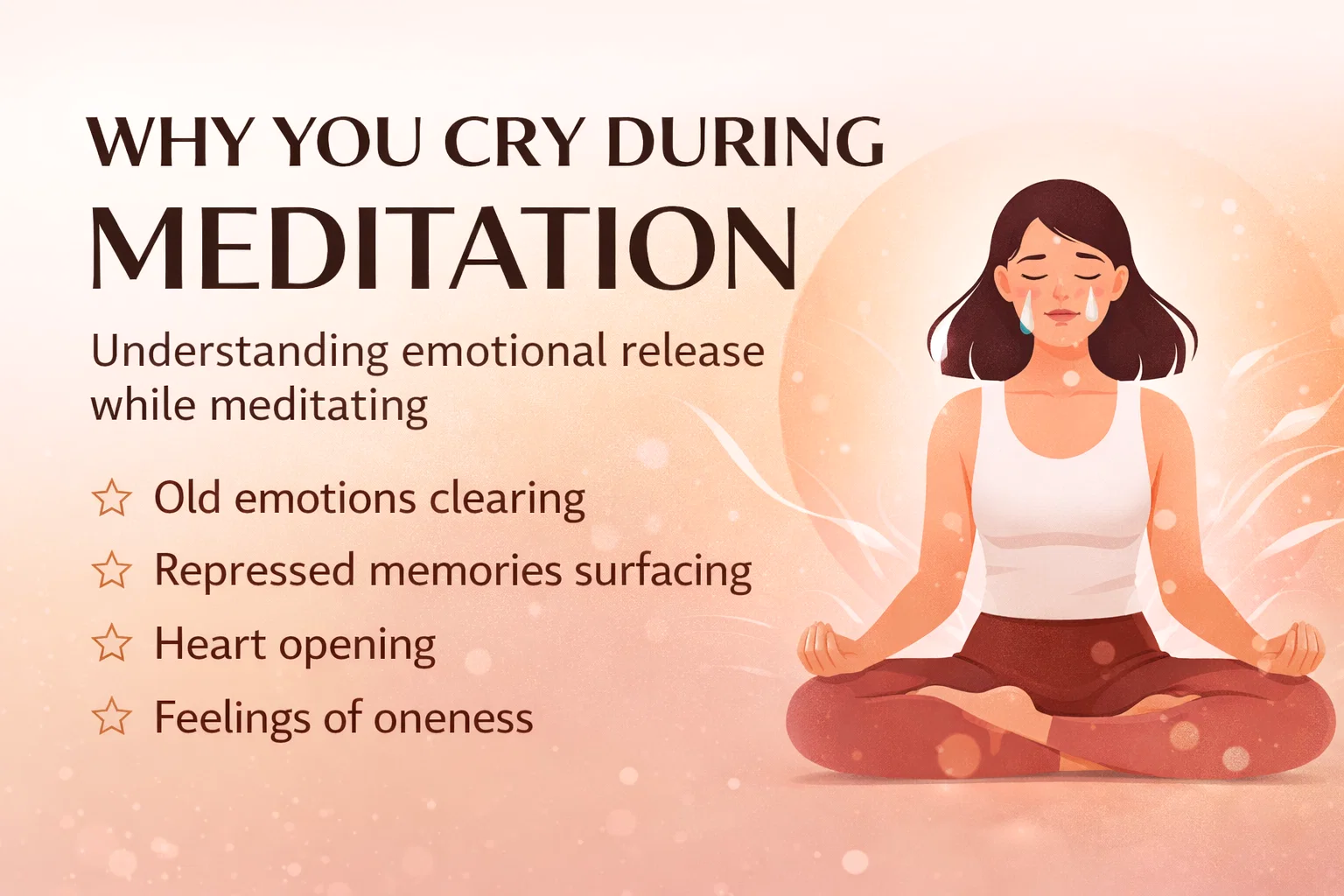
Meditation creates a unique environment where there are no distractions to keep those buried feelings at bay. Without the noise of our daily tasks or the glow of our screens, these repressed memories and old emotions begin to float to the surface. You might not even have a specific memory attached to the tears. You might just feel a sudden wave of grief, longing, or even joy. This is known as a somatic release. Your body is finally processing the backlog of emotions that it didn’t have time for months or even years ago.
Breaking the Cycle of Suppression
By allowing these tears to flow, you are effectively breaking a cycle of suppression. Instead of using energy to keep these emotions buried, you are letting them move through you. This is why many people feel significantly lighter or more clear-headed after a meditative crying session. It is not just a mental shift, it is a literal lightening of your emotional load.
The Spiritual Perspective: Heart Chakra Opening
For those who incorporate energy work or spiritual traditions into their practice, crying is often seen as a symptom of the Anahata, or the Heart Chakra, beginning to open. The Heart Chakra is the center of love, compassion, and connection. When it is blocked, we may feel cynical, isolated, or emotionally numb. As we meditate, we direct our breath and awareness toward this center, which can act as a key in a lock.
An opening heart chakra often manifests as a deep, overwhelming sense of empathy or a sudden realization of the beauty in the world. These are tears of grace. They signify that you are moving from a state of contraction to a state of expansion. You are becoming more receptive to the world around you and more compassionate toward yourself. In this context, crying is not a sign of sadness, but a sign of spiritual growth and the softening of the ego.
Awe, Oneness, and the Experience of the Infinite
Sometimes, we cry during meditation not because we are sad, but because we are overwhelmed by something far greater than ourselves. Deep meditation can lead to moments of transcendence, where the boundaries between the self and the rest of existence seem to blur. This experience of oneness can be so profound and beautiful that the human brain doesn’t quite know how to process it other than through tears.
These experiences of awe are a reminder of our interconnectedness. When you realize that you are a part of a vast, intelligent universe, the sheer magnitude of that connection can be breathtaking. It is a humbling and life-affirming moment that often leaves the meditator in a state of quiet, joyful weeping. It is the soul’s way of saying I see you to the universe.
How to Handle Tears When They Arise
So, what should you do when the tears start to fall? The most important thing is to resist the urge to stop them or analyze them immediately. Many of us have been conditioned to see crying as a sign of weakness or something that needs to be fixed. In the context of meditation, crying is a sign of progress and strength.
- Let it flow: Do not try to wipe your eyes or compose yourself. Just let the tears move down your face.
- Soften your body: Check in with your jaw, shoulders, and belly. If you are tensing up to stop the crying, consciously relax those areas.
- Breathe into the sensation: Instead of focusing on the why, focus on the how. How does the emotion feel in your chest? How does the breath feel as it moves through the tears?
- Avoid judgment: You are not doing meditation wrong because you are crying. In fact, you are doing it exactly right by being present with whatever arises.
The Trap of Over-Analysis
It is tempting to want to know exactly which memory or trauma triggered the tears. While journaling afterward can be helpful, try to stay away from the why during the session itself. Analyzing the emotion takes you out of the experience and back into your analytical mind. The goal of meditation is to feel the emotion, not to think about the emotion. Trust that your body knows what it is doing and that the healing is happening even if you don’t have a logical explanation for it.
Physical Considerations: Ruling Out the Basics
While most crying in meditation is emotional or spiritual, it is always wise to rule out simple physical factors. If your eyes are stinging or watering excessively every time you sit, consider your environment. Are there fans blowing directly into your face? Is the air in the room particularly dry? Are you wearing contact lenses that might be irritating your eyes during long periods of stillness?
Additionally, if you find that the crying is accompanied by intense physical pain or a sudden drop in blood pressure, it may be worth consulting a healthcare professional. However, for the vast majority of practitioners, these tears are purely a result of the deep internal work being done on the cushion.
Embracing the Healing Power of Vulnerability
In a world that often demands we stay composed and together at all times, the meditation cushion offers a sacred space to be completely vulnerable. When you cry during your practice, you are practicing the ultimate form of self-care. You are giving yourself permission to be human, to feel, and to heal. It is a brave act to sit with your own discomfort and let it transform into something else.
Remember that meditation is a journey, not a destination. Some days will be filled with silence, and other days will be filled with sobs. Both are equally valid and equally important. The tears are simply a bridge between where you were and where you are going. They are cleansing the path for a deeper sense of peace and a more authentic version of yourself.
Conclusion: The Path Forward
Crying during meditation is a beautiful, natural part of the human experience. Whether it is a release of the nervous system, a processing of old wounds, or an encounter with the divine, these tears are a gift. They signify that you are safe enough to let go and that you are courageous enough to look within. The next time you feel that wave of emotion rising, don’t turn away. Lean in, breathe deep, and let the healing begin. Your practice is not just about finding peace, it is about finding the truth of who you are, and sometimes that truth is found through the clarity of a tear.