Your Inner Voice Isnt You Neuroscience of Mindset Self-Awareness Mindset Tips
Have you ever caught yourself in the middle of a harsh internal monologue and wondered why you are being so mean to yourself? For many of us, that constant stream of consciousness feels like the very essence of who we are. We assume that because the voice is inside our head, it must be our soul, our identity, or our ultimate truth. However, modern neuroscience is beginning to paint a much different and far more liberating picture. The voice in your head is not actually you. It is a biological process, a sophisticated piece of software running on the hardware of your brain to help you navigate a complex world. Understanding this distinction is the first step toward true emotional freedom and mental clarity.
The Biology of the Inner Narrator
To understand why we have an inner voice at all, we have to look at the specific regions of the brain responsible for language and self-reflection. Neuroscientists often point to the Default Mode Network as the primary source of this internal chatter. This network becomes highly active when we are not focused on an external task. It is the part of the brain that wanders, ruminates on the past, and worries about the future. It uses language as a tool to make sense of your life story.
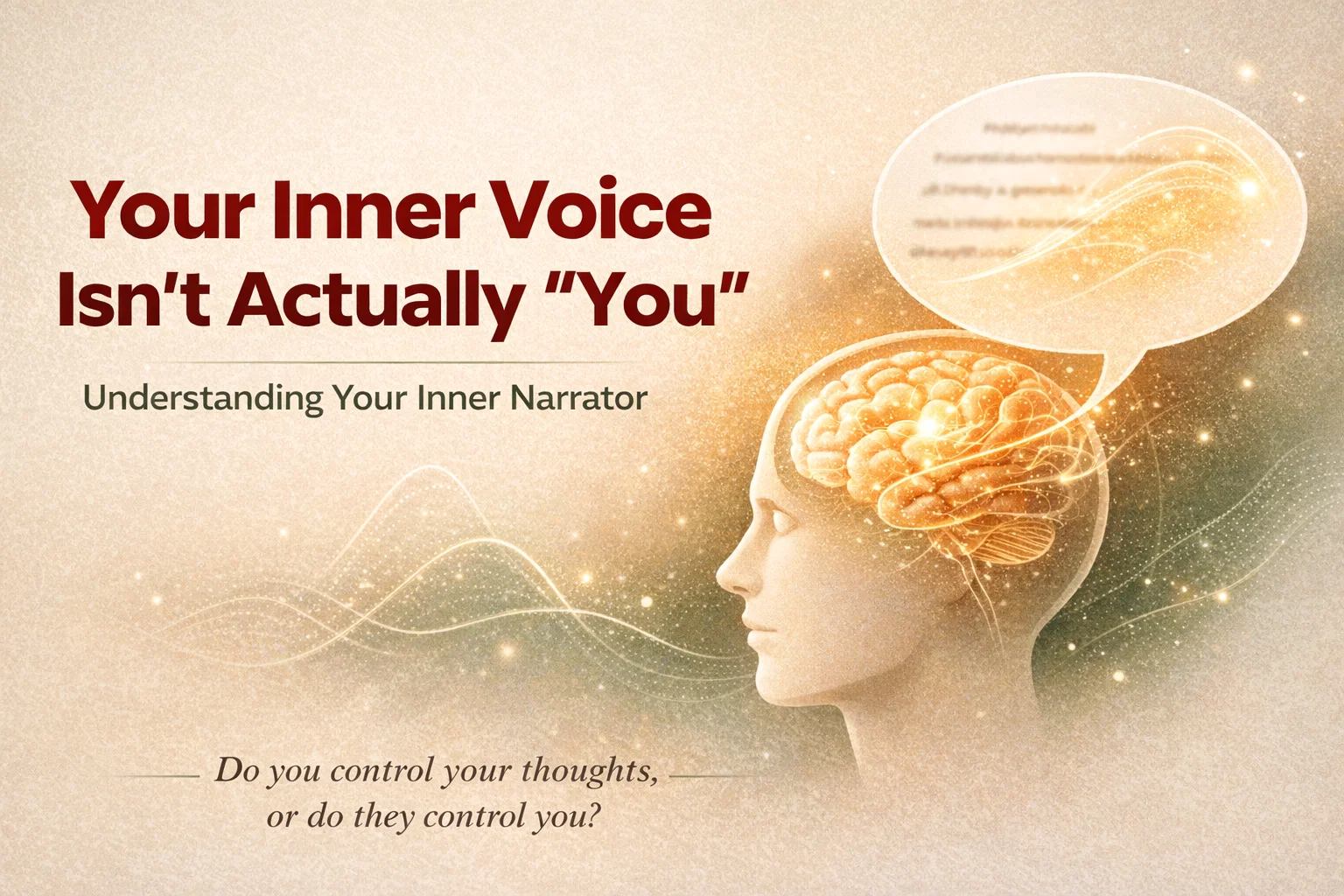
Inner speech is essentially a brain function generated by language centers like Broca’s area. When you speak out loud, this area is active. Interestingly, when you think silently to yourself, the same area lightens up on a brain scan. This proves that your inner voice is simply a sub-vocalized version of speech. It is a physical, chemical, and electrical event. It is not a mystical soul voice communicating from another dimension. It is your brain doing what it was evolved to do: process information through the lens of language.
Why the Brain Narrates Everything
You might wonder why our brains evolved to provide a 24/7 running commentary on our lives. The answer lies in survival and organization. The brain narrates to create a sense of control. By turning abstract experiences into a concrete narrative, the brain can better predict and organize future events. If you can name a feeling or describe a situation to yourself, it feels less chaotic and more manageable.
This commentary helps you navigate social hierarchies, plan your day, and learn from mistakes. However, the problem arises when the narration becomes skewed. Because the brain is wired with a negativity bias to keep you safe from perceived threats, the inner voice often leans toward criticism or anxiety. It is trying to protect you, but it often does so by over-analyzing every possible flaw or danger. Recognizing that this is a survival mechanism rather than a reflection of your worth can change how you interact with your thoughts.
The Illusion of Conscious Manufacture
One of the most startling realizations in neuroscience is that thoughts appear automatically. You do not consciously manufacture most of them. If you sit quietly for five minutes and try to stop thinking, you will quickly realize that you have very little control over what pops into your head. Thoughts bubble up from the subconscious based on various triggers, biological rhythms, and environmental cues.
Because these thoughts appear in our own internal voice, we take ownership of them. We say, I thought that, therefore I must believe it. In reality, the brain is simply throwing options against the wall to see what sticks. Just because a thought appears does not mean it is a reflection of your character or your desires. It is simply a suggestion from a very busy biological processor.
How Conditioning Shapes Your Inner Tone
If the inner voice is a process, what determines its tone? Why is one person’s inner voice encouraging while another’s is relentlessly critical? The answer lies in conditioning. The voice in your head reflects a lifetime of past experiences, cultural beliefs, and deep-seated fears. It is often a mosaic of the voices you heard growing up, including parents, teachers, and peers.
If you were raised in an environment where perfection was expected, your inner voice likely adopted that standard as a safety mechanism. It believes that by criticizing you first, it can protect you from the pain of being criticized by others. This conditioning becomes a habit, a neural pathway that gets stronger every time it is used. The good news is that because this is a learned process, it can be unlearned through consistent awareness and rewiring.
Identifying the Source of the Voice
- Childhood Influences: Many of our most persistent internal criticisms are actually echoes of authority figures from our youth.
- Social Media Pressure: Constant comparison to others can shift the inner voice toward a tone of inadequacy and lack.
- Trauma Responses: Past negative events can cause the inner voice to become hyper-vigilant, always looking for what might go wrong.
The Observer vs. The Commentary
The most powerful concept in both neuroscience and mindfulness is the idea that awareness sits behind the voice. There is a fundamental difference between a thought and the awareness of that thought. If you can observe a thought, you cannot be the thought itself. This is the essence of the observer effect in psychology. When you step back and look at your thoughts as if they were clouds passing in the sky, you break the identification with the ego.
Imagine you are watching a movie. You might get caught up in the drama, feel the characters’ pain, and even cry. But at no point do you actually become the characters on the screen. You are the one sitting in the seat, witnessing the projection. Your inner voice is the movie, and your consciousness is the person in the theater. By staying in the seat of the observer, you gain the power to choose which thoughts to take seriously and which to let pass by.
Practical Strategies for Mindset Mastery
Knowing that your inner voice is a process is helpful, but applying that knowledge during a moment of stress is where the real growth happens. You can begin to reprogram your relationship with your mind by implementing small, daily shifts in how you perceive your internal dialogue. This is not about silencing the voice, as that is nearly impossible for the human brain. Instead, it is about changing your reaction to it.
The Power of the Pause
When you notice your inner voice starting to spiral into negativity, the first step is to pause. This pause creates a tiny gap between the stimulus (the thought) and your response (the emotional reaction). In that gap, you can ask yourself a vital question: Is this truth, or is this just neural narration? Most of the time, you will find it is the latter. This simple act of questioning shifts the brain from the emotional limbric system back to the logical prefrontal cortex.
Labeling Your Thoughts
Another effective technique is labeling. Instead of saying, I am a failure, try saying, I am having a thought that I am a failure. This might seem like a small linguistic shift, but it creates massive psychological distance. You are no longer the failure; you are the person noticing a thought about failure. You can even give your inner critic a name. When it starts acting up, you can think, Oh, there goes Grumpy Greg again. This externalization makes it much harder to take the voice seriously.
The Path to Self-Compassion
Once you realize the voice isn’t you, it becomes much easier to practice self-compassion. You wouldn’t be angry at a computer for running a glitchy program; you would simply try to fix the code. Similarly, you don’t need to be angry at your brain for having negative thoughts. It is just doing its job based on the data it has been given over the years. By treating your mind with the same curiosity and kindness you would offer a friend, you create an internal environment where growth can actually happen.
Self-compassion is not about making excuses for yourself. It is about acknowledging that being a human with a complex brain is difficult. When the inner voice is harsh, you can respond with a compassionate thought like, My brain is feeling very anxious right now and is trying to protect me, but I am safe. This validates the biological process without letting it run the show.
A Final Perspective on Mental Freedom
True mental freedom does not come from having a perfectly positive inner voice. It comes from the realization that you don’t have to believe anything your inner voice says. You are the vast, quiet space in which the voice exists. You are the awareness that experiences the world, the observer of the thoughts, and the conscious entity that can choose how to act regardless of what the commentary says.
Next time your inner voice criticizes your appearance, your work, or your choices, take a deep breath. Remind yourself that you are the observer, not the commentary. You are the one who hears the music, not the instrument itself. By detaching from the noise and grounding yourself in the truth of your awareness, you can navigate life with a sense of peace that no amount of internal chatter can ever take away. Your brain is a wonderful tool, but it is a terrible master. It is time to step back into your role as the one in charge.
Conclusion: Living as the Observer
In summary, the journey of understanding your inner voice is one of the most important paths you can take for your mental well-being. By embracing the neuroscience that proves your thoughts are a process rather than an identity, you unlock the door to a more stable and peaceful life. You no longer have to be at the mercy of every automatic thought that bubbles up. Instead, you can move through the world with the confidence of someone who knows exactly who they are: the silent, powerful observer behind it all.
Keep practicing the pause, keep labeling the narration, and most importantly, keep being kind to the biological machine that is doing its best to keep you going. When you change your relationship with your mind, you change your entire reality. Save these reminders for the next time the noise gets a little too loud, and remember that you have the power to simply listen without letting it define you.