Motivation in Psychology Types, Factors, Theories, and Importance Explained
Motivation is the psychological force that inspires us to take action, pursue goals, overcome challenges, and keep moving forward even when progress feels slow. Whether you are studying for an exam, building a new habit, improving your performance at work, or working toward personal growth, motivation plays an important role in shaping your behavior. Understanding how motivation works can help you recognize what drives you, develop better habits, and create an environment that supports success.
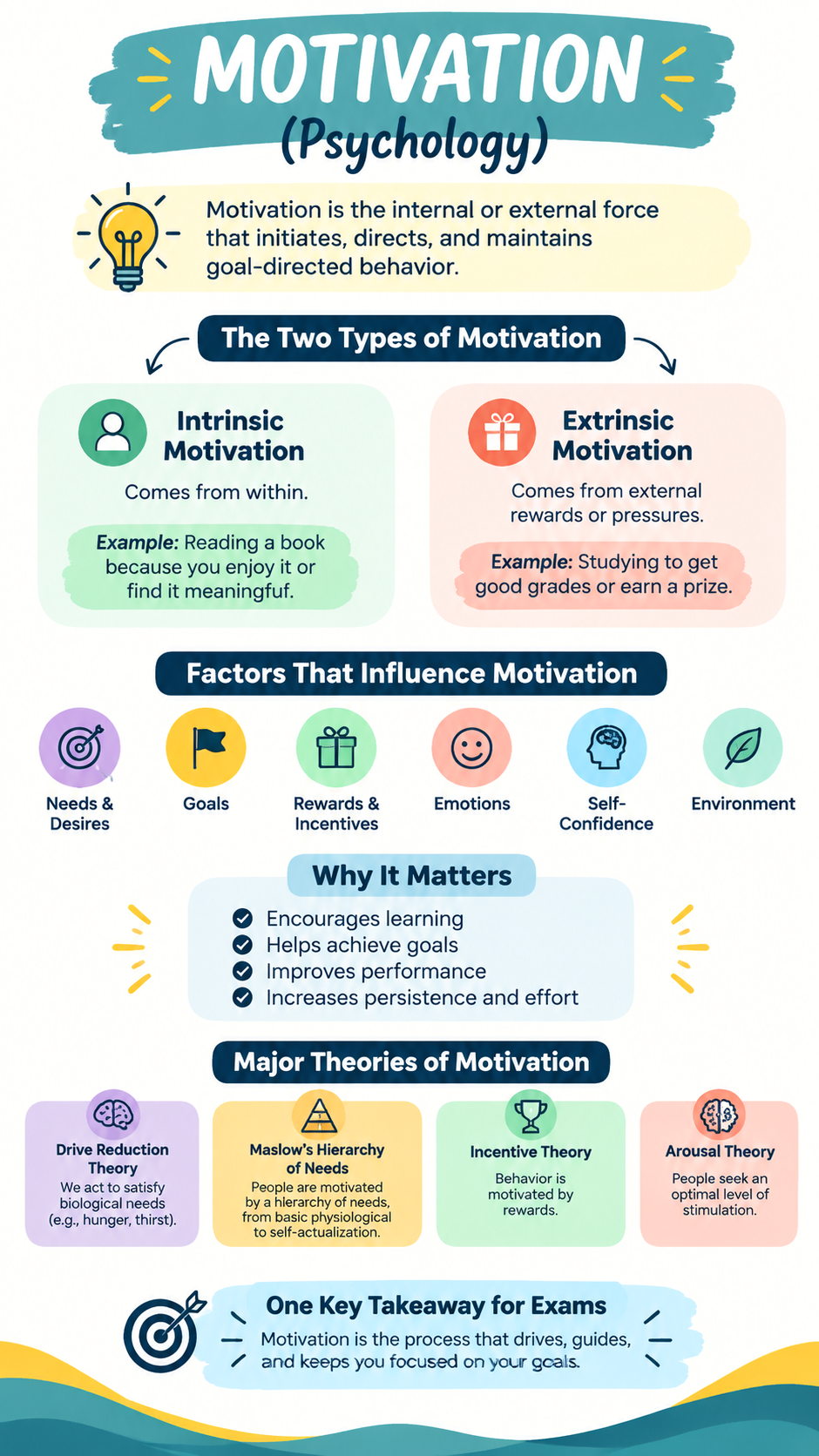
In psychology, motivation refers to the internal and external forces that initiate, direct, and maintain goal-oriented behavior. It explains why people make certain choices, how they maintain their effort, and what encourages them to continue when obstacles appear. From personal ambition to rewards and encouragement, several factors influence the way we act and the goals we pursue.
Key Takeaways
- Motivation is the process that initiates, directs, and sustains goal-oriented behavior.
- Intrinsic motivation comes from personal interest, enjoyment, or a sense of meaning.
- Extrinsic motivation is influenced by external rewards, recognition, consequences, or pressure.
- Goals, emotions, needs, incentives, self-confidence, and the environment can affect motivation.
- Motivation supports learning, performance, persistence, and personal development.
- Understanding motivation theories can help you develop practical strategies for achieving your goals.
What Is Motivation in Psychology?
Motivation is the process that gives behavior direction and energy. It helps explain why someone begins a task, chooses one activity over another, and continues working toward an outcome. Motivation can come from personal desires, emotional experiences, social expectations, practical needs, or the possibility of receiving a reward.
For example, a student might study psychology because the subject is fascinating, because earning a good grade is important, or because passing an exam is necessary for graduation. The behavior may look similar, but the reasons behind it are different.
Psychologists often examine motivation through three closely related elements:
- Initiation: Starting an activity or taking the first step toward a goal.
- Direction: Choosing where to focus attention and effort.
- Persistence: Continuing an activity despite distractions, difficulty, or delayed results.
These elements work together to influence everyday decisions. Motivation can help you begin a project, decide which tasks deserve attention, and remain committed when the work becomes challenging.
Important: Motivation is not simply about feeling inspired. It also involves the direction and consistency of your actions. You can make meaningful progress even when enthusiasm is low by using routines, clear goals, and manageable steps.
The Two Main Types of Motivation
One of the most useful distinctions in psychology is the difference between intrinsic motivation and extrinsic motivation. Both can influence behavior, and people often experience them at the same time. Understanding the difference can help you identify what encourages you to act and how to make your efforts more sustainable.
1. Intrinsic Motivation: Motivation From Within
Intrinsic motivation occurs when you engage in an activity because you find it enjoyable, interesting, satisfying, or personally meaningful. The activity itself provides a reason to participate, rather than an external reward being the primary goal.
Imagine someone who reads psychology books because they enjoy learning about human behavior. They may continue reading even when there is no examination, financial reward, or public recognition involved. Curiosity and the satisfaction of understanding something new provide the motivation.
Other examples of intrinsic motivation include:
- Learning a language because you enjoy discovering another culture.
- Painting because the creative process makes you feel fulfilled.
- Exercising because you enjoy movement and the feeling of progress.
- Solving puzzles because you find challenging problems interesting.
- Developing a new skill because mastering it feels rewarding.
Benefits of Intrinsic Motivation
Intrinsic motivation can support curiosity, creativity, deeper engagement, and long-term participation, particularly when people have opportunities to make choices and develop their abilities. Enjoying an activity may also make it easier to return to that activity regularly.
To strengthen intrinsic motivation, look for aspects of a task that interest you. Connect the activity to your values, explore different approaches, and notice the satisfaction that comes from learning or improving.
2. Extrinsic Motivation: Motivation From External Factors
Extrinsic motivation occurs when behavior is influenced by an outcome separate from the activity itself. These outcomes may include rewards, grades, money, recognition, approval, or avoiding negative consequences.
For instance, a student may study to earn a high grade, receive a scholarship, or meet a course requirement. An employee may complete a project to earn a bonus or qualify for a promotion. In these situations, the expected outcome provides an important reason to act.
Common examples of extrinsic motivation include:
- Completing an assignment to receive a good grade.
- Working toward a promotion or financial reward.
- Participating in a competition to earn a prize.
- Following a deadline to avoid a penalty.
- Practicing a presentation to receive positive feedback.
Benefits and Limitations of Extrinsic Motivation
External incentives can clarify expectations, encourage people to begin unfamiliar tasks, and provide a useful way to recognize achievement. They can be particularly helpful when a task is necessary but not immediately enjoyable.
However, relying exclusively on rewards or pressure may make it harder to maintain engagement when those incentives disappear. In some circumstances, rewards that feel controlling can also weaken a person’s existing interest in an activity.
The effect depends on the type of reward, how it is presented, and the individual’s experience. Feedback that recognizes effort and growing competence may support motivation differently from a reward that feels like a threat or a way to control behavior.
Intrinsic vs. Extrinsic Motivation: What Is the Difference?
The main difference is the reason behind the behavior. Intrinsic motivation comes from interest or personal satisfaction, while extrinsic motivation is connected to a separate outcome or consequence.
- Intrinsic: You study psychology because you love learning about the mind.
- Extrinsic: You study psychology to earn a high exam score.
- A combination of both: You enjoy the subject and also want to earn a qualification.
Neither type is automatically better in every situation. External rewards may help people meet immediate requirements, while intrinsic motivation can encourage meaningful engagement. Many real-life activities involve a combination of both.
Factors That Affect Motivation
Motivation changes according to personal circumstances, experiences, and surroundings. A task that feels exciting one day may feel difficult the next. Recognizing the main factors that influence motivation makes it easier to understand these changes and respond constructively.
1. Needs and Desires
Human needs can strongly influence behavior. People may act to satisfy basic physical needs, seek safety, develop relationships, gain recognition, or pursue personal growth.
For example, hunger can motivate someone to find food, while a desire for connection can encourage someone to spend time with friends. A need for achievement may inspire a student to develop new skills or work toward an ambitious goal.
Understanding your current needs can help you identify why a particular goal matters to you and what might be preventing you from making progress.
2. Goals and Expectations
Goals provide direction by defining what you want to achieve. Without a clear objective, it can be difficult to decide where to focus your energy or determine whether your actions are effective.
Specific, realistic goals often make progress easier to track. Instead of saying, “I want to improve my psychology knowledge,” you could decide to study one topic for 25 minutes each evening and summarize what you learn.
Breaking a large objective into smaller milestones can also make it feel less overwhelming. Each completed step provides evidence of progress and creates an opportunity to adjust your approach.
3. Rewards and Incentives
Rewards can influence whether people begin or continue a behavior. An incentive might be a good grade, a financial benefit, recognition, or a small personal treat after completing a difficult task.
For example, you might reward yourself with a relaxing break after finishing a study session. This creates a clear connection between effort and a pleasant outcome.
Rewards work best when they support a meaningful objective rather than becoming the only reason to participate. Whenever possible, combine external incentives with opportunities to develop competence, independence, and genuine interest.
4. Emotions and Mood
Emotions can influence attention, decision-making, and willingness to act. Excitement may encourage someone to start a project, while anxiety can make a challenging task feel more intimidating. Frustration may reduce persistence, especially when progress seems slow.
Positive emotions can make activities feel more approachable, but motivation does not require feeling happy all the time. Learning to manage difficult emotions and taking small actions despite discomfort can help people maintain progress.
5. Self-Confidence
Self-confidence influences how people approach challenges and interpret setbacks. When you believe that your efforts can improve your abilities, you may be more willing to attempt difficult tasks and continue after making mistakes.
In psychology, the concept of self-efficacy refers more specifically to a person’s belief in their ability to perform actions required for a particular task. Someone who believes they can improve their writing through practice may be more likely to seek feedback and revise their work.
Build confidence by setting achievable challenges, recognizing genuine progress, learning from feedback, and focusing on skills that can improve through practice.
6. Environment and Social Support
Your surroundings can either support or interfere with motivation. A quiet study space, clear instructions, helpful resources, and encouragement from others can make it easier to concentrate and follow through.
Distractions, unrealistic expectations, limited resources, and constant interruptions may make tasks more difficult. Small environmental changes can therefore improve your ability to act, even when your feelings about the task remain the same.
Pro Tip: Do not depend on motivation alone to make progress. Prepare your environment, remove unnecessary distractions, and decide exactly when and where you will begin. Making the first step easier can help you act before you feel fully motivated.
Why Is Motivation Important?
Motivation plays a valuable role in education, work, relationships, personal development, and everyday decision-making. It helps people direct their attention toward meaningful objectives and continue working when results are not immediate.
Motivation Encourages Learning
Motivated learners are often more willing to explore new ideas, ask questions, practice unfamiliar skills, and seek feedback. Interest in a subject can encourage deeper engagement, while clear academic goals can help students organize their study time.
For example, a student who wants to understand human behavior may spend extra time connecting psychological concepts to everyday experiences. This active engagement can make learning more meaningful than simply memorizing information for a test.
Motivation Helps People Achieve Goals
Goals usually require repeated actions rather than one dramatic effort. Motivation can encourage people to plan, begin tasks, evaluate their progress, and return to their objectives after interruptions.
Whether the goal involves improving fitness, learning a language, building a career, or developing a creative skill, maintaining a clear sense of purpose can make daily decisions easier.
Motivation Can Improve Performance
When people are motivated, they may invest more attention, practice, and effort in a task. These behaviors can contribute to better performance, especially when people also have the necessary skills, resources, and opportunities.
However, motivation alone does not guarantee success. Effective strategies, realistic expectations, adequate rest, and constructive feedback also influence performance.
Motivation Supports Persistence
Progress often involves mistakes, delays, and unexpected obstacles. Motivation can help people remain committed to a goal while adjusting their strategies when something does not work.
Persistence does not mean continuing with the same approach regardless of the circumstances. Sometimes, staying committed to a larger goal requires changing a plan, seeking support, or taking time to recover.
Why This Matters
Motivation is most useful when it is connected to practical action. Instead of waiting for a burst of inspiration, identify a meaningful goal, choose one manageable step, and create a routine that makes repeating that step easier. Consistency can help turn intentions into observable progress.
Major Theories of Motivation in Psychology
Psychologists have developed several theories to explain why people behave in particular ways. Each theory emphasizes different influences, including biological needs, personal goals, external rewards, and the desire for an appropriate level of stimulation.
1. Drive-Reduction Theory
Drive-reduction theory proposes that biological needs can create internal states of tension that motivate behavior intended to reduce them. When the body requires something essential, the resulting drive encourages actions that help restore balance.
Hunger provides a simple example. When someone becomes hungry, the discomfort can motivate them to seek and eat food. Thirst can similarly encourage drinking water.
This theory helps explain some biologically motivated behaviors. However, it does not fully explain actions such as seeking adventure, pursuing creative challenges, or exploring something simply out of curiosity.
2. Maslow’s Hierarchy of Needs
Maslow’s hierarchy of needs is a well-known psychological framework that organizes human needs into levels. In its familiar form, it includes physiological needs, safety, love and belonging, esteem, and self-actualization.
- Physiological needs: Basic requirements such as food, water, sleep, and shelter.
- Safety needs: A sense of security, stability, and protection.
- Love and belonging: Connection, friendship, affection, and social relationships.
- Esteem needs: Respect, competence, achievement, and recognition.
- Self-actualization: Developing abilities and pursuing personal potential.
The framework suggests that different needs can influence motivation and that unmet basic needs may make other goals more difficult to prioritize. For example, someone struggling with food insecurity or an unsafe living situation may find it harder to concentrate on long-term personal development.
However, people do not always pursue these needs in a fixed order. Individuals may seek meaningful relationships, creative achievement, or personal growth even when some basic needs remain unmet. The hierarchy is best understood as a useful conceptual framework rather than a universal sequence that applies identically to everyone.
3. Incentive Theory
Incentive theory emphasizes the role of external outcomes in motivating behavior. People may be encouraged to act when they anticipate a desirable reward or want to avoid an unwanted consequence.
A student may complete extra practice questions to earn a better grade. An employee may work toward a performance bonus. A person developing a habit may use a small reward to acknowledge completing a planned activity.
Incentives can help direct attention toward specific objectives, but their effectiveness depends on individual preferences, the perceived value of the reward, and the surrounding circumstances.
4. Arousal Theory
Arousal theory suggests that people are motivated to seek or maintain a suitable level of alertness and stimulation. The preferred level can vary depending on the individual and the activity.
For example, someone who feels bored may look for an engaging challenge, while someone overwhelmed by noise or pressure may seek a quiet environment. Different people may also prefer different levels of stimulation when studying, working, or relaxing.
The ideal level of arousal is not identical for every person or every task. A familiar activity may be easier with a calm environment, while a creative activity may benefit from a more stimulating setting.
5. Self-Determination Theory
Self-determination theory offers another influential explanation of motivation. It emphasizes the importance of three psychological needs: autonomy, competence, and relatedness.
- Autonomy: Feeling that you have meaningful choice and some control over your actions.
- Competence: Feeling capable of learning, improving, and handling challenges.
- Relatedness: Feeling connected to and supported by other people.
For example, a student may become more engaged when they can choose a topic that interests them, receive feedback that helps them improve, and feel supported by a teacher or study group.
This theory helps explain why motivation is influenced not only by rewards but also by the quality of a person’s experience. Environments that support choice, skill development, and connection can encourage more self-directed forms of motivation.
How to Improve Motivation in Everyday Life
Understanding motivation becomes more valuable when you can apply it to real situations. You do not need to feel inspired every day to make progress. Instead, develop practical systems that help you take action, respond to setbacks, and reconnect with your goals.
Set Clear and Achievable Goals
Start by defining what you want to accomplish. A vague goal such as “be more productive” can be difficult to act on because it does not identify a specific behavior. A clearer goal might be “spend 20 minutes reviewing my notes after dinner.”
Make your goal challenging enough to encourage growth but realistic enough to fit your circumstances. As you gain confidence, gradually increase the difficulty.
Break Large Tasks Into Smaller Steps
Large projects can feel intimidating when the final result seems far away. Breaking them into manageable actions makes it easier to identify what to do next.
If you want to write an essay, for example, begin by choosing a topic, outlining the main points, drafting one section, and reviewing your work. Each step creates a clear target and makes the overall task feel more manageable.
Connect Your Actions to Personal Values
Ask yourself why a particular goal matters. You might be learning a skill to become more independent, studying a subject because you value knowledge, or exercising because you want to maintain your energy and mobility.
Connecting tasks to personal values can make them feel more meaningful, especially when the immediate activity is difficult or repetitive.
Track Progress and Celebrate Milestones
Progress can be difficult to notice when you focus only on the final outcome. Use a checklist, journal, calendar, or simple progress tracker to record completed actions and recognize improvement.
Celebrating milestones does not need to involve expensive rewards. Acknowledge your effort, take a relaxing break, or reflect on what you learned. The purpose is to recognize progress and reinforce useful behaviors.
Create a Supportive Environment
Make it easier to begin by preparing the materials you need, limiting unnecessary distractions, and choosing a consistent time for important activities. If accountability helps you, share your goal with someone you trust or arrange regular study sessions with a friend.
Remember that your environment should support your needs rather than create unnecessary pressure. A realistic schedule that allows time for rest is often more sustainable than an intense routine that leaves no room for recovery.
Build Consistency Instead of Waiting for Inspiration
Motivation naturally fluctuates. Some days, a task feels exciting. On other days, it feels ordinary or difficult. A consistent routine reduces the need to make the same decision repeatedly.
Try beginning with a small action that takes only a few minutes. Opening a book, writing one sentence, or organizing your workspace can help you overcome the initial resistance to starting.
Over time, repeated actions can become more familiar and easier to initiate. You can then adjust your routine as your abilities, goals, and circumstances change.
Common Motivation Challenges and How to Handle Them
Even people who care deeply about their goals experience periods of low motivation. Recognizing the possible causes can help you choose a response that addresses the problem instead of blaming yourself.
Feeling Overwhelmed
When a goal appears too large or complicated, you may struggle to identify where to begin. Reduce the task to its smallest useful step and focus on completing that step before worrying about the entire project.
Fear of Failure
Fear can make people avoid activities where the outcome is uncertain. Reframe mistakes as information that can guide improvement. Focus on what you can learn from an attempt instead of treating every result as a judgment of your ability.
Unclear Priorities
Trying to pursue too many goals at once can divide your attention. Identify the one or two objectives that matter most right now, then schedule time for the actions that support them. Other goals can be reconsidered when your priorities change.
Low Energy and Burnout
Sometimes, a lack of motivation reflects exhaustion rather than a lack of discipline. Sleep, breaks, manageable workloads, and social support can all influence your ability to concentrate and persist.
If a persistent loss of interest or motivation interferes with everyday life, consider speaking with a qualified health professional. Motivation is affected by many factors, and seeking support can be an important step toward understanding what you need.
Quick Points: Motivation at a Glance
- Definition: Motivation initiates, directs, and maintains goal-oriented behavior.
- Intrinsic motivation: Comes from interest, enjoyment, or personal meaning.
- Extrinsic motivation: Comes from external rewards, recognition, or consequences.
- Key influences: Needs, goals, incentives, emotions, confidence, and environment.
- Practical strategy: Set clear goals, take small steps, track progress, and create supportive routines.
Conclusion: Turn Motivation Into Meaningful Action
Motivation is a central concept in psychology because it helps explain why people begin activities, direct their efforts, and continue pursuing goals. It can arise from internal interest and personal meaning or from external rewards and expectations. Needs, emotions, confidence, incentives, and environmental conditions all contribute to the way motivation develops and changes.
Drive-reduction theory, Maslow’s hierarchy of needs, incentive theory, arousal theory, and self-determination theory offer different perspectives on what encourages human behavior. Together, these approaches provide useful ways to understand motivation in education, work, relationships, and personal development.
The most practical lesson is that motivation does not have to depend on constant enthusiasm. You can support it by choosing meaningful goals, breaking difficult tasks into manageable steps, recognizing progress, and building routines that make useful actions easier to repeat.
Start small, stay curious, and give yourself room to improve. Every thoughtful action can become part of a larger journey toward learning, achievement, and personal growth. When you understand what drives you, you are better equipped to make intentional choices and keep moving toward the goals that matter most.
Tags
Motivation in Psychology
Intrinsic Motivation
Extrinsic Motivation
Maslow’s Hierarchy of Needs
Goal Setting
Self-Improvement
Personal Growth
Psychology Theories