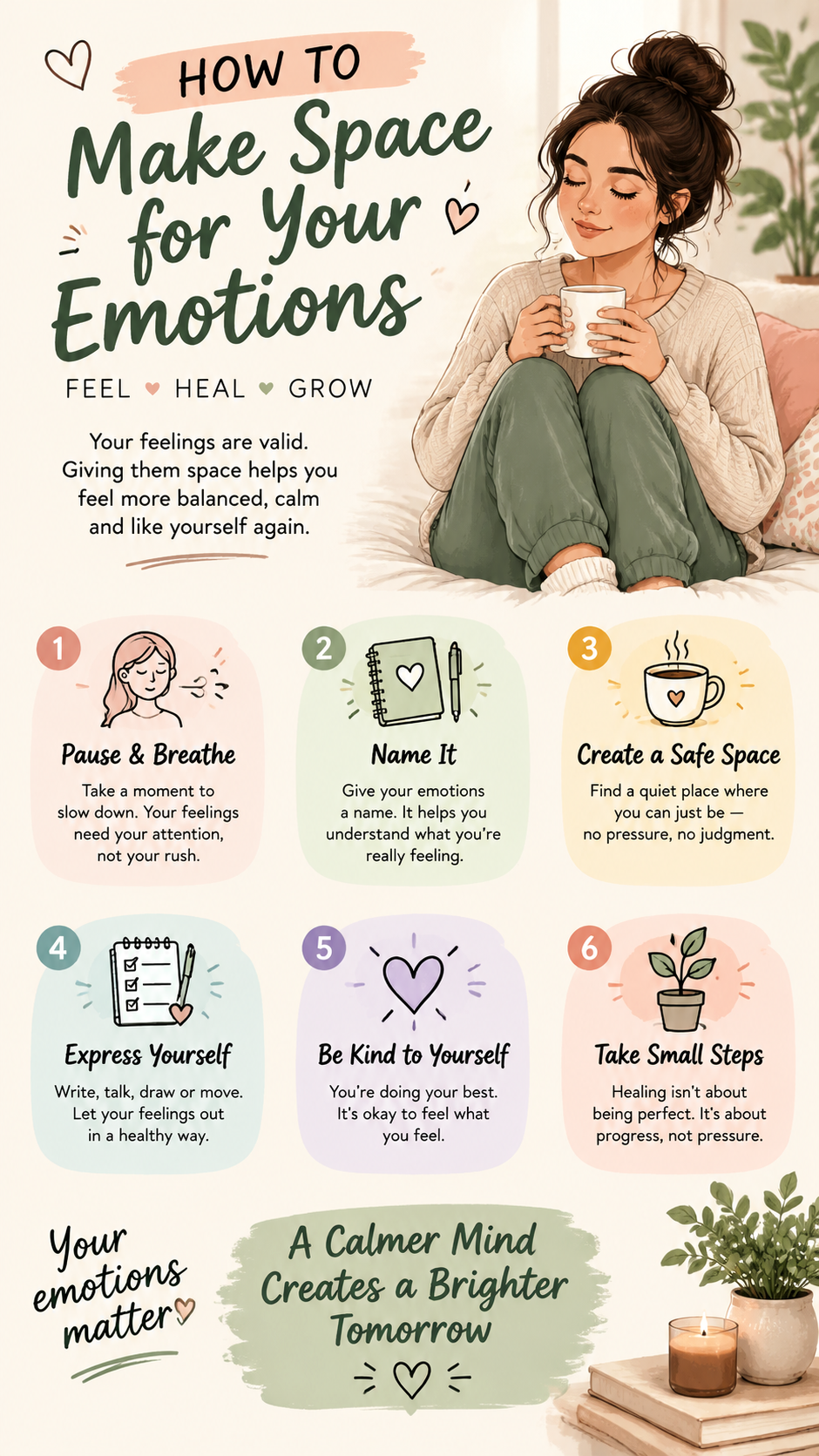
How to Make Space for Your Emotions 7 Self-Care Tips for Emotional Healing
Making space for your emotions is an important part of self-care, emotional healing, and personal growth. Life can feel overwhelming when you constantly push your feelings aside, stay busy to avoid discomfort, or tell yourself that you should be stronger. Yet every emotion you experience deserves to be acknowledged with patience and compassion. Whether you feel anxious, sad, frustrated, lonely, overwhelmed, or simply unsure of what is happening inside you, learning to make space for your emotions can help you reconnect with yourself and find greater emotional balance.
You do not have to figure everything out immediately. Sometimes, the most meaningful thing you can do is slow down, take a deep breath, notice what you are feeling, and allow yourself to experience the moment without judgment. With a few gentle mindfulness practices and healthy emotional coping strategies, you can create a safe space where your feelings are welcome rather than something you need to hide.
Key Takeaways
- Slow down and give yourself permission to feel without rushing toward a solution.
- Name your emotions to better understand what you are experiencing.
- Notice physical sensations that may accompany stress, sadness, anxiety, or frustration.
- Create a comfortable, judgment-free space for reflection and emotional release.
- Use journaling, music, movement, creativity, or trusted conversations to express your feelings.
- Treat yourself with kindness and remember that emotional healing takes time.
Why Making Space for Your Emotions Matters
Emotions are a natural part of being human. They help you respond to experiences, recognize personal needs, understand relationships, and make decisions. Happiness can signal that something feels meaningful, while anger may point toward a boundary that needs attention. Sadness can accompany loss or disappointment, and anxiety may arise when you face uncertainty.
However, many people learn to suppress their emotions because they believe they should always be productive, positive, calm, or strong. You might distract yourself whenever sadness appears, ignore your frustration to avoid conflict, or criticize yourself for feeling anxious about something that seems small.
Although temporarily setting feelings aside can sometimes be necessary, consistently avoiding them may make it harder to understand what you need. You might feel disconnected from yourself, become more irritable, struggle to communicate clearly, or find that stress builds up over time.
Important: Making space for your emotions does not mean allowing every feeling to control your behavior. It means acknowledging what you feel, understanding it as best you can, and choosing how to respond in a way that supports your well-being.
When you stop treating emotions as problems that must immediately disappear, you can begin to approach them with curiosity. Instead of asking, “How do I stop feeling this way?” try asking, “What might this feeling be telling me?” That small shift can make emotional self-awareness feel more approachable.
1. Slow Down and Give Yourself Permission to Feel
One of the simplest ways to make space for your emotions is to slow down. When your day is filled with responsibilities, notifications, conversations, and constant demands, you may barely notice how you feel until everything becomes overwhelming.
Taking a short pause gives you an opportunity to reconnect with the present moment. You do not need a complicated routine or a perfectly quiet environment. Even a few minutes of intentional breathing can help you shift your attention away from constant activity and toward your current experience.
Practice a Gentle Mindfulness Pause
- Find a comfortable position. Sit in a chair, stretch out on your bed, or stand somewhere you feel reasonably comfortable.
- Relax your attention. Notice your surroundings without trying to change anything immediately.
- Breathe naturally. Pay attention to the feeling of air entering and leaving your body. Let your breathing remain comfortable rather than forcing deep breaths.
- Notice what is happening inside. Ask yourself whether you feel tense, tired, worried, peaceful, sad, or something else.
- Give yourself permission to pause. Remind yourself that you do not have to solve every problem during this moment.
You can practice this mindful pause in the morning, during a lunch break, after a difficult conversation, or before going to sleep. If sitting quietly makes you uncomfortable, try walking slowly, stretching gently, or observing the world around you instead.
Let Go of the Pressure to Feel Better Immediately
Sometimes, you may become frustrated because an uncomfortable emotion does not disappear as quickly as you would like. You might tell yourself that you should be over a disappointment already or that you have no reason to feel upset.
Try replacing those judgments with a gentler reminder: “This is what I am feeling right now, and I can give myself time to understand it.”
You are allowed to experience difficult feelings without turning them into another task on your to-do list. Slowing down creates room for understanding, even when it does not produce an immediate answer.
2. Notice and Name Your Emotions Without Judgment
Once you have paused, the next step is to identify what you are feeling. This may sound simple, but emotions are not always easy to recognize. Sometimes, you know that something feels wrong without understanding whether you are disappointed, embarrassed, exhausted, anxious, hurt, or angry.
Learning to name your emotions can help you become more emotionally aware. It also gives you clearer language for expressing your needs to yourself and other people.
Ask Yourself What You Are Feeling
When you notice an emotional shift, pause and ask a few simple questions:
- What emotion seems strongest right now?
- Did something happen that might have influenced this feeling?
- Am I feeling one emotion or several emotions at once?
- What do I need in this moment?
- Can I acknowledge this feeling without criticizing myself for having it?
You might discover that what initially feels like anger is actually disappointment. What feels like laziness may be exhaustion. What appears to be frustration with another person might include fear of rejection or a need for clearer communication.
There is no need to identify the perfect word every time. The goal is to become more curious about your inner experience rather than automatically dismissing it.
Build Your Emotional Vocabulary
If you tend to describe everything as “fine,” “bad,” or “stressed,” expanding your emotional vocabulary may help. Consider these examples:
- Sadness: disappointed, lonely, discouraged, heartbroken, or nostalgic.
- Anxiety: worried, uncertain, nervous, overwhelmed, or apprehensive.
- Anger: irritated, frustrated, resentful, or offended.
- Happiness: grateful, content, excited, hopeful, or connected.
- Fear: vulnerable, intimidated, uneasy, or insecure.
You may also experience mixed emotions. Starting a new chapter can feel exciting and frightening at the same time. You might love someone and still feel hurt by their behavior. Recognizing these combinations helps you understand that human feelings are rarely as simple as they first appear.
Most importantly, naming an emotion does not mean judging it as good or bad. Feelings are experiences, not evidence that something is wrong with you.
3. Feel Your Emotions in Your Body
Emotions are not only thoughts. They can also appear as physical sensations. You might notice a tight chest when you feel anxious, tense shoulders when you are stressed, a heavy feeling in your legs when you are discouraged, or a racing heart during a difficult conversation.
Paying attention to these sensations can help you recognize emotional experiences before you have fully understood them mentally. Your body may offer useful clues about your current state, although physical sensations can also have medical or other causes.
Try a Gentle Body Check-In
Choose a quiet moment and bring your attention to different parts of your body. You do not have to force yourself to relax or change what you notice.
- Start with your face. Notice whether your jaw is clenched, your forehead is tense, or your eyes feel tired.
- Check your shoulders and neck. Observe whether you are holding tension or naturally resting.
- Notice your chest and stomach. Pay attention to tightness, fluttering, heaviness, or other sensations.
- Observe your hands and legs. Are they relaxed, restless, shaky, or tense?
- Respond with kindness. If something feels uncomfortable, try a gentle stretch, a change of position, or a few comfortable breaths.
You can use this practice after work, before journaling, or whenever you notice yourself becoming emotionally overwhelmed. If focusing inward makes you feel more distressed, shift your attention to the room, your feet on the floor, or an ordinary activity that helps you feel grounded.
Allow Feelings Without Forcing Them
Making space for an emotion does not require you to intensify it, relive a painful memory, or keep focusing on something that feels unbearable. You can acknowledge sadness without examining every detail of a loss. You can notice anxiety and then choose to focus on something reassuring in your environment.
The aim is gentle awareness, not emotional pressure. You are allowed to take breaks, seek comfort, and decide how much you are ready to explore.
4. Create a Safe Space for Your Emotions
Your surroundings can influence how comfortable you feel when processing difficult emotions. A peaceful, familiar environment may make it easier to pause, reflect, and listen to yourself without constant interruptions.
Creating a safe emotional space does not require an expensive makeover or a perfectly decorated room. A comfortable chair, a warm drink, a soft blanket, a journal, or a few minutes of privacy may be enough to help you settle into a reflective moment.
Build a Simple Self-Care Corner
Choose a place where you can spend a little time without feeling rushed. Add a few things that make the space feel welcoming and comfortable.
- A cozy blanket: Something soft can make a quiet moment feel more comforting.
- A warm drink: Tea or another favorite beverage can become part of a calming routine.
- A notebook and pen: Keep them nearby for journaling or recording thoughts.
- Gentle lighting: Use a lamp or natural light that feels comfortable to you.
- Calming sounds: Try soft music, nature sounds, or silence if that feels better.
- Fewer distractions: Put your phone aside for a few minutes if notifications tend to interrupt your attention.
You can also make a cup of tea, sit near a window, or spend time in a familiar outdoor space. What matters most is choosing an environment that supports your comfort and gives you room to reflect.
Make Emotional Safety a Daily Practice
A safe space is not only physical. It also includes the way you speak to yourself and the boundaries you establish with others.
For example, you might decide not to discuss a sensitive subject when you are exhausted. You could ask a friend to listen without offering immediate advice. You may also choose to spend less time in conversations where your feelings are repeatedly dismissed.
Pro Tip: You do not need to wait until you are overwhelmed to create a calming routine. Spending five or ten minutes checking in with yourself on ordinary days can make emotional awareness feel more familiar when difficult moments arise.
5. Let Your Emotions Out in Healthy Ways
Emotions often need some form of expression. When you keep every thought to yourself, you may find it harder to understand what is bothering you or communicate your needs clearly. Healthy emotional expression gives you opportunities to release tension, gain perspective, and respond to your experiences more intentionally.
There is no single method that works for everyone. Some people find comfort in writing, while others prefer movement, music, creative activities, or talking with someone they trust. Experiment with different options and notice which ones leave you feeling supported.
Journal Your Thoughts and Feelings
Journaling offers a private place to express thoughts that may be difficult to say out loud. You do not need to write beautifully, follow a particular format, or produce a positive lesson at the end of every entry.
Start with a sentence such as “Today, I feel…” and continue writing whatever comes to mind. If you get stuck, use one of these prompts:
- What has been taking up the most space in my mind lately?
- What emotion have I been trying to ignore?
- What made me feel supported or understood today?
- What do I wish someone understood about my experience?
- What is one kind thing I can do for myself right now?
Even a few sentences can help you organize your thoughts. If journaling makes you dwell on painful experiences rather than feel clearer, shorten the exercise or switch to a grounding activity.
Use Music, Movement, and Creativity
Sometimes, words are not enough. Creative and physical activities can offer other ways to acknowledge what you feel.
- Listen to music. Choose songs that reflect your mood or help you feel calmer and more hopeful.
- Move your body. Take a walk, stretch, dance, or try gentle movement that feels comfortable.
- Draw or paint. Use colors, shapes, or simple sketches to express feelings you cannot easily describe.
- Make something with your hands. Cooking, crafting, gardening, or another familiar activity may help you reconnect with the present moment.
- Allow yourself to cry. If tears come naturally, you do not need to treat them as a failure or a sign of weakness.
These activities are not guaranteed to make every difficult emotion disappear. Their purpose is to give you supportive ways to experience and express what is happening inside.
Talk to Someone You Trust
Sharing your feelings with a trusted friend, family member, partner, or other supportive person can help you feel less alone. You do not always need advice. Sometimes, you simply need someone who can listen without interrupting, judging, or immediately trying to fix everything.
You can make your needs clearer by saying, “I have had a difficult day, and I would appreciate it if you could listen for a few minutes.” You can also ask, “Could you sit with me while I talk through something?”
Choose someone who respects your boundaries and treats your experiences with care. If you do not have a suitable person to talk to, a qualified mental health professional can provide a confidential setting to explore your emotions and develop coping strategies.
Why This Matters
Healthy emotional expression is not about reacting to every feeling immediately. It is about finding constructive ways to acknowledge your experience, understand your needs, and choose a response that protects your well-being and respects other people.
6. Practice Self-Compassion Instead of Self-Judgment
The way you respond to your emotions can influence how difficult they feel. If you criticize yourself every time you become anxious, cry, feel jealous, or struggle with uncertainty, you may end up carrying both the original emotion and the additional burden of shame.
Self-compassion means treating yourself with the same basic kindness you would offer someone you care about. It does not mean pretending that everything is fine or avoiding responsibility. Instead, it allows you to acknowledge your experience without attacking your character.
Replace Harsh Self-Talk With Kinder Language
Notice the thoughts you use when you are struggling. Then experiment with a more compassionate alternative.
- Instead of: “I should not feel this way.” Try: “My feelings are part of my experience, and I can take time to understand them.”
- Instead of: “I am too sensitive.” Try: “Something has affected me, and I can explore why.”
- Instead of: “I should be over this by now.” Try: “I can give myself time while taking small steps forward.”
- Instead of: “I am failing because I feel overwhelmed.” Try: “I am having a difficult moment, and I can ask for support.”
These statements may feel unfamiliar at first, especially if you are used to being hard on yourself. You do not have to believe every compassionate thought immediately. Simply practicing a kinder response can create a little distance between what you feel and how you judge yourself.
Remember That You Can Feel and Still Be Worthy
Your emotions do not determine your worth. Feeling sad does not make you weak. Feeling anxious does not mean you are incapable. Needing reassurance does not make you a burden, and having a difficult day does not erase your progress.
You can acknowledge that an emotion is uncomfortable while reminding yourself that you deserve patience and care. You can also take responsibility for your actions without shaming yourself for the feelings that came before them.
For example, anger may be understandable, but hurting someone is still a behavior you can choose not to engage in. Self-compassion allows you to recognize both truths: your emotions deserve acknowledgment, and your actions remain your responsibility.
7. Give Your Emotions Time to Move Through You
Emotional healing rarely follows a perfectly predictable schedule. You might feel peaceful in the morning and overwhelmed later in the day. A difficult memory may return after you thought you had moved forward, or you may experience several emotions while adjusting to a change.
These experiences do not automatically mean that you are going backward. Feelings can change as your circumstances, energy levels, relationships, and understanding develop.
Rather than demanding an immediate solution, try to approach emotional experiences one moment at a time. Ask what would help you get through the next few minutes, the next hour, or the rest of the day.
Focus on Small, Manageable Steps
When you are overwhelmed, large plans can feel impossible. Small actions make self-care more approachable and give you a clear place to begin.
- Drink a glass of water and take a short break.
- Write down one feeling you have been carrying.
- Step outside for fresh air or take a gentle walk.
- Send a message to someone you trust.
- Postpone a nonurgent decision until you feel more settled.
- Choose one comforting activity that fits your energy level today.
You do not have to complete every item. Choose what feels useful and realistic in the moment. Some days, emotional self-care may involve journaling or taking a walk. Other days, it may mean resting, asking for help, or simply acknowledging that you are having a hard time.
Know When to Seek Additional Support
Making space for your emotions is a valuable everyday practice, but you do not have to manage everything alone. If distress feels persistent, becomes difficult to cope with, interferes with sleep or daily responsibilities, or makes relationships increasingly challenging, consider speaking with a qualified mental health professional.
Professional support can help you understand recurring emotional patterns, develop coping skills, and work through difficult experiences at a manageable pace. You can seek help even if you cannot identify a specific reason for how you feel.
If an emotional exercise makes you feel significantly worse, stop and return to something grounding, such as noticing objects around you, drinking water, or contacting a trusted person. You are not required to explore every feeling at once.
How to Build a Simple Daily Emotional Wellness Routine
You do not need to practice all seven strategies every day. A short, consistent routine can help you develop emotional awareness without making self-care feel like another responsibility.
A Five-Minute Emotional Check-In
- Minute 1: Pause. Put aside distractions and notice your breathing without forcing it to change.
- Minute 2: Name your feelings. Identify one or two emotions that describe your current experience.
- Minute 3: Notice your body. Observe any tension, heaviness, restlessness, or comfort.
- Minute 4: Identify a need. Ask whether you need rest, connection, movement, reassurance, or a practical next step.
- Minute 5: Choose one kind action. Decide on a small, realistic way to support yourself.
This routine can be adapted to your schedule and preferences. You might prefer doing it before bed, while drinking your morning tea, or during a quiet break between activities.
The goal is not to monitor every emotion or analyze every thought. It is to build a gentle habit of checking in with yourself before your needs become easy to overlook.
Common Mistakes to Avoid When Processing Emotions
Learning to make space for your emotions becomes easier when you recognize a few common habits that can get in the way.
Trying to Force Positivity
Gratitude and optimism can be helpful, but you do not need to turn every painful experience into a positive lesson. Sometimes, acknowledging disappointment or grief is more supportive than trying to find a silver lining immediately.
You can appreciate the good parts of your life while admitting that something hurts. Both experiences can exist together.
Expecting One Technique to Fix Everything
Breathing exercises, journaling, music, and movement can all support emotional wellness, but none works perfectly in every situation. If one strategy does not help, it does not mean you have failed. Try a different approach or seek additional support when needed.
Comparing Your Healing Journey With Someone Else’s
People respond to experiences differently. What feels manageable for one person may be difficult for another. Comparing your emotional progress with someone else’s can create unnecessary pressure and make it harder to recognize your own needs.
Focus instead on what helps you feel supported, what you are learning about yourself, and which small steps make daily life more manageable.
Confusing Acceptance With Giving Up
Accepting an emotion does not mean accepting every circumstance that contributed to it. You can acknowledge that you feel hurt while deciding to set a boundary. You can recognize anxiety while preparing for a difficult conversation. You can allow disappointment while taking steps toward a goal that still matters to you.
Emotional acceptance creates room to respond more thoughtfully. It does not require you to remain passive or tolerate situations that are harmful to your well-being.
Quick Points: Making Space for Your Emotions
- Pause first: Give yourself a moment before reacting or trying to solve everything.
- Name the feeling: Use simple, honest words to identify your emotional experience.
- Listen to your body: Notice physical sensations and respond gently to your needs.
- Express yourself: Journal, listen to music, move, create, or talk with someone supportive.
- Be patient: You are allowed to take your time and seek help when you need it.
Conclusion: Your Feelings Deserve Space
Making space for your emotions begins with a simple but meaningful choice: allowing yourself to feel without assuming that every emotion needs to be fixed, hidden, or explained away. When you slow down, name what you feel, notice your body’s signals, and find healthy ways to express yourself, you create opportunities to understand your needs with greater clarity.
Remember that emotional wellness is not about feeling happy all the time. It is about developing a more compassionate relationship with yourself, learning to respond to difficult experiences, and recognizing when you need rest, connection, boundaries, or support.
Some days, you may feel ready to journal, reflect, and explore what is happening inside. On other days, the kindest choice may be to make a warm drink, listen to comforting music, or give yourself permission to rest. Both can be meaningful forms of self-care.
You do not have to have everything figured out. You just have to be willing to feel, one moment at a time. Your emotions are not a burden that makes you less worthy of love or care. They are part of your human experience, and you deserve patience as you learn to understand them.
Start small today. Take one deep, comfortable breath, ask yourself what you are feeling, and choose one gentle action that supports your well-being. Save these emotional wellness tips for a day when you need a reminder that it is okay not to be okay, and that you can give yourself the space you need to grow.
Tags
Emotional Wellness
Emotional Healing
Self-Compassion
Mindfulness
Mental Wellness
Healthy Coping Skills
Self-Care Ideas
Personal Growth