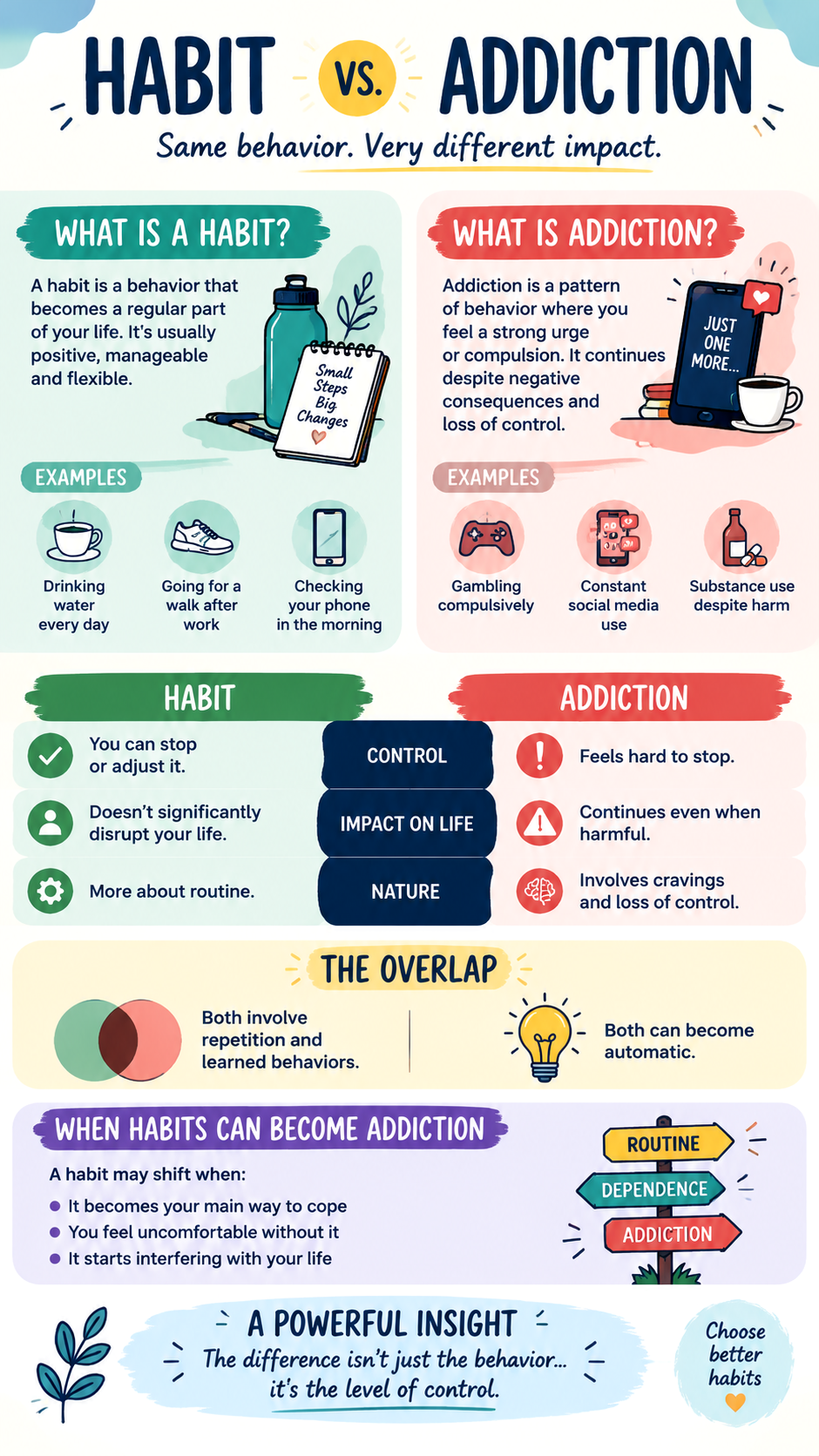
Habit vs Addiction Key Differences, Warning Signs, and How to Recognize Them
Habits shape our daily lives in ways we often barely notice. From checking your phone in the morning to enjoying a cup of coffee before work, many behaviors become automatic through repetition. But what happens when a behavior starts feeling impossible to control? Understanding the difference between a habit and an addiction can help you recognize unhealthy patterns, make informed choices, and build a healthier relationship with your everyday routines.
Although habits and addictions may look similar on the surface, they differ in important ways. A habit is generally a repeated behavior that becomes familiar and automatic, while addiction involves a more persistent pattern of behavior or substance use that can be difficult to control despite harmful consequences. Learning to recognize these differences is an important step toward improving mental well-being, strengthening self-awareness, and knowing when additional support may be helpful.
Key Takeaways
- Habits are repeated behaviors that often become automatic and remain relatively manageable.
- Addiction involves impaired control, strong urges, and continued behavior despite harmful consequences.
- The impact on health, relationships, work, and responsibilities is an important distinction.
- Not every repeated behavior is an addiction, and not every habit is beneficial.
- Self-awareness, practical changes, and professional support can help address problematic patterns.
- Progress begins with understanding your behavior rather than judging yourself for it.
What Is a Habit?
A habit is a behavior that becomes more automatic through repetition. When you perform the same action in a familiar situation over time, your brain can learn to initiate that action with less conscious effort. This makes everyday life more efficient because you do not need to make a fresh decision about every small task.
Think about checking your phone shortly after waking up, drinking coffee every morning, brushing your teeth before bed, or going for a walk after work. These actions may become part of your routine because they are connected to familiar times, places, feelings, or activities.
Habits can be helpful, neutral, or unhelpful. Preparing a healthy breakfast can support your well-being, while repeatedly scrolling through social media before getting out of bed might interfere with your morning routine. Both behaviors can become habitual, but their consequences are different.
Common Characteristics of Habits
- Repetition: The behavior occurs regularly in familiar situations.
- Automaticity: You may perform the action without thinking about every step.
- Manageability: You can often adjust the behavior when circumstances or priorities change.
- Routine: The action fits into a daily schedule or follows a recognizable cue.
- Purpose: The behavior may save time, provide comfort, or help you accomplish something.
For example, someone who drinks coffee every morning may enjoy the taste and appreciate the familiar ritual. If they decide to change their routine, they can often experiment with tea, water, or another morning activity. The change might take some adjustment, but the behavior does not necessarily dominate their decisions or disrupt their life.
Are All Habits Healthy?
No. A habit can be automatic without being beneficial. Nail biting, repeatedly postponing important tasks, late-night scrolling, and reaching for sugary snacks whenever you feel bored can all become established patterns.
The important question is not simply whether you repeat an action. Instead, consider whether it supports your goals, fits your priorities, and remains flexible enough to change when necessary.
Important insight: Repetition alone does not make a behavior an addiction. The level of control you have, the reasons you continue, and the consequences for your life provide much more meaningful clues.
What Is Addiction?
Addiction is a complex condition involving a persistent pattern of substance use or behavior that becomes difficult to control and continues despite significant negative consequences. It can affect a person’s health, emotional well-being, relationships, finances, work, and everyday responsibilities.
Substance-related addictions may involve alcohol or other drugs. Gambling can also develop into an addictive behavior. Other activities, including social media use, gaming, shopping, or spending time online, can become seriously problematic when they interfere with daily functioning. However, frequent engagement alone does not establish a clinical addiction, and not every excessive behavior meets the criteria for an addictive disorder.
Addiction is not simply a lack of discipline or a sign of weak character. Biological processes, psychological factors, stress, environmental influences, and personal circumstances can all contribute. Understanding this complexity encourages a more compassionate and effective approach to recovery.
Common Warning Signs of Addiction
Although experiences differ, several patterns may indicate that a behavior has become more serious than an ordinary habit.
- Strong urges or cravings: You experience persistent urges to engage in the behavior or use a substance.
- Difficulty controlling the behavior: Attempts to reduce, stop, or limit it repeatedly prove unsuccessful.
- Continuing despite harm: You keep engaging in the behavior even after recognizing negative consequences.
- Increasing priority: The behavior begins taking precedence over relationships, responsibilities, or activities you previously valued.
- Repeated disruption: The pattern interferes with your health, finances, work, education, or family life.
- Distress when trying to stop: Attempts to change may bring significant discomfort, frustration, or other symptoms, depending on the behavior or substance involved.
One sign alone does not automatically prove that someone has an addiction. Context, severity, duration, and the overall pattern matter. A qualified healthcare professional can help determine whether a behavior meets the criteria for a recognized condition and identify appropriate treatment options.
Examples of Potentially Addictive Behaviors
Compulsive Gambling
A person may gamble repeatedly despite losing money they need for essential expenses. They might attempt to recover previous losses, hide their gambling from loved ones, or continue even when relationships and financial security are suffering. The concern is not simply enjoying a game of chance, but losing control and continuing despite harm.
Problematic Social Media Use
Checking social media occasionally is a common habit. However, a person may develop a seriously problematic relationship with online platforms if they repeatedly attempt to limit their use but cannot, lose substantial sleep, neglect responsibilities, or experience significant distress connected to their use. These difficulties deserve attention even though excessive social media use is not automatically a formally recognized addiction.
Substance Use Despite Harm
Someone may continue using alcohol or another substance despite health problems, conflict with family members, difficulties at work, or other serious consequences. They may want to cut down but find it difficult to do so. This pattern can indicate a substance use disorder and warrants professional assessment.
Habit vs Addiction: The Key Differences
Habits and addictions can share some outward characteristics. Both may involve repetition, familiar triggers, and behaviors that happen with limited conscious thought. The distinction becomes clearer when you examine control, consequences, and the role the behavior plays in your life.
1. Control Over the Behavior
With an ordinary habit, you can generally adjust your routine when necessary. You might skip your usual morning coffee, choose to walk after lunch instead of after work, or put your phone away during a conversation.
With addiction, attempts to control the behavior may repeatedly fail. You may sincerely intend to stop but find yourself returning to it despite the decision and the consequences.
2. Impact on Everyday Life
A habit usually fits within the structure of your life, even when it is unhelpful. You might spend too much time checking your phone, but still meet your responsibilities and maintain your relationships.
An addictive pattern can begin to interfere with essential areas of life. Work may suffer, bills may go unpaid, sleep may become irregular, or relationships may deteriorate. The behavior increasingly competes with other priorities.
3. Routine Versus Compulsion
Habits are often connected to cues and routines. Seeing your running shoes might remind you to exercise, or finishing lunch might prompt you to brush your teeth.
Addiction can involve intense cravings or a powerful urge to continue, even when the person understands that the behavior is harmful. Relief, emotional escape, or other reinforcing effects may help keep the pattern going.
4. Flexibility and Consequences
A habit can often be modified by changing the environment, adjusting a schedule, or substituting a different action. Although changing a long-standing habit may take effort, the person can usually experiment with alternatives.
Addiction is often more persistent. A person may continue even when the consequences are obvious and meaningful. This does not mean change is impossible. It means the person may need a more comprehensive approach, including professional support, rather than relying on willpower alone.
| Feature | Habit | Addiction |
|---|---|---|
| Control | Generally manageable | Repeated difficulty controlling the behavior |
| Purpose or motivation | Often linked to routine or convenience | May involve cravings, reinforcement, or compulsive urges |
| Impact on life | Often limited, although unhealthy habits can cause problems | May cause substantial harm or disruption |
| Response to change | May improve through routine adjustments | May require structured support or treatment |
| Flexibility | Usually adapts to changing circumstances | Can become a dominant priority despite negative outcomes |
These differences are general guidelines rather than a diagnostic checklist. A harmful habit does not automatically mean addiction, and someone can experience serious consequences from a behavior without meeting the criteria for an addictive disorder.
Can a Habit Turn Into an Addiction?
A repeated behavior can become increasingly difficult to manage, particularly when it provides immediate relief, pleasure, or escape from uncomfortable feelings. However, habits do not inevitably develop into addictions, and there is no universal progression that every person follows.
For example, someone might begin using social media to relax after work. Over time, they may start checking it whenever they feel bored, lonely, anxious, or overwhelmed. If the behavior gradually takes up more time, repeatedly disrupts sleep, and becomes difficult to control despite attempts to change, it may be a sign of a problematic pattern.
The same general principle applies to other behaviors. An activity that begins as an occasional source of enjoyment may become a concern when it consistently interferes with responsibilities or becomes the person’s primary way of managing difficult emotions.
Three Warning Signs to Watch For
- It becomes your main coping strategy: You increasingly rely on the behavior whenever you experience stress, sadness, loneliness, or frustration.
- You feel unable to function comfortably without it: You experience persistent urges or distress when you try to reduce the behavior.
- It interferes with your life: Your health, relationships, sleep, finances, or responsibilities suffer because of the pattern.
These signs do not establish a diagnosis, but they can help you recognize when a behavior deserves closer attention. You do not need to wait until your life feels completely out of control before seeking help.
Quick Note: Some habits provide short-term emotional relief while creating long-term problems. Ask yourself whether a behavior is helping you address a difficulty or simply allowing you to avoid it temporarily. That distinction can reveal useful opportunities for change.
Why Habits and Addiction Can Feel Similar
Both habits and addictions can involve repetition and learned associations. When a particular action repeatedly follows a situation, your brain can begin to anticipate the action when that situation appears again.
For instance, receiving a notification may prompt you to check your phone. Finishing dinner may remind you to have a sweet snack. Feeling stressed may lead you to seek an activity that offers quick relief.
These patterns are influenced by cues, rewards, expectations, and the environment. Once established, they may occur before you have consciously considered whether the behavior fits your current needs.
However, automatic behavior is not the same as addiction. A person can perform an action almost without thinking and still have the flexibility to change it. Addiction involves a more concerning pattern of impaired control and continued behavior despite harmful consequences.
The Role of Stress and Emotional Coping
Stress can make familiar behaviors particularly appealing because familiar actions may require less effort than trying a new response. A person who feels overwhelmed might scroll through their phone, shop online, gamble, or use a substance to change how they feel in the moment.
Short-term relief can reinforce a behavior, especially when the underlying difficulty remains unresolved. Over time, the person may rely increasingly on the same response.
Developing additional coping strategies can help create more choices. Walking, talking with a trusted person, practicing relaxation, maintaining regular sleep, and seeking professional guidance may provide healthier ways to respond to difficult emotions.
How to Recognize Your Own Behavioral Patterns
Understanding your habits begins with curiosity rather than criticism. Instead of immediately labeling a behavior as bad, take time to notice when it occurs, what triggers it, and how you feel afterward.
1. Identify the Trigger
Notice what usually happens just before the behavior. Is it connected to a particular time, place, emotion, person, or activity?
For example, you may automatically check your phone whenever you have a few minutes of free time. Identifying boredom or the appearance of a notification as a trigger can help you understand the pattern.
2. Notice How Much Control You Have
Consider what happens when you decide not to engage in the behavior. Can you postpone it, choose an alternative, or change your routine? Have you repeatedly tried to reduce it without success?
One difficult day does not prove that you have lost control. Look for repeated patterns over time rather than judging yourself based on a single experience.
3. Evaluate the Consequences
Think about how the behavior affects your life. Does it interfere with sleep, relationships, work, education, physical health, or financial stability? Does it leave you feeling better in a lasting way, or does it create problems that make the original difficulty worse?
Be honest about the consequences without turning the exercise into an opportunity for self-blame. The goal is to understand what is happening so you can decide what support or changes might help.
4. Keep a Simple Behavior Journal
Writing down a few observations each day can reveal patterns that are difficult to notice in the moment. You do not need an elaborate tracking system. A short note about the trigger, your feelings, the behavior, and its consequences may be enough to get started.
- What happened immediately before the behavior?
- What were you feeling at the time?
- Did you choose the behavior intentionally or act automatically?
- How did you feel immediately afterward?
- Did the behavior affect any of your responsibilities or relationships?
Over time, these notes can help you identify triggers, recognize progress, and decide whether additional support would be useful.
Practical Ways to Build Healthier Habits
If you have identified a habit that no longer serves you, small, consistent adjustments can help. The most effective approach depends on the behavior, your circumstances, and the reason you want to change it.
Start With One Small Change
Choose a realistic action rather than attempting to transform your entire routine overnight. If you want to become more active, begin with a short walk. If you want to reduce unnecessary phone use, try putting your device away during one meal each day.
Small actions can make a new routine easier to repeat. Once it becomes more familiar, you can adjust the goal gradually.
Make Helpful Behaviors Easier
Your environment influences what you do. Keep items associated with positive routines visible and accessible. Prepare walking shoes near the door, place a book beside your bed, or prepare a water bottle before starting work.
You can also make unwanted behaviors less convenient. Disable unnecessary notifications, move distracting apps away from your home screen, or keep your phone outside the bedroom if that helps you sleep.
Replace Rather Than Simply Remove
When a behavior serves a purpose, removing it without an alternative can leave you feeling frustrated or unsure what to do instead. Consider what the behavior provides and choose another way to meet that need.
If you scroll through social media whenever you feel lonely, you might try messaging a friend or joining a group activity. If you snack whenever you feel stressed, you could experiment with a short walk, a breathing exercise, or another relaxing activity while still responding appropriately to hunger.
The goal is not to eliminate every source of comfort. It is to develop a wider range of responses so that one behavior does not become your only option.
Plan for Setbacks
Changing a familiar behavior can take time. You may return to an old routine during stressful periods or forget your new plan when life becomes busy. These experiences do not automatically mean that you have failed.
Look at what made the behavior more likely, adjust your approach, and begin again. Progress is often easier to maintain when your plan is realistic and allows room for imperfect days.
What to Do If You Suspect an Addiction
When a behavior feels increasingly difficult to control or causes meaningful harm, habit-building techniques alone may not be enough. Addiction can require specialized assessment and treatment, and seeking help is a constructive step rather than a personal failure.
Talk to a Qualified Professional
A doctor, psychologist, psychiatrist, or addiction specialist can help assess what is happening and discuss suitable next steps. Treatment varies according to the substance or behavior, the severity of the problem, and the person’s individual needs.
Options may include counseling, cognitive behavioral therapy, structured addiction treatment, peer support, and medication when clinically appropriate. Some people benefit from a combination of approaches rather than a single intervention.
Reach Out to Trusted People
Isolation can make difficult experiences feel heavier. If you feel comfortable doing so, consider speaking with someone you trust. A supportive friend or family member may help you find resources, attend an appointment, or make practical changes to your environment.
Choose people who can listen without shaming you. Support is most helpful when it respects your dignity and encourages appropriate care.
Avoid Unsafe Attempts to Stop Suddenly
If you suspect dependence on alcohol, sedatives, or another substance, speak with a healthcare professional before stopping abruptly. Withdrawal from some substances can be dangerous and may require medical supervision. A clinician can help you understand the safest way forward.
If the behavior involves gambling or another non-substance activity, practical safeguards may also help. Depending on the situation, these could include blocking access to gambling platforms, limiting access to money, setting digital boundaries, or seeking specialized support. Such steps are not substitutes for treatment when a serious problem is present.
Remember: You do not have to wait until a problem reaches a crisis point before asking for help. If you repeatedly struggle to control a behavior or notice growing harm, an early conversation with a qualified professional can help you understand your options.
Why Understanding the Difference Matters
Recognizing the difference between a habit and an addiction helps you respond to your behavior in a more informed way. Without this understanding, you might dismiss a serious problem as an ordinary routine or assume that every repeated behavior is a sign of addiction.
Neither extreme is helpful. Labeling yourself too quickly can create unnecessary fear, while ignoring persistent loss of control can delay useful support.
Instead, focus on the practical questions: Can I manage this behavior? Does it fit my priorities? What happens when I try to change it? Is it affecting my health or responsibilities? Do I need help to address it safely?
These questions encourage self-awareness without relying on shame. They also help you recognize that healthy change can look different for different people. One person may benefit from adjusting a daily routine, while another may need professional treatment and ongoing support.
At a Glance: Habit vs Addiction
Quick Points
- Habits: Repeated behaviors that often become automatic through routine.
- Addiction: A persistent pattern involving impaired control and continued behavior despite harm.
- Control matters: Notice whether you can change the behavior when you choose to.
- Impact matters: Pay attention to consequences for health, relationships, finances, and responsibilities.
- Support matters: Professional guidance can help when a behavior becomes difficult to manage or causes significant harm.
Conclusion: Build Habits That Support Your Life
The difference between a habit and an addiction is about more than how frequently you repeat a behavior. It also involves your ability to control it, the reasons you continue, and the impact it has on your everyday life.
Healthy habits can help you create structure, support your well-being, and move toward personal goals. Unhelpful habits can often be improved through awareness, environmental changes, and consistent practice. Addiction, however, may involve a more persistent loss of control and continued behavior despite harmful consequences, making professional support especially important.
Start by paying attention to your patterns with honesty and compassion. Notice what triggers your behaviors, consider whether they support your priorities, and identify one realistic change you can make. If a behavior feels impossible to control or is causing serious problems, reach out for appropriate help rather than trying to manage everything alone.
Above all, remember that your behaviors do not define your worth. Understanding them gives you an opportunity to make informed choices, strengthen healthier routines, and seek support when you need it. The goal is not perfection. It is building a life in which your habits serve you instead of controlling your decisions.
Tags
Habit vs Addiction
Healthy Habits
Addiction Awareness
Behavior Change
Mental Well-Being
Self-Awareness
Psychology Tips
Personal Growth