Emotional Regulation Cheat Sheet Coping Skills for Anger, Anxiety, and Overwhelm
Some days, your emotions seem to take over before you have a chance to understand what is happening. Anger builds quickly, anxiety makes it difficult to relax, and even simple tasks can feel overwhelming. On other days, you might feel hurt by something someone said or find yourself shutting down when life becomes too much. Learning how to manage these feelings does not mean ignoring them or forcing yourself to stay positive. It means understanding what you feel, recognizing what you need, and choosing small actions that help you feel more grounded.
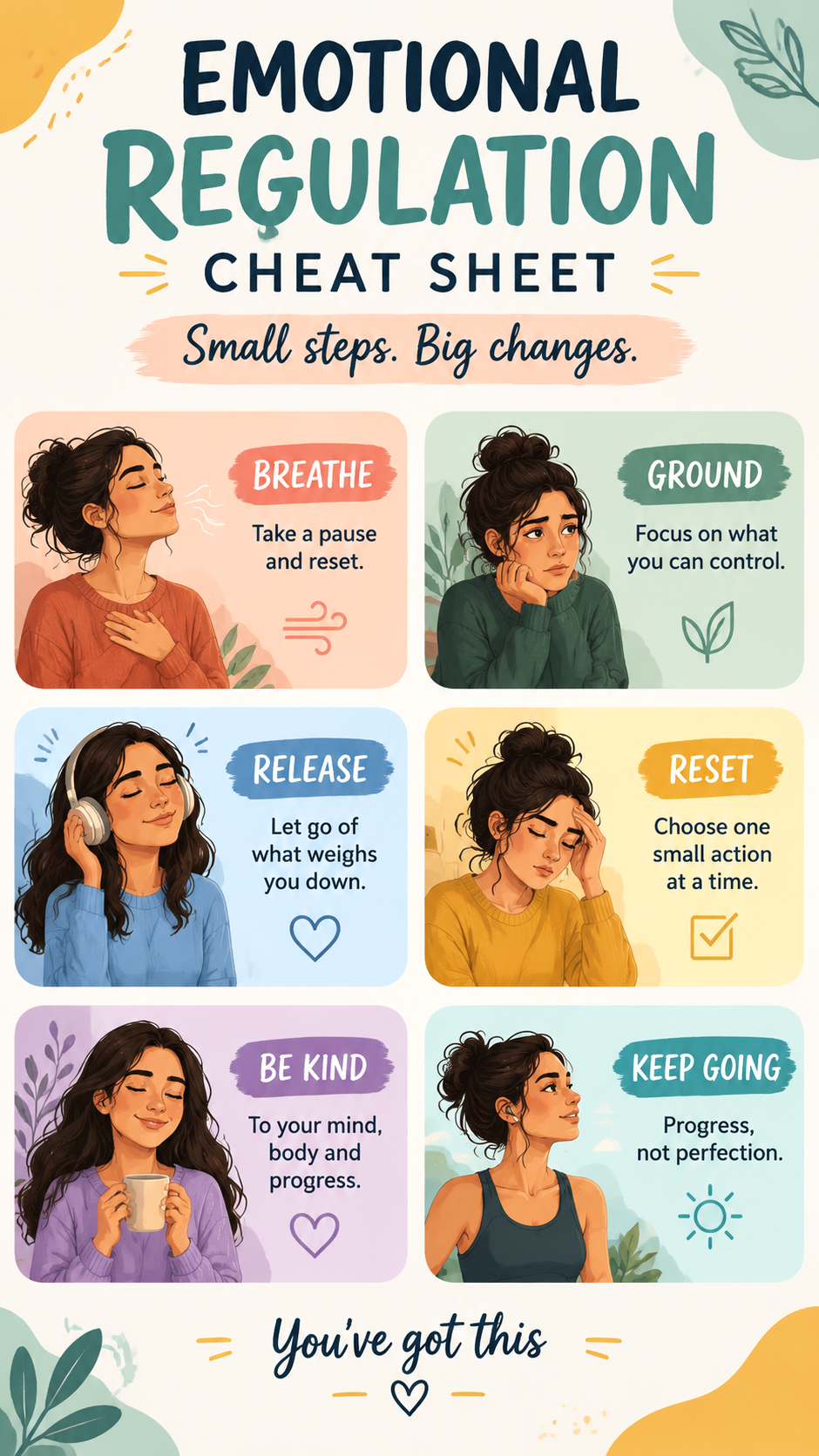
An emotional regulation cheat sheet can make this process easier by giving you practical coping strategies to use when you need them most. Instead of trying to remember complicated advice during a stressful moment, you can turn to simple techniques such as pausing before reacting, grounding yourself, reducing stimulation, naming your needs, and breaking tasks into manageable steps.
The goal is not to control every emotion perfectly. It is to develop a healthier relationship with your feelings so you can respond with greater awareness, patience, and self-compassion.
Key Takeaways
- Emotional regulation begins with noticing your feelings instead of immediately reacting to them.
- Anger may call for a pause, physical movement, and time to cool down.
- Anxiety can become more manageable with grounding techniques and slow, comfortable breathing.
- Feeling overwhelmed may be a sign to reduce stimulation and focus on one thing at a time.
- Emotional hurt often requires identifying your needs, setting boundaries, or seeking connection.
- When you feel shut down, start with basic comfort and one small, manageable action.
What Is Emotional Regulation?
Emotional regulation is the ability to recognize, understand, and respond to your emotions in ways that support your well-being. It involves noticing what you feel, identifying what may have triggered that feeling, and choosing a response that fits the situation.
For example, you might feel angry after a frustrating conversation. Emotional regulation does not require you to pretend that you are fine. Instead, it helps you recognize your anger, pause before saying something hurtful, and decide whether you need space, a conversation, or a practical solution.
Similarly, if you feel anxious before an important appointment, regulating your emotions might involve grounding yourself, slowing your breathing, and preparing for the next step rather than getting caught in a cycle of worrying.
Emotional regulation is not emotional suppression. Suppression involves hiding, denying, or pushing away feelings. Regulation allows you to acknowledge your emotions while deciding how to respond to them.
Why Emotional Regulation Matters
Emotions provide useful information about your experiences, relationships, needs, and environment. Anger may signal frustration or a crossed boundary. Anxiety may alert you to uncertainty. Sadness may reflect loss, disappointment, or a need for support.
When you understand these emotional signals, you can respond more intentionally. You may find it easier to communicate your needs, make thoughtful decisions, recover after stressful experiences, and avoid reacting in ways you later regret.
Emotional regulation can also support healthier relationships. Taking a moment before responding during conflict, for instance, can create room for clearer communication and reduce unnecessary misunderstandings.
1. When You Feel Angry: Pause and Move
Anger can arrive with intense physical sensations. Your jaw may tighten, your breathing may become faster, or you may feel an immediate urge to argue, defend yourself, or walk away. These reactions can make it difficult to think clearly in the moment.
The first step in managing anger is to create a little space between the emotion and your response.
Try These Anger Management Techniques
- Pause before reacting. Give yourself permission to wait before replying to a message, continuing an argument, or making an important decision.
- Notice your body. Check whether your hands are clenched, your shoulders are raised, or your breathing has changed.
- Move gently. Take a short walk, stretch, or change your surroundings if it is safe to do so.
- Name the feeling. Try saying, “I feel angry because I feel ignored,” or “I am frustrated because this situation feels unfair.”
- Choose your next step. Decide whether you need a break, a boundary, a calm conversation, or help solving a problem.
A Simple Script for Angry Moments
When you feel yourself becoming reactive, try saying, “I am upset, and I want to handle this carefully. I need a few minutes before we continue.”
This statement acknowledges your emotion without blaming another person. It also creates space for you to return to the conversation when you feel more prepared.
Important: You do not have to resolve a conflict while your emotions are at their strongest. A pause is useful when it helps you return to the situation more safely and thoughtfully. If you take a break, communicate when you can and return to the discussion when appropriate.
2. When You Feel Anxious: Ground Yourself and Exhale Slowly
Anxiety often pulls your attention toward what might happen next. You may replay conversations, imagine worst-case scenarios, or struggle to settle your thoughts even when nothing urgent is happening around you.
Grounding exercises can help bring your attention back to the present moment. Slow, comfortable breathing may also help you manage the physical sensations associated with stress.
Use the Five-Senses Grounding Exercise
When anxiety begins to build, gently direct your attention to your immediate surroundings.
- Notice five things you can see.
- Identify four things you can physically feel, such as your feet on the floor or your back against a chair.
- Listen for three sounds around you.
- Notice two scents, if any are present.
- Identify one taste or one comfortable sensation in your mouth.
You do not need to complete the exercise perfectly. The purpose is to shift some of your attention away from anxious thoughts and toward what is happening right now.
Practice a Gentle, Longer Exhale
Find a comfortable position and allow your shoulders to relax. Breathe in gently, then breathe out a little more slowly if that feels comfortable. Repeat for several breaths without forcing the pace.
If focusing on your breathing makes you feel more anxious, stop and try another grounding method, such as noticing objects in the room or feeling your feet against the floor.
Pro Tip: You do not need to make anxiety disappear before taking action. Try asking, “What is one thing I can do in the next five minutes?” A small, realistic step can help you move forward even when some uncertainty remains.
3. When You Feel Overwhelmed: Reduce Input
Feeling overwhelmed can happen when too many demands, decisions, sounds, thoughts, or responsibilities compete for your attention. You might struggle to prioritize, experience mental fatigue, or feel unable to begin even a simple task.
In these moments, adding more instructions or trying harder to do everything at once may not help. Reducing the amount of information and activity you are dealing with can make the next step feel more manageable.
How to Lower Overwhelm
- Reduce sensory input. Lower the volume, dim bright lights, or move to a quieter space if possible.
- Pause notifications. Silence nonessential alerts and close tabs or applications you do not need.
- Write down your thoughts. Put tasks, worries, and reminders on paper instead of trying to hold everything in your mind.
- Choose one priority. Identify the single task that matters most right now.
- Take a short reset. Drink some water, stretch, or sit quietly for a few minutes.
Try a Mental Decluttering Exercise
Divide a piece of paper into three sections: “Now,” “Later,” and “Not Mine to Solve.” Write down the things occupying your attention and place each item in the appropriate section.
Focus only on the “Now” section. Move anything that can wait into “Later,” and recognize that some problems may be outside your control or responsibility.
Why This Matters
Overwhelm can make every task feel equally urgent. Reducing distractions and choosing one priority gives your attention a clearer direction. You do not need to finish everything to make progress. Sometimes, the most helpful action is deciding what can wait.
4. When You Feel Hurt: Name What You Need
Emotional hurt can follow rejection, disappointment, criticism, conflict, or feeling misunderstood. Sometimes the feeling is obvious. Other times, you may know that something is wrong without understanding exactly why it affected you so deeply.
Instead of criticizing yourself for being sensitive, give yourself time to identify what the feeling may be communicating.
Identify the Need Behind the Feeling
Ask yourself a few gentle questions:
- What happened, and what part of it affected me?
- What emotion am I experiencing: sadness, disappointment, loneliness, embarrassment, or something else?
- What did I need in that moment?
- Would reassurance, understanding, space, an apology, or a clear boundary help?
- Is there something I need to communicate, or do I need time to process this privately?
For example, if a friend cancels plans at the last minute, you might initially feel angry. After reflecting, you may realize that the deeper feeling is disappointment or loneliness because you were looking forward to spending time together.
Understanding that need can help you respond more clearly. You might explain that you felt disappointed and ask to make another plan, rather than assuming the cancellation means the friendship is unimportant.
Practice Communicating Your Feelings
Try using a simple sentence structure: “I felt ___ when ___ because ___. What would help me is ___.”
For example: “I felt hurt when our plans changed without much notice because I was looking forward to seeing you. Could we try to let each other know earlier next time?”
This approach helps you describe your experience and request what you need without assuming that you know another person’s intentions.
5. When You Feel Frustrated: Make the Task Smaller
Frustration often appears when you are trying to accomplish something but keep running into obstacles. You may feel stuck, impatient, disappointed in yourself, or tempted to give up.
Sometimes the problem is not a lack of motivation. The task may be too large, too vague, too difficult, or too demanding for the energy you currently have.
Break the Task Into Tiny Steps
Instead of focusing on the entire project, identify the smallest useful action you can take.
- If cleaning your home feels overwhelming, clear one surface.
- If writing an assignment feels difficult, open the document and write three rough sentences.
- If your inbox is stressful, answer one important message.
- If planning your week feels complicated, write down tomorrow’s top priority.
- If learning a new skill feels frustrating, practice one part before moving on.
Small steps reduce the pressure to complete everything immediately. They also give you an opportunity to learn what is working and adjust your approach.
Use the Five-Minute Start
Choose one manageable task and commit to working on it for five minutes. When the time is up, you can continue, take a break, or decide what to do next.
The purpose is not to pressure yourself into working longer. It is to make starting feel less intimidating.
It also helps to replace harsh self-talk with a more constructive question. Instead of saying, “Why can’t I get this done?” try asking, “What would make this task easier to begin?”
6. When You Feel Shut Down: Start With Body Safety and One Tiny Action
Sometimes stress does not make you feel restless or reactive. Instead, you may feel numb, exhausted, disconnected, or unable to begin even simple activities. You might want to withdraw from conversations, stay in bed, or avoid decisions because everything feels like too much.
This experience can have different causes, including exhaustion, prolonged stress, emotional overload, or other mental and physical health concerns. It is important not to assume that every experience of shutting down has the same explanation.
When you feel this way, demanding immediate productivity from yourself may add more pressure. A gentler approach is to focus first on basic comfort, a sense of safety, and one achievable action.
Begin With Basic Needs
- Find a comfortable position. Sit somewhere supportive or lie down if you need to rest.
- Notice your surroundings. Look around and identify a few familiar objects in the room.
- Check your physical needs. Consider whether you need water, food, warmth, rest, or a quieter environment.
- Reduce unnecessary demands. Postpone nonurgent decisions when possible.
- Choose one tiny action. Open a curtain, wash your face, change into comfortable clothes, or send a brief message to someone you trust.
Let Small Actions Be Enough
You may not feel motivated before you begin. That is okay. Sometimes a small action makes the next action easier, while other times rest is the most appropriate response.
Try saying, “I do not have to solve everything right now. I can take care of one basic need and decide what comes next.”
If feeling shut down happens frequently, lasts for a long time, or makes daily life difficult, consider speaking with a qualified mental health professional or healthcare provider. You deserve support that goes beyond simply pushing through difficult days.
How to Build an Emotional Regulation Routine
Emotional regulation becomes easier to practice when you develop simple habits during calmer moments. You do not need a complicated wellness routine or a long list of daily tasks. A few consistent practices can help you become more familiar with your emotions and what supports you.
1. Check In With Yourself Daily
Spend a minute or two noticing how you feel. Ask yourself what emotions are present, how your body feels, and what you might need. You can do this in the morning, during a break, or before bed.
2. Create a Personal Coping List
Write down a few strategies that have helped you in the past. Your list might include taking a walk, listening to calming music, journaling, stretching, calling a trusted person, or spending time in a quiet space.
Keep the list somewhere easy to access. When emotions become intense, having options ready can reduce the effort involved in deciding what to do.
3. Practice Before You Need It
Try grounding, mindful breathing, or brief pauses when you are relatively calm. Practicing a technique ahead of time helps you learn whether it feels comfortable and useful for you.
4. Reflect Without Judging Yourself
After a difficult moment, consider what happened and what you might try next time. Instead of evaluating yourself as successful or unsuccessful, focus on what you learned.
Perhaps you noticed your anger earlier than usual, remembered to take a break, or realized that you needed more rest. These are useful observations, even if the situation did not unfold exactly as you hoped.
Remember: Emotional regulation is a skill, not a test you must pass. Some days, you may be able to use several coping strategies. On other days, getting through the moment with patience and support may be enough. Progress includes learning what you need, recognizing your limits, and trying again without unnecessary self-criticism.
Common Emotional Regulation Mistakes to Avoid
Even helpful coping strategies can become frustrating when you approach them with unrealistic expectations. Understanding a few common mistakes can make your emotional regulation practice more compassionate and practical.
Expecting Yourself to Calm Down Immediately
Breathing exercises, grounding, and movement may help, but they do not guarantee that a difficult emotion will disappear. Give yourself time and experiment with different approaches.
Treating Every Emotion as a Problem
Uncomfortable emotions are a normal part of being human. You do not need to eliminate sadness, anger, anxiety, or disappointment to be emotionally healthy. The aim is to understand these feelings and respond in ways that support your needs and values.
Ignoring Physical Needs
Stress can feel more difficult to manage when you are hungry, exhausted, uncomfortable, or overstimulated. Alongside emotional coping skills, pay attention to rest, nourishment, hydration, movement, and your surroundings.
Comparing Your Progress With Someone Else’s
People experience emotions differently, and the same strategy will not work equally well for everyone. Focus on discovering what helps you rather than measuring your progress against another person’s routine.
When to Seek Additional Support
Self-help strategies can be useful, but they are not a substitute for professional support when emotional difficulties become persistent or significantly interfere with daily life.
Consider reaching out to a qualified mental health professional if you frequently feel unable to manage your emotions, experience ongoing anxiety or low mood, struggle with relationships, or find it difficult to complete everyday responsibilities.
A therapist can help you identify emotional patterns, understand possible triggers, and develop coping skills suited to your circumstances. You do not need to wait until you reach a breaking point to ask for help.
If you feel unsafe, fear that you may harm yourself or someone else, or cannot meet your immediate basic needs, seek appropriate urgent support from local emergency services or a trusted person who can help you access care.
Emotional Regulation Cheat Sheet: Quick Guide
At a Glance
- Angry: Pause, notice your body, move gently, and choose your response.
- Anxious: Ground yourself in the present and breathe slowly if comfortable.
- Overwhelmed: Reduce distractions, simplify your surroundings, and choose one priority.
- Hurt: Name the emotion, identify the need, and communicate it clearly when appropriate.
- Frustrated: Break the task into smaller steps and start with one manageable action.
- Shut down: Check your basic needs, reduce demands, and begin with a tiny action or rest.
Consider saving this quick guide somewhere you can find it easily. You might keep a copy in your journal, add the strategies to your phone’s notes, or place a printed version near your desk. The best emotional regulation cheat sheet is one you can actually use when you need a little extra support.
Conclusion: Small Steps Can Make Difficult Moments Easier
Learning emotional regulation is about creating more space between what you feel and how you respond. When anger rises, you can pause and move. When anxiety takes over your attention, you can ground yourself in the present. When everything feels overwhelming, you can reduce input and focus on one priority. When you feel hurt, you can identify your needs. When frustration builds, you can make the task smaller. And when you feel shut down, you can begin with comfort, basic needs, and one tiny action.
You will not use every strategy perfectly every time, and that is completely normal. The purpose of these coping skills is to give you practical options, not another set of expectations to meet.
Start with the technique that feels most appropriate for your current situation. Practice it gently, notice what helps, and adjust when necessary. Over time, these small moments of awareness can help you build a more supportive relationship with your emotions.
Save this emotional regulation cheat sheet for a hard day. You do not have to solve everything at once. Sometimes, the most helpful next step is simply pausing, noticing what you need, and treating yourself with a little more kindness.
Tags
Emotional Regulation
Coping Skills
Anger Management
Anxiety Relief
Grounding Techniques
Stress Management
Mindfulness
Self-Care