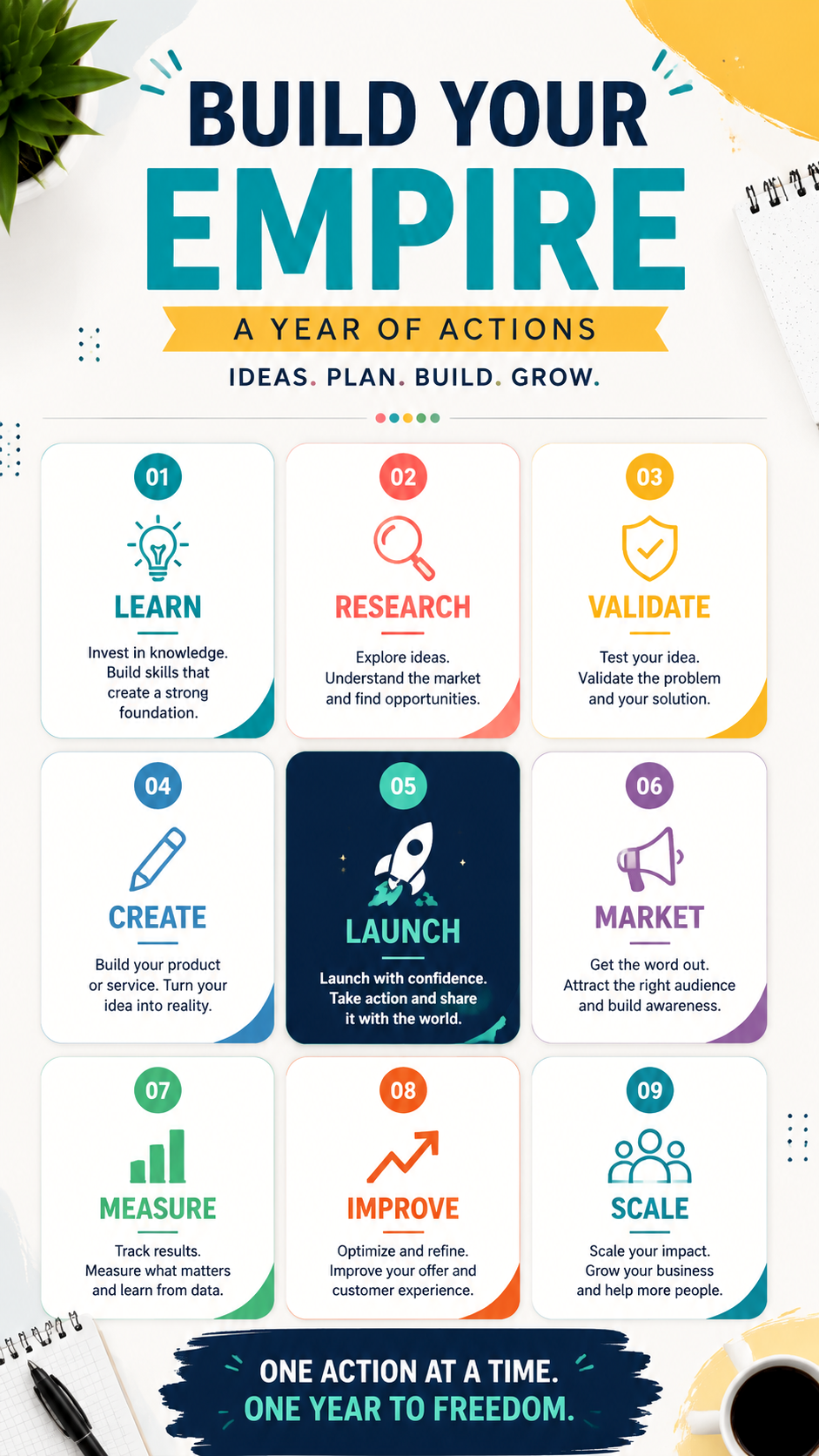
Build Your Empire 12-Month Business Growth Plan Success Strategy
Building a successful business rarely happens through one dramatic breakthrough. It is usually the result of a series of focused actions taken consistently over time. A strong business growth plan turns a big ambition into manageable steps, helping you move from an initial idea to a validated offer, a confident launch, effective marketing, measurable results, and sustainable growth.
The 12-month roadmap presented here follows a practical progression: learn, research, validate, create, launch, market, measure, improve, and scale. Each stage has a specific purpose, making the journey easier to understand and giving entrepreneurs a clear action plan for building their own business empire.
Key Takeaways
- Build knowledge and skills before rushing into execution.
- Research your market and understand the people you want to serve.
- Validate your business idea before investing heavily in it.
- Create a useful product or service and launch it with confidence.
- Use marketing, measurement, and customer feedback to improve steadily.
- Scale only after you understand what is working and why.
What It Really Means to Build Your Empire
The phrase build your empire can sound ambitious, but business growth is often much more practical than the phrase suggests. Your empire does not have to begin with a large company, a huge audience, or a complicated business model. It can start with one useful skill, one clear idea, one customer, or one simple offer.
The goal is to create something valuable and develop it systematically. Instead of trying to accomplish everything at once, divide the journey into stages. This makes business planning less overwhelming and gives you a way to identify what deserves your attention right now.
Important: The strongest business growth strategies are built around consistent action. You do not need to have every answer on day one. Learn, test, measure, and improve as you move forward.
Months 1 to 3: Learn, Research, and Validate
The first quarter of the roadmap focuses on preparation. This does not mean spending months planning without taking action. Instead, it means developing enough knowledge to make smarter decisions and testing whether your idea has genuine potential.
1. Learn the Skills That Build Your Foundation
January begins with learning. Every business requires knowledge, whether that knowledge involves marketing, sales, product development, communication, finance, content creation, leadership, or customer service.
Start by identifying the skills most relevant to your business goal. You do not need to become an expert in everything. Focus first on the capabilities that will help you solve a real problem and communicate your value clearly.
- Identify three to five skills your business needs most.
- Study successful businesses in your niche.
- Practice your skills through small real-world projects.
- Keep notes on lessons, mistakes, and useful ideas.
2. Research the Market Before You Build
February shifts from learning to research. A good idea becomes much stronger when you understand the market around it. Research helps you discover what customers want, what competitors offer, what gaps exist, and what people are already willing to spend time or money on.
Look beyond surface-level trends. Study customer questions, complaints, reviews, competitor positioning, common solutions, and recurring problems. The goal is to understand the environment in which your business will operate.
Questions Worth Asking During Market Research
- Who experiences the problem I want to solve?
- How are people solving it today?
- What do existing solutions do well?
- Where are customers still frustrated?
- What could make my offer simpler, better, or more useful?
3. Validate the Problem and Your Solution
March is dedicated to validation. This is one of the most important stages because enthusiasm for an idea does not automatically mean there is demand for it.
Validation means putting your assumptions in front of real people and looking for evidence. Talk to potential customers, gather feedback, test a simple version of your offer, or create a basic landing page or sample product. You are not trying to make everything perfect. You are trying to learn whether the problem matters enough for people to consider your solution.
Pro Tip: Validate the problem before becoming attached to your solution. If customers describe the problem differently than you expected, treat that feedback as valuable information rather than a setback.
Months 4 to 6: Create, Launch, and Market
Once your idea has been researched and tested, the next phase is about turning it into something people can actually experience. This is where planning becomes visible action.
4. Create a Product or Service People Can Use
April focuses on creation. Build the simplest useful version of your product or service. Avoid spending excessive time polishing details that customers have not said they need.
A strong first version should solve the core problem identified during validation. Whether you are creating a digital product, consulting service, physical product, creative offer, or online business, concentrate on usefulness and clarity.
- Define the primary customer problem.
- Create a clear solution to that problem.
- Remove unnecessary features or complexity.
- Ask early users for practical feedback.
- Prepare a simple explanation of the value you provide.
5. Launch With Confidence
May represents the major action point in the roadmap: launch. A launch does not need to be enormous. What matters is making your offer available, communicating what it does, and giving people an opportunity to respond.
Set a launch date, prepare your core messaging, organize your customer journey, and decide how you will announce the offer. Give yourself permission to learn during the process. Your first launch is not necessarily the final version of your business.
Why This Matters
A business idea cannot generate meaningful feedback until it meets the real world. Launching creates an opportunity to learn from customers, identify weaknesses, discover strengths, and replace assumptions with evidence.
6. Market Your Business and Build Awareness
June focuses on marketing. Creating something valuable is only part of the job. The right audience needs to know that it exists and understand why it may be useful to them.
Choose marketing channels that match your audience and your strengths. Content marketing, social media, email, partnerships, search engine optimization, communities, referrals, and direct outreach can all play a role depending on your business.
Focus Your Marketing Message
A simple marketing message should explain who you help, what problem you solve, and what outcome your offer supports. Avoid trying to appeal to everyone. A specific message often makes it easier for the right audience to recognize that your business is relevant to them.
Months 7 to 9: Measure, Improve, and Scale
The second half of the roadmap moves from launching and promoting to understanding performance. Growth becomes more sustainable when decisions are based on what you can observe rather than what you hope is happening.
7. Measure What Matters
July is about measurement. Choose a small number of meaningful metrics that tell you whether your business is progressing.
Depending on your business model, useful measurements might include leads, conversions, sales, repeat customers, website traffic, engagement, customer acquisition costs, average order value, or customer feedback. The goal is not to track everything. It is to understand the numbers that support better decisions.
- Identify your most important business goal.
- Choose metrics directly connected to that goal.
- Review results consistently.
- Look for patterns instead of reacting to every small change.
8. Improve Your Offer and Customer Experience
August is dedicated to improvement. Once you have real data and customer feedback, you can make more informed changes.
Look for friction in the customer journey. Is your offer easy to understand? Is purchasing or signing up straightforward? Are customers getting the result they expected? Which parts generate the most positive feedback, and which areas repeatedly create confusion?
Important: Improvement does not always mean adding more. Sometimes the best growth decision is to simplify your offer, clarify your message, remove unnecessary steps, or make one important customer experience significantly better.
9. Scale Your Impact
September brings the roadmap to scaling. Scaling should come after you have evidence that your business model, offer, and customer experience are working reasonably well.
Growth can involve reaching a larger audience, introducing complementary offers, improving systems, building a team, expanding distribution, or increasing your capacity to serve customers. The right path depends on the business.
Before scaling, identify the activities that already produce results. Then consider how to repeat them more efficiently without sacrificing quality. Sustainable growth is about creating systems that can support increased demand.
How to Turn the Roadmap Into a Weekly Action Plan
A 12-month business roadmap is useful, but it becomes far more powerful when translated into weekly actions. Big goals can feel distant. Small commitments create momentum.
At the beginning of each week, choose one primary business objective. Break it into a few tasks that can realistically be completed. At the end of the week, review what happened and decide what should happen next.
- Choose one priority: Decide what would create the most progress this week.
- Define the next actions: Turn the priority into specific tasks.
- Schedule focused work: Give important tasks a place on your calendar.
- Track completion: Record what was finished and what remains.
- Review and adjust: Use what you learned to plan the following week.
This approach supports the central message of the roadmap: one action at a time can become a year of meaningful progress. You do not need constant motivation when your next step is clear.
Common Mistakes That Can Slow Business Growth
Following a business growth plan does not guarantee that every decision will work. The key is to avoid predictable mistakes and respond quickly when something needs to change.
Trying to Build Everything at Once
Entrepreneurs often have dozens of ideas competing for attention. Too many priorities can dilute your effort. Choose a clear focus and complete the most important work before expanding into additional projects.
Skipping Market Validation
It is tempting to start creating immediately because building feels productive. However, a polished product without a clear customer need can consume significant time and resources. Research and validation can reduce that risk.
Ignoring Feedback
Customer feedback can reveal opportunities that were impossible to see from inside the business. Listen for repeated concerns, questions, and requests. Not every suggestion needs to be implemented, but recurring patterns deserve attention.
Measuring Vanity Metrics
Large numbers can look impressive without indicating business health. Focus on measurements that connect to your actual goals. A smaller but engaged audience can be more valuable than a large audience that never takes meaningful action.
Build Your Empire One Step at a Time
The most encouraging part of a structured business roadmap is that it replaces an overwhelming vision with a sequence of achievable actions. First, learn. Then research. Validate the opportunity before creating. Build something useful, launch it, tell the right people about it, measure the response, improve what you have, and scale what works.
You may not follow every month perfectly, and your business may require adjustments along the way. That is completely normal. A roadmap is a guide, not a rigid set of rules. The most important habit is continuing to move forward while learning from the results.
Important: Sustainable business growth is rarely about doing everything faster. It is about doing the right things consistently, learning from real results, and building systems that make progress repeatable.
Quick Points
- Learn before you leap.
- Research before you build.
- Validate before you invest heavily.
- Measure before you scale.
- Keep improving as your customers and business evolve.
Conclusion: Make This Your Year of Action
Building your empire does not require one giant leap. It requires a direction, a practical plan, and the willingness to take the next useful step. This 12-month business growth strategy provides a simple framework for moving from education and research to validation, creation, launching, marketing, measurement, improvement, and scaling.
Use the roadmap as a starting point for your own business plan. Adapt the timeline to your goals, industry, resources, and audience. Most importantly, keep your attention on meaningful action. One focused action today can become a powerful foundation for tomorrow.
Whether you are starting a small business, developing a startup idea, growing an online brand, or building a personal business around your skills, progress becomes easier when you know what to focus on next. Start where you are, take the next step, learn from the result, and keep building.
Tags
Business Growth
Entrepreneurship
Business Plan
Startup Strategy
Marketing Strategy
Business Success
Productivity
Personal Growth