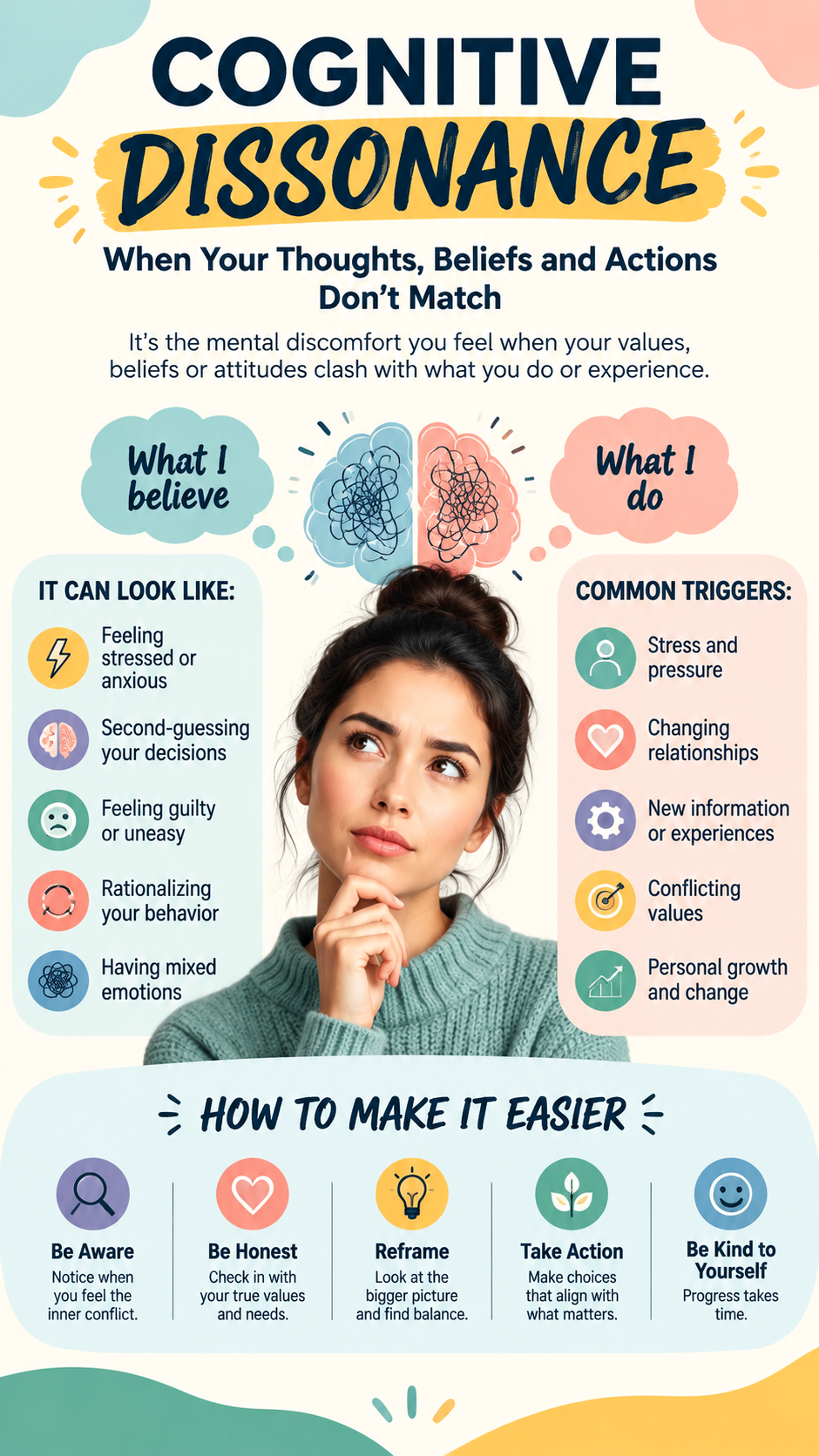
Cognitive Dissonance Explained Psychology, Beliefs, Behavior Mental Conflict
Have you ever found yourself doing something that goes against what you believe is right? Perhaps you know that smoking can harm your health but continue the habit, spend money on something you do not need despite trying to save, or stay in a situation that conflicts with your personal values. These experiences can create an uncomfortable feeling that is difficult to ignore. In psychology, this mental tension is known as cognitive dissonance.
Cognitive dissonance occurs when a person’s beliefs, attitudes, values, or behaviors conflict with one another. The mind naturally seeks consistency, so recognizing a contradiction can create psychological discomfort, stress, guilt, or uncertainty. To reduce these feelings, people may change their behavior, reconsider their beliefs, justify their choices, or avoid information that challenges their existing views.
Understanding cognitive dissonance can help you recognize everyday thinking patterns, make more thoughtful decisions, and develop greater self-awareness. It also provides valuable insight into habits, relationships, consumer behavior, addiction, and personal growth.
Key Takeaways
- Cognitive dissonance is the psychological discomfort associated with conflicting beliefs, values, or actions.
- The theory was proposed by psychologist Leon Festinger in 1957.
- People often reduce dissonance by changing their behavior, adjusting their beliefs, or rationalizing their decisions.
- Everyday examples include unhealthy habits, impulse purchases, procrastination, and relationship conflicts.
- Recognizing contradictions can encourage more consistent choices and healthier coping strategies.
- Honest reflection and openness to new information can help people respond constructively to mental conflict.
What Is Cognitive Dissonance in Psychology?
Cognitive dissonance is a psychological concept describing the discomfort that can arise when two or more cognitions are inconsistent. Cognitions include thoughts, beliefs, attitudes, values, knowledge, and perceptions about personal behavior.
For example, someone might believe that maintaining good health is important while regularly ignoring exercise, sleep, or nutrition. The person’s belief and behavior do not align. When this inconsistency becomes noticeable, it may produce frustration, guilt, anxiety, or a desire to explain the behavior.
The term does not mean that every disagreement between thoughts automatically causes distress. The discomfort depends on factors such as the importance of the conflicting beliefs, the person’s commitment to them, and whether the inconsistency feels personally significant.
The Meaning Behind Beliefs and Actions
People develop beliefs about how they should live, what they value, and how they want others to perceive them. These beliefs help guide decisions and provide a sense of identity. However, real-life behavior does not always match personal standards.
Consider someone who strongly values honesty but tells a lie to avoid an uncomfortable conversation. The person may experience an internal conflict between the value of honesty and the decision to lie.
To reduce the discomfort, the person might apologize and tell the truth, reconsider the importance of honesty in that situation, or convince themselves that the lie was necessary. Each response represents a different way of dealing with inconsistency.
Important insight: Cognitive dissonance is not simply a sign that someone is confused or behaving irrationally. It reflects a tension between thoughts, values, and actions that can motivate a person to restore consistency or find an explanation for the conflict.
Leon Festinger and the Origins of Cognitive Dissonance Theory
Psychologist Leon Festinger introduced cognitive dissonance theory in 1957. His work challenged the simple assumption that people always change their attitudes when presented with evidence that contradicts their beliefs.
Festinger proposed that inconsistencies among important cognitions can create an uncomfortable motivational state. People are then encouraged to reduce that discomfort, although the method they choose may not always be logical, accurate, or beneficial.
For instance, a person who makes a costly decision may become more committed to defending it after discovering information that suggests the decision was a mistake. Instead of immediately changing course, the person might emphasize the benefits and minimize the disadvantages.
This theory has influenced research into decision-making, persuasion, attitudes, social psychology, and the ways people explain their own behavior.
Why Does the Brain Seek Consistency?
Consistency helps people make sense of their experiences. When beliefs and behavior seem aligned, decisions can feel easier to understand and defend. Contradictions, on the other hand, may challenge a person’s self-image or sense of control.
Imagine believing that you are a careful shopper while repeatedly purchasing expensive items on impulse. Acknowledging the contradiction may raise uncomfortable questions about your spending habits.
You might respond by creating a budget and changing your behavior. Alternatively, you could tell yourself that the purchases were deserved or that the discounts made them financially sensible. The second response may reduce immediate discomfort without addressing the underlying habit.
How Cognitive Dissonance Develops
Cognitive dissonance often follows a recognizable pattern. A person holds a belief, encounters behavior or information that conflicts with it, experiences discomfort, and attempts to reduce the inconsistency.
1. A Person Holds a Belief or Value
The process begins with an idea, expectation, or personal standard. Someone might believe that smoking is harmful, that honesty matters, or that financial responsibility is important.
The belief becomes especially relevant when it is connected to personal identity, long-term goals, or a decision the person must make.
2. Behavior or New Information Creates a Conflict
The person acts in a way that contradicts the belief or encounters evidence that challenges an existing opinion. Someone who knows smoking carries health risks but continues smoking may recognize a clear mismatch between knowledge and behavior.
Likewise, a student who values academic success but repeatedly postpones studying may notice that their actions are inconsistent with their goals.
3. Psychological Discomfort Appears
Once the contradiction becomes meaningful, the person may feel guilt, regret, tension, embarrassment, or frustration. The exact emotional response varies from one individual and situation to another.
Some people experience a strong internal conflict, while others barely notice the inconsistency until someone points it out or the consequences become difficult to ignore.
4. The Person Tries to Reduce the Discomfort
The mind may respond by changing the behavior, revising a belief, introducing an additional explanation, or avoiding information that makes the conflict more noticeable.
For example, a person who repeatedly misses exercise sessions might decide to establish a realistic schedule. Another person might insist that exercise is unnecessary because they already feel healthy. These responses differ because one changes the behavior while the other attempts to reinterpret the situation.
5. A New Sense of Consistency Emerges
After making a change or adopting an explanation, the person may feel less conflicted. However, the resolution does not necessarily mean the original problem has been solved.
Changing a harmful habit can address the source of the inconsistency. Rationalizing that habit may reduce discomfort temporarily while leaving the behavior unchanged.
Why This Matters
Reducing psychological discomfort and solving the underlying problem are not always the same thing. When a contradiction appears, ask whether your response helps you act according to your values or simply makes an uncomfortable situation easier to justify.
Common Ways People Reduce Cognitive Dissonance
People can respond to cognitive dissonance in several ways. The most appropriate response depends on the situation, the available evidence, and whether the conflicting behavior can realistically be changed.
1. Change the Behavior
Changing behavior directly addresses the inconsistency between what a person believes and what they do.
For example, someone who values physical health but rarely exercises might begin taking short daily walks. A person who wants to save money could set spending limits and review purchases before checking out.
Behavior change can be difficult, especially when habits are reinforced by stress, convenience, social pressure, or addiction. Small, realistic steps may be more sustainable than expecting an immediate transformation.
2. Change or Reconsider a Belief
Sometimes new information reveals that an existing belief is inaccurate, unrealistic, or too rigid. Reconsidering that belief can reduce the conflict.
For example, a person who believes that asking for help demonstrates weakness might reconsider that assumption after learning how collaboration and support can improve problem-solving.
Changing a belief is not automatically a negative response. It can represent learning, personal development, and a willingness to update one’s perspective when credible evidence becomes available.
3. Use Rationalization to Justify the Behavior
Rationalization occurs when someone creates an explanation that makes a questionable decision feel more acceptable. The explanation may contain some truth, but it can also minimize responsibility or overlook important evidence.
For example, a person who purchases an expensive item despite having financial goals might say, “I have worked hard, so I deserve this.” That statement may reflect a genuine desire for enjoyment, but it does not resolve the conflict with the person’s budget.
Rationalization is common because it can protect self-esteem and reduce uncomfortable feelings without requiring an immediate change.
4. Add New Beliefs or Explanations
A person may introduce additional thoughts that make the conflicting behavior seem more reasonable. This process is sometimes described as adding consonant cognitions.
For instance, someone who struggles to maintain a balanced diet might focus on the fact that they exercised earlier in the day. Exercise is beneficial, but it does not automatically eliminate the effects of every dietary choice.
The new belief may help the person see a more balanced picture, or it may become a way to dismiss the original concern. The difference depends on whether the explanation is realistic and relevant.
5. Avoid Conflicting Information
People sometimes avoid information that challenges their existing beliefs. They may ignore feedback, reject unfamiliar perspectives, or seek opinions that reinforce what they already think.
This response can provide temporary relief, but it may also prevent learning and make inaccurate assumptions harder to recognize.
Being willing to consider different viewpoints does not mean accepting every claim. It means evaluating evidence fairly rather than dismissing information simply because it feels uncomfortable.
Everyday Examples of Cognitive Dissonance
Cognitive dissonance is not limited to major life decisions. It can appear in ordinary situations involving health, relationships, finances, education, and personal responsibility.
Unhealthy Habits Despite Knowing the Risks
A person may understand the health risks associated with smoking but continue because nicotine dependence, social situations, or stress make quitting difficult. The contradiction between knowledge and behavior can produce concern or guilt.
The person might attempt to quit, reduce smoking, seek professional support, or minimize the risks to feel less conflicted. Understanding the psychological conflict can be useful, but effective support may also be necessary to address dependence.
Staying in an Unhealthy Relationship
Someone may believe that respect, trust, and emotional safety are essential in a relationship while continuing to tolerate repeated harmful behavior. Their feelings, shared history, practical circumstances, and hopes for change may complicate the decision to leave or set boundaries.
They might focus on positive memories, explain away recurring problems, or believe that the other person will eventually change. These reactions are not proof of cognitive dissonance on their own, but they can illustrate how conflicting beliefs and experiences may create emotional tension.
When a relationship feels unsafe or controlling, personal safety and support from trusted people or qualified professionals should take priority over trying to resolve the inconsistency alone.
Impulse Buying and Financial Decisions
A shopper may believe in financial responsibility but purchase something expensive without planning for it. Afterward, the shopper may feel regret and justify the purchase by emphasizing its quality, usefulness, or discounted price.
One practical response is to introduce a waiting period before nonessential purchases. Reviewing the budget and identifying the reason behind the purchase can help align spending with long-term priorities.
Procrastination Despite Valuing Success
A student might want to perform well academically but repeatedly postpone assignments. The gap between their goal and behavior can create stress as deadlines approach.
They might explain that they work better under pressure or that the assignment is not important. Alternatively, they can identify what makes starting difficult and break the work into smaller tasks.
Procrastination can also involve fear of failure, perfectionism, low motivation, or difficulties with planning. Cognitive dissonance is one possible part of the experience, not a complete explanation for every case.
Ignoring Personal Values
Imagine a person who values fairness but takes credit for a colleague’s work. The action conflicts with an important value and may produce guilt or defensiveness.
The person could acknowledge the mistake, give proper credit, and change how they handle collaboration in the future. Alternatively, they might argue that the colleague did not contribute enough, even when that explanation is unfair.
Recognizing this pattern helps people take responsibility without assuming that one mistake defines their entire character.
Cognitive Dissonance and Mental Health
Cognitive dissonance can be emotionally uncomfortable, especially when the conflict involves deeply held values, important relationships, or decisions with lasting consequences.
Depending on the situation, a person may experience stress, guilt, regret, frustration, anxiety, or difficulty making a decision. These reactions are not universal, and cognitive dissonance is not itself a mental health diagnosis.
Stress and Emotional Discomfort
When people repeatedly encounter a conflict they do not know how to resolve, they may spend considerable time defending their choices or worrying about their consequences. This can make decisions feel more exhausting.
For example, someone who repeatedly promises to establish healthier habits but struggles to follow through may feel frustrated with themselves. Recognizing the barriers behind the behavior can be more helpful than relying on self-criticism.
Guilt, Regret, and Self-Image
People often want to see themselves as responsible, kind, capable, and consistent. When their actions conflict with that self-image, they may feel guilty or defensive.
These feelings can sometimes encourage positive change. A person who recognizes that they have hurt someone may apologize and work to repair the relationship. However, excessive self-blame can make it harder to think clearly about practical solutions.
Pro Tip: Treat discomfort as information, not as a verdict on your character. Ask what the situation reveals about your values, what you can learn from it, and which realistic action would help you move forward.
When Additional Support May Help
Occasional internal conflict is a normal part of decision-making. However, persistent anxiety, overwhelming guilt, relationship distress, or difficulty changing harmful habits may require more than personal reflection.
A qualified mental health professional can help someone explore recurring patterns, develop healthier coping strategies, and address concerns that contribute to emotional distress. Professional support is particularly valuable when substance dependence, trauma, or other significant challenges are involved.
Cognitive Dissonance in Healthcare and Nursing
Understanding cognitive dissonance can be useful in healthcare because patients sometimes make decisions that appear inconsistent with medical recommendations or their own health goals.
A patient might understand the importance of taking prescribed medication but struggle with side effects, cost, a complicated schedule, fear, or doubts about treatment. Describing the behavior simply as noncompliance may overlook the practical and emotional barriers involved.
Patient Education and Behavioral Change
Healthcare professionals can help patients understand the reasons behind recommended care while creating space for questions and concerns. Clear explanations, realistic goals, and respectful communication can make it easier for patients to participate in treatment decisions.
For example, a patient who struggles to follow a dietary recommendation may benefit from discussing affordable food choices, cultural preferences, daily routines, and available support rather than receiving repeated criticism.
Nursing Responsibilities
Nurses can apply insights about conflicting beliefs and behavior in several practical ways:
- Provide nonjudgmental counseling: Encourage patients to discuss their concerns without fear of embarrassment.
- Explore barriers: Identify practical, emotional, cultural, or financial factors that affect treatment decisions.
- Encourage realistic changes: Help patients develop achievable steps that fit their circumstances.
- Support informed decisions: Explain the benefits, risks, and alternatives associated with available treatments.
- Use motivational interviewing: Explore a patient’s own goals and reasons for change through collaborative conversation.
These approaches can improve communication and support patient-centered care. Cognitive dissonance is one useful concept among many, and it should not be used to assume why a patient behaves in a particular way without asking questions.
How to Recognize and Manage Cognitive Dissonance
Recognizing cognitive dissonance creates an opportunity to respond more thoughtfully. Instead of automatically defending a decision or ignoring an uncomfortable feeling, you can examine the conflict and decide what deserves attention.
1. Identify the Conflicting Thoughts
Start by naming the belief, value, or goal that matters to you. Then identify the behavior or information that seems inconsistent with it.
For example, you might write, “I want to save money, but I keep making unplanned purchases.” Describing the conflict clearly makes it easier to identify a practical response.
2. Understand What Is Driving the Behavior
Ask yourself why the behavior continues. Is it connected to stress, convenience, social expectations, fear, habit, or a lack of resources?
A person who procrastinates because an assignment feels overwhelming may need a smaller starting task. Someone who overspends when stressed may benefit from identifying alternative ways to manage emotions.
Understanding the cause does not remove personal responsibility. It helps you choose a response that addresses the actual problem.
3. Examine Your Assumptions
Not every belief needs to remain unchanged. Ask whether your assumptions are supported by evidence and whether they reflect your current values.
For example, if you believe that successful people never make mistakes, a setback may feel like proof that you are incapable. Revising that unrealistic belief may help you respond to challenges with greater flexibility.
4. Choose One Realistic Action
Once you understand the conflict, identify a small step that brings your behavior closer to your values. If you want to improve your health, schedule a short walk. If you want to spend less, set a weekly limit for nonessential purchases.
Small actions can make an abstract goal more manageable. They also give you an opportunity to build new habits instead of relying entirely on motivation.
5. Accept Mistakes Without Excessive Self-Criticism
Everyone sometimes acts in ways that conflict with their intentions. Acknowledging a mistake is often more constructive than trying to prove that the behavior was justified.
Focus on what happened, what you can learn, and what you can do differently next time. Self-awareness works best when it is paired with accountability and a willingness to improve.
6. Stay Open to Constructive Feedback
Trusted friends, colleagues, educators, or professionals may notice patterns that are difficult to recognize on your own. Listening to feedback can reveal blind spots and help you consider alternatives.
You do not have to agree with every opinion. Instead, consider whether the feedback is specific, supported by evidence, and relevant to the situation.
Cognitive Dissonance vs. Hypocrisy and Confirmation Bias
Cognitive dissonance is related to several other psychological concepts, but these terms do not mean exactly the same thing.
Cognitive Dissonance vs. Hypocrisy
Cognitive dissonance refers to the discomfort associated with inconsistent cognitions. Hypocrisy generally describes a mismatch between stated principles and actual behavior, particularly when someone presents themselves as following standards they do not follow.
A person may experience dissonance after recognizing their own hypocrisy, but the concepts are not interchangeable. Someone can behave inconsistently without consciously noticing the contradiction.
Cognitive Dissonance vs. Confirmation Bias
Confirmation bias is the tendency to favor, interpret, or seek information in ways that support existing beliefs. Cognitive dissonance is the discomfort that may arise when beliefs, actions, or other cognitions conflict.
The two can interact. A person who feels threatened by contradictory evidence may selectively seek information that confirms an existing opinion. This can reduce discomfort without requiring a change in belief.
Cognitive Dissonance vs. Indecision
Indecision occurs when a person struggles to choose between alternatives. Cognitive dissonance may contribute to that struggle, especially when the options conflict with important values or expectations, but indecision can also result from uncertainty, limited information, or fear of consequences.
Recognizing these differences helps explain why people sometimes defend a choice, avoid information, or feel uncomfortable even after making a decision.
Frequently Asked Questions About Cognitive Dissonance
Is Cognitive Dissonance a Mental Disorder?
No. Cognitive dissonance is a psychological concept, not a mental disorder or diagnosis. It describes a type of conflict that can occur during ordinary decision-making and personal reflection.
Can Cognitive Dissonance Be a Good Thing?
Yes. Although the discomfort can be unpleasant, recognizing a meaningful contradiction may encourage someone to reconsider an inaccurate belief, correct a mistake, or change an unhelpful habit. The outcome depends on how the person responds to the conflict.
Why Do People Justify Bad Decisions?
People may justify decisions to protect their self-image, reduce regret, or make a difficult choice feel more acceptable. This response can be especially appealing when a decision has required significant time, money, effort, or emotional investment.
How Can You Reduce Cognitive Dissonance?
You can address cognitive dissonance by changing behavior, reconsidering beliefs in light of evidence, acknowledging mistakes, or finding a realistic way to understand the situation. The goal is not to eliminate every uncomfortable thought but to respond honestly and constructively.
Does Everyone Experience Cognitive Dissonance?
People commonly encounter conflicting beliefs, goals, and behaviors, but they do not all experience the same level of discomfort. The intensity depends on personal values, the importance of the issue, the context, and how the individual interprets the conflict.
Cognitive Dissonance at a Glance
- Definition: Psychological discomfort caused by meaningful inconsistencies among thoughts, beliefs, values, or actions.
- Key psychologist: Leon Festinger, who proposed the theory in 1957.
- Common responses: Behavior change, belief revision, rationalization, adding explanations, or avoiding conflicting information.
- Everyday examples: Unhealthy habits, impulse buying, procrastination, and conflicts involving personal values.
- Practical strategy: Identify the contradiction, examine the evidence, and choose a realistic action aligned with your priorities.
Conclusion: Turn Cognitive Dissonance Into an Opportunity for Growth
Cognitive dissonance helps explain why people sometimes feel uncomfortable when their actions do not match their beliefs, values, or expectations. From unhealthy habits and impulse purchases to relationship difficulties and important life decisions, these conflicts can influence how people think, feel, and behave.
As Leon Festinger’s theory explains, people are motivated to reduce inconsistencies, but they do not always choose the most constructive solution. Changing behavior, reconsidering a belief, or learning from new evidence can lead to meaningful progress. Rationalization and avoidance may provide temporary relief while leaving the original conflict unresolved.
The most useful response begins with honest self-reflection. Notice when your choices do not align with your priorities, explore the reasons behind the mismatch, and decide whether a belief needs reconsideration or a behavior needs to change. You do not need to be perfectly consistent to grow. You need to be willing to learn from your decisions and make better ones over time.
Remember: The next time you notice a gap between what you believe and what you do, treat it as an opportunity to understand yourself more clearly. With greater awareness, thoughtful decisions, and realistic action, cognitive dissonance can become a starting point for personal growth rather than a reason to remain stuck.
Tags
Cognitive Dissonance
Psychology Explained
Human Behavior
Behavioral Psychology
Self-Awareness
Decision-Making
Personal Growth
Mental Wellness