12 Psychology Tricks That Actually Work to Improve Your Mindset and Mood
Small changes in the way you think, respond, and approach everyday challenges can make a meaningful difference in your life. If you struggle with overthinking, feel overwhelmed by big tasks, or want to develop a more positive mindset, simple psychology tricks can help you build healthier habits and navigate daily situations with greater confidence. The best part is that you do not need to change everything at once. A few practical techniques, repeated consistently, can help you understand your emotions, manage stress, and take action when motivation feels low.
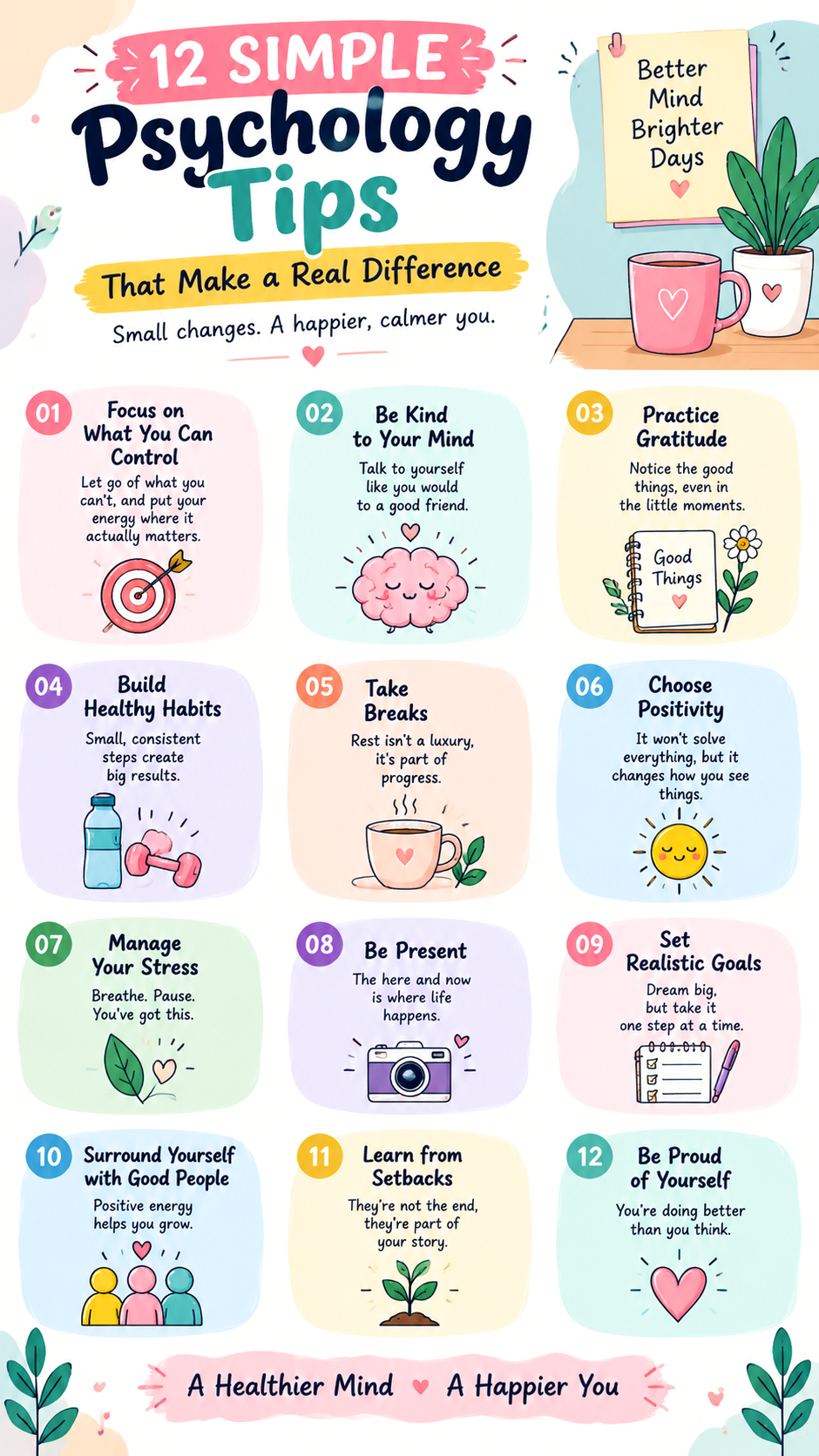
From the five-second rule and thought reframing to gratitude journaling and visualization, these psychology tips offer approachable ways to support personal growth. Each technique is designed to help you pause, shift your perspective, or make a small decision that moves you toward a better outcome. Let’s explore 12 psychology tricks that actually work and learn how to incorporate them into your everyday routine.
Key Takeaways
- Use the five-second rule as a simple prompt to begin tasks before hesitation takes over.
- Reframe negative thoughts by considering alternative explanations and more balanced perspectives.
- Break overwhelming responsibilities into small, manageable steps.
- Practice gratitude and emotional labeling to become more aware of your thoughts and feelings.
- Use breathing, brief pauses, and supportive social connections to respond more thoughtfully to stress.
- Build a healthier mindset through consistent habits rather than expecting instant transformation.
1. The Five-Second Rule: Stop Overthinking and Start Acting
Have you ever spent so much time thinking about a task that you eventually avoided doing it altogether? Perhaps you wanted to start exercising, send an important message, tidy your workspace, or begin a project. You knew what needed to happen, but hesitation kept getting in the way.
A simple technique is to count backward from five to one and then take a small, concrete action. Instead of waiting until you feel completely ready, use the countdown as a reminder to interrupt hesitation and begin.
How to Use the Five-Second Rule
- Identify one task you have been postponing.
- Count backward: five, four, three, two, one.
- Immediately perform the first small action.
- Continue for a few minutes without demanding perfection.
For example, if you want to go for a walk, count down and put on your shoes. If you need to study, open your notebook and read the first paragraph. The goal is not to complete the entire task instantly. It is to make starting easier.
Important: The five-second countdown is a practical motivational technique, not a scientifically established law of the brain. It can help you initiate action, but it will not eliminate every form of procrastination. When a task feels overwhelming, combine it with smaller goals, realistic expectations, and a supportive routine.
2. Reframe Your Thoughts to Change Your Perspective
The way you interpret an experience influences how you feel about it. Two people can encounter the same setback and respond differently because they attach different meanings to what happened.
Thought reframing involves examining an initial interpretation and considering a more balanced alternative. It does not mean pretending that everything is wonderful or ignoring genuine problems. Instead, it helps you avoid treating your first thought as the only possible explanation.
Ask Yourself a Better Question
When a negative thought appears, pause and ask, “Is there another way to look at this situation?” This question creates room for a more thoughtful response.
- Initial thought: “I made a mistake, so I’m terrible at this.”
- Reframed thought: “I made a mistake, and I can learn how to handle this better next time.”
- Initial thought: “My friend hasn’t replied, so they must be upset with me.”
- Reframed thought: “I don’t know why they haven’t replied. They may simply be busy.”
- Initial thought: “I’ll never finish this project.”
- Reframed thought: “This project is challenging, but I can make progress one step at a time.”
The purpose is to replace automatic assumptions with interpretations that better reflect the available evidence. Over time, this practice can support emotional resilience and help you approach difficulties with greater flexibility.
3. Use Visualization to Prepare for Success
Visualization involves mentally imagining a situation, action, or desired outcome. Athletes, performers, and other people preparing for challenging activities sometimes use mental rehearsal to practice what they want to do before they do it.
You can apply the same idea to everyday goals. Imagine yourself delivering a presentation, completing a workout, studying with concentration, or having a difficult but respectful conversation.
A Simple Daily Visualization Exercise
- Choose one realistic goal for the day.
- Spend one or two minutes imagining yourself taking the necessary steps.
- Picture a likely obstacle and how you could respond.
- Identify the first action you can take in real life.
For instance, if your goal is to exercise regularly, imagine preparing your clothes, starting your warm-up, and finishing a manageable session. Visualize the process, not just the satisfying feeling of reaching the finish line.
Pro Tip: Visualization works best as a companion to action. Imagining a successful outcome does not guarantee that it will happen. Pair mental rehearsal with preparation, practice, and a clear next step to turn your goal into something practical.
4. Name Your Emotions to Understand Them Better
Sometimes emotions become more difficult to manage when you cannot identify what you are feeling. You might describe yourself as having a bad day without recognizing that you are actually disappointed, anxious, embarrassed, frustrated, or exhausted.
Emotional labeling means putting your experience into words. Instead of judging yourself for having a feeling, acknowledge it as clearly as possible.
Try This Three-Step Method
- Notice: Pay attention to changes in your mood, thoughts, or physical sensations.
- Name: Identify the feeling using a specific word, such as worried, disappointed, lonely, or irritated.
- Explore: Ask what may have triggered the feeling and what you need right now.
For example, instead of saying, “Everything is going wrong,” you might say, “I’m feeling overwhelmed because I have several deadlines.” This description identifies a specific emotion and a possible source of stress, making it easier to decide what to do next.
Try writing down your emotions in a journal or quietly naming them during a stressful moment. You do not have to solve every feeling immediately. Sometimes, acknowledging an emotion is a useful first step toward responding to it thoughtfully.
5. Break Big Tasks Into Smaller Steps
Large responsibilities can feel intimidating when you focus on everything that must be completed. A complicated assignment, a messy home, or a long-term personal goal may seem impossible when viewed as one enormous task.
The solution is to divide the responsibility into smaller, specific actions. This approach reduces the amount of planning required at any given moment and makes it easier to recognize progress.
Turn an Overwhelming Goal Into a Simple Plan
Imagine that you need to organize your entire home. Rather than trying to finish everything in one day, start with a single drawer, one shelf, or one corner of a room.
If you need to write an article, begin by choosing the topic. Next, create an outline, draft one section, and review the finished work. Each action gives you a clear place to begin.
- Choose one priority.
- Divide it into steps that take a manageable amount of time.
- Complete the smallest useful step first.
- Review your progress and choose the next action.
Smaller tasks can also make progress more visible. Instead of measuring success only by the final result, you can recognize the effort you make along the way.
6. Practice Gratitude to Notice What’s Going Right
Daily life naturally draws attention toward problems that need solving. You may spend more time thinking about an uncomfortable conversation, a missed opportunity, or a task that remains unfinished than noticing the positive moments around you.
A gratitude practice encourages you to recognize things you appreciate. These might include a supportive friend, a peaceful morning, a delicious meal, progress toward a personal goal, or a moment when you handled a difficult situation well.
How to Start a Gratitude Journal
- Choose a regular time, such as before bed.
- Write down three things you appreciated during the day.
- Include a brief explanation of why each one mattered.
- Try to notice small, ordinary experiences as well as major achievements.
For example, you might write, “I’m grateful for the conversation that made me laugh,” or “I appreciate that I finished a task I had been avoiding.”
Gratitude is not about denying hardship or forcing yourself to feel happy. It is about giving positive experiences a place in your attention alongside the difficult parts of life.
7. Use Body Language to Support Your Mood
Your mind and body influence each other. When you feel tense, you may notice that your shoulders rise, your jaw tightens, or your breathing becomes shallow. When you feel relaxed, your movements and posture may become more comfortable.
Paying attention to posture and breathing can help you notice tension and create an opportunity to settle yourself. You do not need to adopt a perfect posture or force yourself to appear confident. The aim is to find a comfortable physical position that supports the activity you are doing.
A Quick Posture and Breathing Reset
- Sit or stand in a comfortable, balanced position.
- Allow your shoulders to relax rather than holding them rigidly.
- Unclench your jaw and release unnecessary tension.
- Breathe slowly and comfortably without forcing deep breaths.
- Notice how your body feels after a short pause.
This exercise can be useful before a meeting, while studying, or whenever you notice yourself becoming tense. Comfortable movement, regular physical activity, and adequate rest can also contribute to overall well-being.
Remember that posture alone does not determine confidence or mood. Body language is one small part of a much larger picture that includes your thoughts, circumstances, physical health, and experiences.
8. Replace Fearful “What If” Thoughts With Helpful Questions
Thinking about possible problems can help you prepare, but repeated worst-case scenarios can leave you feeling stuck. You might wonder what will happen if you fail, make a mistake, disappoint someone, or discover that your plan does not work.
Instead of allowing every question to lead toward fear, try asking a more balanced question: “What if things go well?” You can also ask, “What can I do if a challenge appears?” Both questions encourage you to consider possibilities rather than focusing exclusively on negative outcomes.
Turn Worry Into Preparation
- Fearful question: “What if I make a mistake during my presentation?”
- Helpful alternative: “What if I prepare well, communicate clearly, and learn from the experience?”
- Fearful question: “What if I cannot finish everything?”
- Helpful alternative: “What is the most important task I can complete first?”
- Fearful question: “What if I am not good enough?”
- Helpful alternative: “What skills can I practice to improve?”
Why This Matters: Positive thinking is most useful when it leaves room for reality. You do not need to assume that everything will work out perfectly. Focus on what you can influence, prepare for reasonable challenges, and remind yourself that uncertainty does not automatically mean failure.
9. Use the Ten-Minute Rule to Overcome Resistance
When a task feels unpleasant or demanding, the thought of spending hours on it can make starting even harder. The ten-minute rule offers a simpler alternative: commit to working on the task for just ten minutes.
During those ten minutes, focus on beginning rather than completing everything. Once the time is up, you can decide whether to continue, take a break, or make a new plan.
When the Ten-Minute Rule Helps Most
- Starting a study session when you feel distracted.
- Beginning a workout when motivation is low.
- Cleaning a small part of a cluttered room.
- Writing the first few paragraphs of a project.
- Organizing a task list or preparing for the next day.
The technique reduces the pressure associated with a long commitment. It also gives you an opportunity to discover whether the task feels easier once you begin.
If ten minutes still feels like too much, try two minutes. The best starting point is one that makes meaningful action more accessible without creating unnecessary pressure.
10. Strengthen Your Mood Through Social Connection
Human connection plays an important role in emotional well-being. A supportive conversation can help you feel understood, gain a fresh perspective, or experience a welcome break from daily stress.
You do not always need a long conversation or a major social event. Small interactions can be meaningful, especially when they involve genuine attention and care.
Simple Ways to Build Meaningful Connections
- Send a thoughtful message to someone you care about.
- Ask a friend how they are doing and listen to the answer.
- Make time for a shared meal, walk, or cup of coffee.
- Express appreciation when someone helps you.
- Reach out to a trusted person when you need support.
Meaningful conversations can provide emotional support, strengthen relationships, and help you see challenges from another perspective. However, everyone has different social needs. If you need quiet time to recharge, make space for that as well.
The goal is not to become more social than you naturally prefer. It is to nurture relationships that help you feel respected, supported, and connected.
11. Practice the Pause Before You React
When someone says something upsetting or an unexpected problem appears, it is easy to respond immediately. Strong emotions can make a quick reaction feel necessary, even when taking a moment to think would be more helpful.
The pause technique creates a small space between what happens and what you choose to do next. It does not require you to suppress your feelings. Instead, it helps you acknowledge them without automatically acting on every impulse.
How to Pause Before Responding
- Notice the emotion or physical tension you are experiencing.
- Stop typing, speaking, or acting for a moment if it is safe to do so.
- Take a comfortable breath and allow yourself to settle.
- Ask what response would best support your needs and values.
- Choose your next step deliberately.
For example, if a message makes you angry, you might wait before replying. Revisit it when you feel calmer and decide whether to ask a question, explain your perspective, or set a boundary.
This technique is especially useful during disagreements, stressful conversations, and moments when you feel tempted to make a decision out of frustration. A pause can help you respond with intention rather than regret.
12. Surround Yourself With Supportive Influences
Your surroundings can influence your attention, routines, and behavior. The people you spend time with, the content you consume, and the spaces where you work or relax can all make certain habits easier or harder to maintain.
Creating a supportive environment does not mean removing every challenge or avoiding people who disagree with you. It means becoming more intentional about the influences you welcome into your daily life.
Create an Environment That Supports Your Goals
- Choose your influences thoughtfully: Spend time with people who respect your boundaries and encourage healthy growth.
- Make good habits convenient: Keep your journal, exercise clothes, or study materials easy to access.
- Reduce unnecessary distractions: Silence nonessential notifications when you need to focus.
- Curate your online experience: Follow content that informs, inspires, or supports you rather than constantly making you feel inadequate.
- Protect time for rest: Create opportunities for sleep, relaxation, and enjoyable activities.
Your environment does not control every decision you make, but small adjustments can reduce friction and make helpful routines easier to repeat.
How to Turn These Psychology Tricks Into Daily Habits
Learning a new technique is only the first step. The real benefit comes from applying it consistently in situations where it can help. Trying to practice all twelve techniques immediately may feel overwhelming, so begin with one or two that address your most common challenges.
A Simple Seven-Day Mindset Practice
Use the following plan as a flexible starting point. Adjust it to suit your schedule, energy, and personal goals.
- Day 1: Use the five-second countdown to begin one task you have been postponing.
- Day 2: Identify a negative thought and write down a more balanced alternative.
- Day 3: Spend two minutes visualizing yourself taking action toward a realistic goal.
- Day 4: Name your emotions during one challenging moment.
- Day 5: Break a large task into three smaller actions and complete the first one.
- Day 6: Write down three things you appreciated during the day.
- Day 7: Reflect on which techniques felt useful and choose one to continue practicing.
You can repeat this plan every week, focusing on the habits that fit your life best. There is no need to treat a missed day as failure. Simply return to the practice when you are ready.
Common Mistakes to Avoid
Expecting Instant Results
Psychology tips are not magic solutions. Some techniques may feel helpful immediately, while others require practice before they become familiar. Give yourself time to discover what works for your circumstances.
Forcing Positivity
Healthy thinking does not require you to feel happy all the time. Disappointment, sadness, frustration, and fear are normal parts of life. A balanced mindset allows you to acknowledge difficult emotions while considering constructive ways forward.
Trying to Change Everything at Once
Too many new habits can become another source of pressure. Choose a manageable starting point, practice it regularly, and add another technique when you feel ready.
Blaming Yourself for Struggling
Difficulty with motivation, anxiety, or emotional regulation does not mean you lack discipline. Stress, health, responsibilities, and personal circumstances all influence how you feel and behave. Be curious about what makes a task difficult rather than assuming that you simply need to try harder.
Quick Points: Psychology Tricks at a Glance
- Stop overthinking: Count down and take one small action.
- Change your perspective: Look for a balanced explanation instead of assuming the worst.
- Manage emotions: Name what you feel and pause before reacting.
- Make progress: Break large tasks into smaller, achievable steps.
- Build a healthier mindset: Practice gratitude, nurture relationships, and create supportive routines.
Conclusion: Small Psychology Tricks Can Support Meaningful Change
Improving your mindset does not require a complete life transformation. Often, meaningful progress begins with a small decision: taking the first step instead of overthinking, questioning an unhelpful assumption, recognizing an emotion, or giving yourself a moment to breathe before responding.
These twelve psychology tricks offer practical ways to approach everyday challenges with greater awareness and flexibility. The five-second rule can help you begin, thought reframing can encourage a more balanced perspective, and breaking tasks into smaller steps can make progress feel more manageable. Gratitude, visualization, social connection, and supportive surroundings can also help you build routines that align with your goals.
The most important principle is consistency without perfection. You will have difficult days, lose motivation, and occasionally fall back into familiar habits. That is normal. Instead of treating every setback as a failure, use it as an opportunity to learn what you need and choose your next step.
Start with one technique today. Practice it in a real situation, notice how it affects your response, and keep the approaches that genuinely help. Small psychological shifts, repeated over time, can support a calmer, more intentional, and more balanced daily life.
If persistent anxiety, low mood, or emotional difficulties are interfering with your daily activities, consider speaking with a qualified mental health professional. Everyday psychology tips can complement appropriate support, but they are not a substitute for individualized care when you need it.
Your Next Small Step
Choose one psychology trick from this list and try it today. Save this guide so you can revisit the techniques whenever you need help managing overthinking, building motivation, or approaching a challenge with a fresh perspective. You do not have to be perfect to make progress. You just have to begin.
Tags
Psychology Tricks
Mindset Improvement
Personal Growth
Emotional Intelligence
Positive Thinking
Overthinking Tips
Mental Wellness
Healthy Habits